BRISBANE & THE GOLD COAST — In a major double-pronged attack on the state’s housing shortage, the Crisafulli Government has deployed a rare and powerful planning weapon to fast-track more than 5,000 homes across Brisbane and Logan, just as the Gold Coast skyline hits a historic high in residential apartment construction.
The government officially declared the Land Activation Program (SEQ Tranche 1) Provisional Priority Development Area (PPDA). Covering four key urban sites, the declaration marks only the second time a PPDA has been used in Queensland’s history—the first being the Port Hinchinbrook declaration in October 2025.
The aggressive move aims to slice through standard council red tape to support the government’s overarching target of delivering one million homes by 2044.
Unlocking 30 Hectares of ‘Idle’ Government Land
The newly minted PPDA gives Economic Development Queensland (EDQ) a targeted, short-term mechanism to compress planning timelines and accelerate housing delivery over the next three years. By taking over development assessments immediately, EDQ will bypass traditional bureaucratic bottlenecks to get shovels in the ground faster.
The declaration activates more than 30 hectares of under-utilised, state-owned land across four strategic, transit-accessible hubs:
South Brisbane: The landmark mixed-use precinct planned for the former Visy site.
Brisbane CBD: A highly anticipated urban development footprint on Turbot Street.
Banyo: A development-ready, 6.4-hectare state-owned parcel slated to quickly accommodate up to 400 homes.
Meadowbrook (Logan): A key parcel of under-utilised land in one of the state’s fastest-growing corridors.
Deputy Premier and Minister for State Development, Infrastructure and Planning, Jarrod Bleijie, framed the intervention as an urgent course correction.
“Unlike Labor, whose glossy brochures delivered nothing, the Crisafulli Government is getting on with the job of driving new development through the activation of land that has sat idle for years,” Deputy Premier Bleijie said.
“By unlocking under-utilised government land and using the power of a PPDA, we will accelerate delivery of more than 5,000 new homes in areas close to jobs, transport, and everyday services.”
Queenslanders have been invited to review and have their say
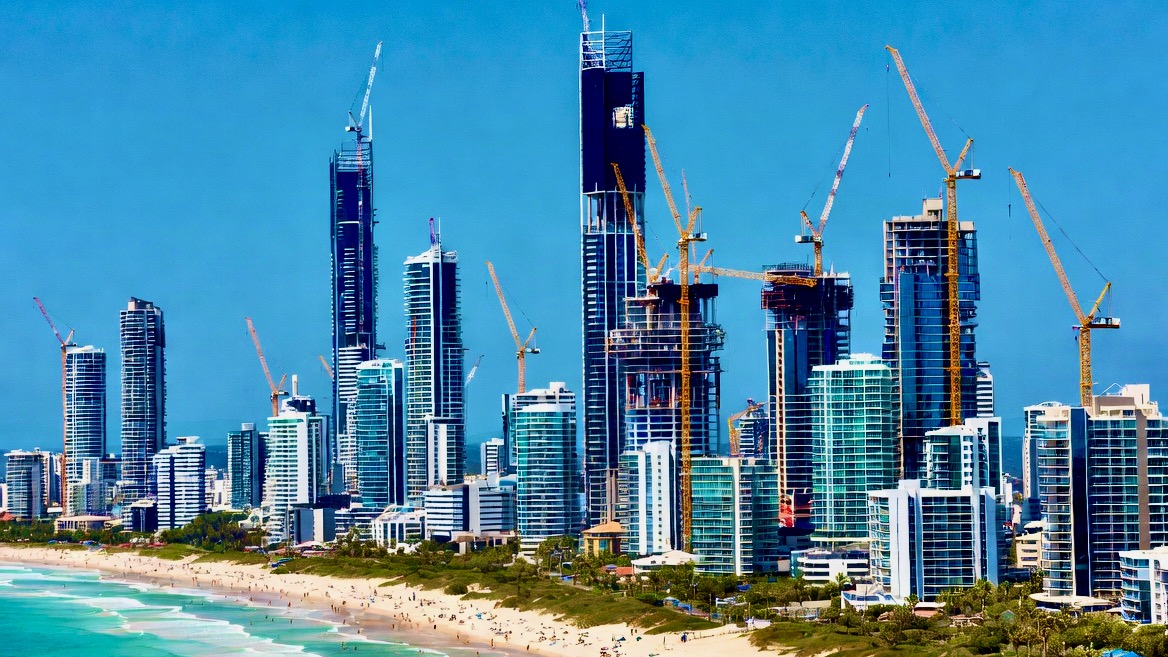
AI Image of Surfers Paradise Building Boom in 2027
The Gold Coast Power Surge: A Forest of Cranes
While the state government injects direct planning adrenaline into Brisbane and Logan, the private sector is independently shifting South East Queensland’s skyline into overdrive further south.
Anyone looking up at the Gold Coast sky will see a literal forest of construction cranes building the next generation of mega-tall high-rise apartment blocks. Recent data from the Rider Levett Bucknall (RLB) Crane Index confirms this visual spectacle is backed by historic, hard data. For the first time in the index’s history, the Gold Coast has officially overtaken Brisbane in total crane activity.
The numbers tell a striking story of vertical housing growth:
A staggering 93% of all cranes are anchored to housing projects
Hotspots
High-density towers rising in Surfers Paradise, Broadbeach, Main Beach, and Burleigh Heads
A Two-Front Strategy for the SEQ Population Boom
Industry analysts suggest that the combination of targeted government land activation in Brisbane and the record-breaking private apartment boom on the Gold Coast represents a massive structural shift for South East Queensland.
With developers rushing to get shovel-ready projects out of the ground ahead of the 2032 Olympics—and with interstate migration continuing to swell the region’s population—the race to build up, rather than out, is officially on.
By slashing red tape via PPDAs in metropolitan Brisbane and riding the wave of high-rise construction on the Gold Coast, Queensland is attempting an unprecedented transformation of its urban landscape to finally get ahead of the housing crisis.
New Planning Scheme and Local Growth Management Strategy (LGMS)Council is developing a new Planning Scheme (replacing the current City Plan) informed by the Local Growth Management Strategy (LGMS)—in-principle endorsed in March 2026. This 20-year framework addresses where and how growth occurs.
The Gold Coast is transitioning from rapid, somewhat unplanned coastal vertical growth to a more strategic, balanced model. The high-rise boom in Surfers Paradise continues, but future emphasis is on distributed, infrastructure-supported density inland and better integration of buildings with public spaces. This should sustain the “Gold Coast lifestyle” while accommodating growth. Let me know if you’d like details on a specific suburb, maps, or comparisons!