he radical alarmists proposed a fistful of bad stuff during COP 26. A lot was in the surprise COP President’s proposed decision document on the last Wednesday, with just three days to go. Other ridiculous stuff was proposed by various country groups.
None of it make it whole into the final decision. Most just disappeared and what was left was rendered harmless.
Among the crazy proposals that happily went missing in action:
2. Developed countries paying reparations for developing countries’ bad weather losses and damages.
3. Aid payments to developing countries of $1.3 trillion a year beginning in 2025. This is up from the already promised $100 billion a year beginning 2020, which gas yet to appear.
B. Phasing out coal use by a date certain. This nonsense was changed to phasing it down at some undefined point, with support for the adversely affected coal industry.
What did survive was that National Plans will be updated again next year instead of waiting until 2025. All this really does is get already made promises into the official record, so who cares? All the stupid stuff will probably get proposed again, but it will be much easier to shoot down a second time.
They also managed to get the rules passed to set up the global market in emission indulgences. This was supposed to be the primary point of COP 26, before it went crazy.
Of course the alarmists decried every wacky proposal that went away or was gutted. So did the liberal mainstream (as it is wrongly called) press, but now they seem to be defending the result as real progress. It does not do to admit failure, which this debacle surely was for alarmism.
During the COP this IEA result was ignored in favor of studies that failed to include these promises, so as to get a forecast well over the Paris top target of 2 degrees, typically 2.4 degrees. This was to keep the pressure on. Now I am suddenly seeing the 1.8 degrees figure quoted, as part of the claim that COP 26 was really okay.
Mind you these forecasts are all nonsense, especially given the wide range of estimates of temperature sensitivity to atmospheric CO2 levels. Even the IPCC posits a three degree range of uncertainty, while the scientific literature shows a range over four degrees. Either way it is clearly impossible to specify the future temperature to a tenth of a degree, by the alarmists’ own account. Yet there it is.
I note with amusement that the alarmists are now officially alarmed, so I got that right. The decision document says that COP “Expresses alarm and utmost concern that human activities have caused around 1.1 °C of warming to date, that impacts are already being felt in every region, and that carbon budgets consistent with achieving the Paris Agreement temperature goal are now small and being rapidly depleted”.
None of these alarming claims is known to be true. They are just the IPCC’s biased interpretation of the science, plus a budget that is unknowable according to the IPCC itself. The supposed budget, if it even exists, would depend on the theoretical carbon sensitivity and the degree to which that sensitivity gets expressed in reality.
That anything much happens next year at COP 27, in Egypt, remains to be seen. At least it won’t be as cold as Glasgow has been for COP 26.
It is hard to sell the “last, best chance to save the world” two years in a row. Then too we are about to see a winter with terrible energy prices. If the a Republicans win a house or two in Congress just before COP 27, which seems likely, Biden will be powerless.
Unfortunately, climate alarmism seems to be inexhaustible, so get ready for another year of silly hype. It will just show how much of a failure COP 26 really was.
A delightful failure to be sure. Let’s do it again!
David Wojick, Ph.D. is an independent analyst working at the intersection of science, technology and policy. For origins see http://www.stemed.info/engineer_tackles_confusion.html For over 100 prior articles for CFACT see http://www.cfact.org/author/david-wojick-ph-d/ Available for confidential research and consulting.
Vladimir Putin took part in a plenary session of the 18th annual meeting of the Valdai International Discussion Club.
Putin: We look in amazement at the processes underway in the countries which have been traditionally looked at as the standard-bearers of progress. Of course, the social and cultural shocks that are taking place in the United States and Western Europe are none of our business; we are keeping out of this. Some people in the West believe that an aggressive elimination of entire pages from their own history, “reverse discrimination” against the majority in the interests of a minority, and the demand to give up the traditional notions of mother, father, family and even gender, they believe that all of these are the mileposts on the path towards social renewal.
Listen, I would like to point out once again that they have a right to do this, we are keeping out of this. But we would like to ask them to keep out of our business as well. We have a different viewpoint, at least the overwhelming majority of Russian society – it would be more correct to put it this way – has a different opinion on this matter. We believe that we must rely on our own spiritual values, our historical tradition and the culture of our multiethnic nation.
The advocates of so-called ‘social progress’ believe they are introducing humanity to some kind of a new and better consciousness. Godspeed, hoist the flags as we say, go right ahead. The only thing that I want to say now is that their prescriptions are not new at all. It may come as a surprise to some people, but Russia has been there already. After the 1917 revolution, the Bolsheviks, relying on the dogmas of Marx and Engels, also said that they would change existing ways and customs and not just political and economic ones, but the very notion of human morality and the foundations of a healthy society. The destruction of age-old values, religion and relations between people, up to and including the total rejection of family (we had that, too), encouragement to inform on loved ones – all this was proclaimed progress and, by the way, was widely supported around the world back then and was quite fashionable, same as today. By the way, the Bolsheviks were absolutely intolerant of opinions other than theirs.
This, I believe, should call to mind some of what we are witnessing now. Looking at what is happening in a number of Western countries, we are amazed to see the domestic practices, which we, fortunately, have left, I hope, in the distant past. The fight for equality and against discrimination has turned into aggressive dogmatism bordering on absurdity, when the works of the great authors of the past – such as Shakespeare – are no longer taught at schools or universities, because their ideas are believed to be backward. The classics are declared backward and ignorant of the importance of gender or race. In Hollywood memos are distributed about proper storytelling and how many characters of what colour or gender should be in a movie. This is even worse than the agitprop department of the Central Committee of the Communist Party of the Soviet Union.
Countering acts of racism is a necessary and noble cause, but the new ‘cancel culture’ has turned it into ‘reverse discrimination’ that is, reverse racism. The obsessive emphasis on race is further dividing people, when the real fighters for civil rights dreamed precisely about erasing differences and refusing to divide people by skin colour. I specifically asked my colleagues to find the following quote from Martin Luther King: “I have a dream that my four little children will one day live in a nation where they will not be judged by the colour of their skin but by their character.” This is the true value. However, things are turning out differently there. By the way, the absolute majority of Russian people do not think that the colour of a person’s skin or their gender is an important matter. Each of us is a human being. This is what matters.
In a number of Western countries, the debate over men’s and women’s rights has turned into a perfect phantasmagoria. Look, beware of going where the Bolsheviks once planned to go – not only communalising chickens, but also communalising women. One more step and you will be there.
Zealots of these new approaches even go so far as to want to abolish these concepts altogether. Anyone who dares mention that men and women actually exist, which is a biological fact, risk being ostracised. “Parent number one” and “parent number two,” “’birthing parent” instead of “mother,” and “human milk” replacing “breastmilk” because it might upset the people who are unsure about their own gender. I repeat, this is nothing new; in the 1920s, the so-called Soviet Kulturtraegers also invented some newspeak believing they were creating a new consciousness and changing values that way. And, as I have already said, they made such a mess it still makes one shudder at times.
Not to mention some truly monstrous things when children are taught from an early age that a boy can easily become a girl and vice versa. That is, the teachers actually impose on them a choice we all supposedly have. They do so while shutting the parents out of the process and forcing the child to make decisions that can upend their entire life. They do not even bother to consult with child psychologists – is a child at this age even capable of making a decision of this kind? Calling a spade a spade, this verges on a crime against humanity, and it is being done in the name and under the banner of progress.
Well, if someone likes this, let them do it. I have already mentioned that, in shaping our approaches, we will be guided by a healthy conservatism. That was a few years ago, when passions on the international arena were not yet running as high as they are now, although, of course, we can say that clouds were gathering even then. Now, when the world is going through a structural disruption, the importance of reasonable conservatism as the foundation for a political course has skyrocketed – precisely because of the multiplying risks and dangers, and the fragility of the reality around us.
This conservative approach is not about an ignorant traditionalism, a fear of change or a restraining game, much less about withdrawing into our own shell. It is primarily about reliance on a time-tested tradition, the preservation and growth of the population, a realistic assessment of oneself and others, a precise alignment of priorities, a correlation of necessity and possibility, a prudent formulation of goals, and a fundamental rejection of extremism as a method. And frankly, in the impending period of global reconstruction, which may take quite long, with its final design being uncertain, moderate conservatism is the most reasonable line of conduct, as far as I see it. It will inevitably change at some point, but so far, do no harm – the guiding principle in medicine – seems to be the most rational one. Noli nocere, as they say.
Again, for us in Russia, these are not some speculative postulates, but lessons from our difficult and sometimes tragic history. The cost of ill-conceived social experiments is sometimes beyond estimation. Such actions can destroy not only the material, but also the spiritual foundations of human existence, leaving behind moral wreckage where nothing can be built to replace it for a long time.
Finally, there is one more point I want to make. We understand all too well that resolving many urgent problems the world has been facing would be impossible without close international cooperation. However, we need to be realistic: most of the pretty slogans about coming up with global solutions to global problems that we have been hearing since the late 20th century will never become reality. In order to achieve a global solution, states and people have to transfer their sovereign rights to supra-national structures to an extent that few, if any, would accept. This is primarily attributable to the fact that you have to answer for the outcomes of such policies not to some global public, but to your citizens and voters.
However, this does not mean that exercising some restraint for the sake of bringing about solutions to global challenges is impossible. After all, a global challenge is a challenge for all of us together, and to each of us in particular. If everyone saw a way to benefit from cooperation in overcoming these challenges, this would definitely leave us better equipped to work together.
One of the ways to promote these efforts could be, for example, to draw up, at the UN level, a list of challenges and threats that specific countries face, with details of how they could affect other countries. This effort could involve experts from various countries and academic fields, including you, my colleagues. We believe that developing a roadmap of this kind could inspire many countries to see global issues in a new light and understand how cooperation could be beneficial for them.
I have already mentioned the challenges international institutions are facing. Unfortunately, this is an obvious fact: it is now a question of reforming or closing some of them. However, the United Nations as the central international institution retains its enduring value, at least for now. I believe that in our turbulent world it is the UN that brings a touch of reasonable conservatism into international relations, something that is so important for normalising the situation.
Many criticise the UN for failing to adapt to a rapidly changing world. In part, this is true, but it is not the UN, but primarily its members who are to blame for this. In addition, this international body promotes not only international norms, but also the rule-making spirit, which is based on the principles of equality and maximum consideration for everyone’s opinions. Our mission is to preserve this heritage while reforming the organisation. However, in doing so we need to make sure that we do not throw the baby out with the bathwater, as the saying goes.
This is not the first time I am using a high rostrum to make this call for collective action in order to face up to the problems that continue to pile up and become more acute. It is thanks to you, friends and colleagues, that the Valdai Club is emerging or has already established itself as a high-profile forum. It is for this reason that I am turning to this platform to reaffirm our readiness to work together on addressing the most urgent problems that the world is facing today.
Friends,
The changes mentioned here prior to me, as well as by yours truly, are relevant to all countries and peoples. Russia, of course, is not an exception. Just like everyone else, we are searching for answers to the most urgent challenges of our time.
Of course, no one has any ready-made recipes. However, I would venture to say that our country has an advantage. Let me explain what this advantage is. It is to do with our historical experience. You may have noticed that I have referred to it several times in the course of my remarks. Unfortunately, we had to bring back many sad memories, but at least our society has developed what they now refer to as herd immunity to extremism that paves the way to upheavals and socioeconomic cataclysms. People really value stability and being able to live normal lives and to prosper while confident that the irresponsible aspirations of yet another group of revolutionaries will not upend their plans and aspirations. Many have vivid memories of what happened 30 years ago and all the pain it took to climb out of the ditch where our country and our society found themselves after the USSR fell apart.
The conservative views we hold are an optimistic conservatism, which is what matters the most. We believe stable, positive development to be possible. It all depends primarily on our own efforts. Of course, we are ready to work with our partners on common noble causes.
The result means the Andrews Labor Government’s ambitious 2020 target − to reduce emissions by 15 to 20 per cent below 2005 levels − was exceeded ahead of schedule.
The report also shows that in 2019, Victoria contributed 17.3 per cent of Australia’s total net emissions − less than Queensland (31.1 per cent); NSW (25.8 per cent) and WA (17.4 per cent).
Victoria is decarbonising at the most rapid rate of any major jurisdiction in Australia and is doing so while its population and economy continues to grow.
The report shows that while cutting emissions the economy has continued to grow.
The Government has set targets to halve emissions by 2030 as part of its Climate Change Strategy released in May this year.
“This report clearly shows our action on climate change is having an impact on emissions – protecting our community and our environment, and creating jobs and supporting new industries.”
“As we outlined in our ambitious climate change strategy released earlier this year, we will halve our emissions by 2030 and transition to a zero net emissions economy by 2050.”
On July 28, the President and the bipartisan group announced agreement on the details of a once-in-a-generation investment in our infrastructure, which was immediately taken up in the Senate for consideration. The legislation includes around $550 billion in new federal investment in America’s roads and bridges, water infrastructure, resilience, internet, and more. The bipartisan Infrastructure Investment and Jobs Act will grow the economy, enhance our competitiveness, create good jobs, and make our economy more sustainable, resilient, and just.
The legislation will create good-paying, union jobs. With the President’s Build Back Better Agenda, these investments will add, on average, around 2 million jobs per year over the course of the decade, while accelerating America’s path to full employment and increasing labor force participation.
President Biden believes that we must invest in our country and in our people by creating good-paying union jobs, tackling the climate crisis, and growing the economy sustainably and equitably for decades to come. The bipartisan legislation will deliver progress towards those objectives for working families across the country. The bipartisan Infrastructure Investment and Jobs Act:
Makes the largest federal investment in public transit ever
Makes the largest federal investment in passenger rail since the creation of Amtrak
Makes the single largest dedicated bridge investment since the construction of the interstate highway system
Makes the largest investment in clean drinking water and waste water infrastructure in American history, delivering clean water to millions of families
Ensures every American has access to reliable high-speed internet
Helps us tackle the climate crisis by making the largest investment in clean energy transmission and EV infrastructure in history; electrifying thousands of school and transit buses across the country; and creating a new Grid Deployment Authority to build a resilient, clean, 21st century electric grid
The President promised to work across the aisle to deliver results for working families. He believes demonstrating that democracies can deliver is a critical challenge for his presidency. Today’s agreement shows that we can come together to position American workers, farmers, and businesses to compete and win in the 21st century..embed-container { position: relative; padding-bottom: 56.25%; height: 0; overflow: hidden; max-width: 100%; } .embed-container iframe, .embed-container object, .embed-container embed { position: absolute; top: 0; left: 0; width: 100%; height: 100%; }
Roads, Bridges, and Major Projects
One in five miles, or 173,000 total miles, of our highways and major roads and 45,000 bridges are in poor condition. Bridges in poor condition pose heightened challenges in rural communities, which often may rely on a single bridge for the passage of emergency service vehicles. The bipartisan Infrastructure Investment and Jobs Act will invest $110 billion of new funds for roads, bridges, and major projects, and reauthorize the surface transportation program for the next five years building on bipartisan surface transportation reauthorization bills passed out of committee earlier this year. This investment will repair and rebuild our roads and bridges with a focus on climate change mitigation, resilience, equity, and safety for all users, including cyclists and pedestrians. The bill includes a total of $40 billion of new funding for bridge repair, replacement, and rehabilitation, which is the single largest dedicated bridge investment since the construction of the interstate highway system. The bill also includes around $16 billion for major projects that are too large or complex for traditional funding programs but will deliver significant economic benefits to communities.
Safety
America has one of the highest road fatality rates in the industrialized world. The legislation invests $11 billion in transportation safety programs, including a new, $5 billion Safe Streets for All program to help states and localities reduce crashes and fatalities in their communities, especially for cyclists and pedestrians. It includes a new program to provide grants to community owned utilities to replace leaky and obsolete cast iron and bare steel natural gas pipelines, some of which are over 100 years old. It will more than double funding directed to programs that improve the safety of people and vehicles in our transportation system, including highway safety, truck safety, and pipeline and hazardous materials safety.
Public Transit
America’s transit infrastructure is inadequate – with a multibillion-dollar repair backlog, representing more than 24,000 buses, 5,000 rail cars, 200 stations, and thousands of miles of track, signals, and power systems in need of replacement. The legislation includes $39 billion of new investment to modernize transit, and improve accessibility for the elderly and people with disabilities. That is in addition to continuing the existing transit programs for five years as part of surface transportation reauthorization. In total, the new investments and reauthorization provide $89.9 billion in guaranteed funding for public transit over the next five years. This is the largest Federal investment in public transit in history, and devotes a larger share of funds from surface transportation reauthorization to transit in the history of the programs. It will repair and upgrade aging infrastructure, modernize bus and rail fleets, make stations accessible to all users through a new program with $1.75 billion in dedicated funding, and bring transit service to new communities with an additional $8 billion for Capital Investment Grants. It will replace thousands of transit vehicles, including buses, with clean, zero emission vehicles through an additional $5.75 billion, of which 5 percent is dedicated to training the transit workforce to maintain and operate these vehicles. And, it will benefit communities of color since these households are twice as likely to take public transportation and many of these communities lack sufficient public transit options.
Passenger and Freight Rail
Unlike highways and transit, rail lacks a multi-year funding stream to address deferred maintenance, enhance existing corridors, and build new lines in high-potential locations. The legislation positions Amtrak and rail to play a central role in our transportation and economic future. This is the largest investment in passenger rail since the creation of Amtrak 50 years ago. The legislation invests $66 billion in rail to eliminate the Amtrak maintenance backlog, modernize the Northeast Corridor, and bring world-class rail service to areas outside the northeast and mid-Atlantic. Within these totals, $22 billion would be provided as grants to Amtrak, $24 billion as federal-state partnership grants for Northeast Corridor modernization, $12 billion for partnership grants for intercity rail service, including high-speed rail, $5 billion for rail improvement and safety grants, and $3 billion for grade crossing safety improvements.
EV Infrastructure
U.S. market share of plug-in electric vehicle (EV) sales is only one-third the size of the Chinese EV market. The President believes that must change. The bill invests $7.5 billion to build out the first-ever national network of EV chargers in the United States and is a critical element in the Biden-Harris Administration’s plan to accelerate the adoption of EVs to address the climate crisis and support domestic manufacturing jobs. The bill will provide funding for deployment of EV chargers along highway corridors to facilitate long-distance travel and within communities to provide convenient charging where people live, work, and shop. Federal funding will have a particular focus on rural, disadvantaged, and hard-to-reach communities.
Electric Buses
American school buses play a critical role in expanding access to education, but they are also a significant source of pollution. The legislation will deliver thousands of electric school buses nationwide, including in rural communities, helping school districts across the country buy clean, American-made, zero emission buses, and replace the yellow school bus fleet for America’s children. The legislation also invests $5 billion in zero emission and clean buses and $2.5 billion for ferries. These investments will drive demand for American-made batteries and vehicles, creating jobs and supporting domestic manufacturing, while also removing diesel buses from some of our most vulnerable communities. In addition, they will help the more than 25 million children and thousands of bus drivers who breathe polluted air on their rides to and from school. Diesel air pollution is linked to asthma and other health problems that hurt our communities and cause students to miss school, particularly in communities of color and Tribal communities.
Reconnecting Communities
Too often, past transportation investments divided communities – like the Claiborne Expressway in New Orleans or I-81 in Syracuse – or it left out the people most in need of affordable transportation options. In particular, significant portions of the interstate highway system were built through Black neighborhoods. The legislation creates a first-ever program to reconnect communities divided by transportation infrastructure. The program will fund planning, design, demolition, and reconstruction of street grids, parks, or other infrastructure through $1 billion of dedicated funding in addition to historic levels of major projects funding, for which these investments could also qualify.
Airports, Ports, and Waterways
The United States built modern aviation, but our airports lag far behind our competitors. According to some rankings, no U.S. airports rank in the top 25 of airports worldwide. Our ports and waterways need repair and reimagination too. The bill invests $17 billion in port infrastructure and $25 billion in airports to address repair and maintenance backlogs, reduce congestion and emissions near ports and airports, and drive electrification and other low-carbon technologies. Modern, resilient, and sustainable port, airport, and freight infrastructure will support U.S. competitiveness by removing bottlenecks and expediting commerce and reduce the environmental impact on neighboring communities.
Resilience and Western Water Infrastructure
Millions of Americans feel the effects of climate change each year when their roads wash out, airport power goes down, or schools get flooded. Last year alone, the United States faced 22 extreme weather and climate-related disaster events with losses exceeding $1 billion each – a cumulative price tag of nearly $100 billion. People of color are more likely to live in areas most vulnerable to flooding and other climate change-related weather events. The legislation makes our communities safer and our infrastructure more resilient to the impacts of climate change and cyber-attacks, with an investment of over $50 billion. This includes funds to protect against droughts, floods and wildfires, in addition to a major investment in weatherization. The bill is the largest investment in the resilience of physical and natural systems in American history.
Clean Drinking Water
Currently, up to 10 million American households and 400,000 schools and child care centers lack safe drinking water. The legislation’s $55 billion investment represents the largest investment in clean drinking water in American history, including dedicated funding to replace lead service lines and the dangerous chemical PFAS (per- and polyfluoroalkyl). It will replace all of the nation’s lead pipes and service lines. From rural towns to struggling cities, the legislation invests in water infrastructure across America, including in Tribal Nations and disadvantaged communities that need it most.
High-Speed Internet
Broadband internet is necessary for Americans to do their jobs, to participate equally in school learning, health care, and to stay connected. Yet, by one definition, more than 30 million Americans live in areas where there is no broadband infrastructure that provides minimally acceptable speeds – a particular problem in rural communities throughout the country. The legislation’s $65 billion investment – which builds on the billions of dollars provided for broadband deployment in the American Rescue Plan – will help ensure every American has access to reliable high-speed internet with an historic investment in broadband infrastructure deployment, just as the federal government made a historic effort to provide electricity to every American nearly one hundred years ago.
The bill will also help lower prices for internet service by requiring funding recipients to offer a low-cost affordable plan, by requiring providers to display a “Broadband Nutrition Label” that will help families comparison shop for a better deal, and by boosting competition in areas where existing providers aren’t providing adequate service. It will also help close the digital divide by passing the Digital Equity Act (which creates new grant programs for digital inclusion), by requiring the Federal Communications Commission to adopt rules banning digital redlining, and by creating a new, permanent program to help more low-income households access the internet. Over one in four households will be eligible for this new Affordable Connectivity Benefit.
Environmental Remediation
In thousands of rural and urban communities around the country, hundreds of thousands of former industrial and energy sites are now idle – sources of blight and pollution. 26% of Black Americans and 29% of Hispanic Americans live within 3 miles of a Superfund site, a higher percentage than for Americans overall. Proximity to a Superfund site can lead to elevated levels of lead in children’s blood. The legislation invests $21 billion in environmental remediation, making the largest investment in addressing the legacy pollution that harms the public health of communities and neighbourhoods in American history, creating good-paying union jobs in hard-hit energy communities and advancing economic and environmental justice. The bill includes funds to clean up Superfund and brownfield sites, reclaim abandoned mine land and cap orphaned gas wells.
Power Infrastructure
As the recent Texas power outages demonstrated, our aging electric grid needs urgent modernization. A Department of Energy study found that power outages cost the U.S. economy up to $70 billion annually. The legislation’s roughly $65 billion investment includes the single largest investment in clean energy transmission in American history. It upgrades our power infrastructure, including by building thousands of miles of new, resilient transmission lines to facilitate the expansion of renewable energy. It creates a new Grid Deployment Authority, invests in research and development for advanced transmission and electricity distribution technologies, and promotes smart grid technologies that deliver flexibility and resilience. It invests in demonstration projects and research hubs for next-generation technologies like advanced nuclear, carbon capture, and clean hydrogen.
Offsets
In the years ahead, the legislation will generate significant economic benefits. It is financed through a combination of redirecting unspent emergency relief funds, targeted corporate user fees, strengthening tax enforcement when it comes to cryptocurrencies, and other bipartisan measures, in addition to the revenue generated from higher economic growth as a result of the investments. In addition, the White House intends to move forward with planning for the auction of new spectrum, in coordination with DOD, under the Infrastructure Investment and Jobs Act.
Residents on the Gold Coast are being urged to get vaccinated against COVID-19 to help small business, following the release of Queensland’s COVID Vaccine Plan to unite families and protect Queenslanders.
Visiting a pharmacy in Surfer’s Paradise that received a COVID-19 Business Support Grant, Minister for Employment and Small Business Di Farmer said there was no time to waste.
“The message is simple: the more of us who are vaccinated, the sooner we can be safely reunited with friends and family interstate and overseas, and the more patrons our small businesses can welcome,” Minister Farmer said.
“This call is especially important now that we know of a case that’s potentially been infectious in the Gold Coast community for up to 10 days.
“Parts of the Gold Coast are doing really well, but there are still 156,000 people who aren’t vaccinated.
“Nowhere has reached 80% double vaccinated which is when we will see significant changes, allowing fully vaccinated people to come to Queensland without quarantining.
“I know this will make a huge difference to the Gold Coast tourism industry and other small businesses that have been hard hit by the border closures we’ve needed to keep Queenslanders safe.
“But to do this, we need everyone to roll up their sleeves and get vaccinated.
“Our measured and cautious plan also shows that greater restrictions may apply to the unvaccinated.
“For example, venues and restaurants may be able to operate at greater densities if all patrons are fully vaccinated.
“Currently in the Gold Coast LGA 71.4% of residents have received a first dose, and 54.9% are fully vaccinated.
“We have been supporting small businesses throughout the pandemic, with a $14.5 billion Economic Recovery Plan and more than $265 million paid out to small businesses through our COVID-19 Business Support Grants.
“This includes over $55.5 million to more than 6,000 businesses across the Gold Coast.
“However, one of the most important things Gold Coast residents can do now to support local small businesses is to get vaccinated.”
Priceline pharmacist Naleen Narayan said the COVID-19 Business Support Grant had made a huge difference but is now urging people to make getting their vaccination a priority.
“The grant was really important because even though we remained open during lockdown we missed out on so much trade,” Naleen said.
“It was a really big help to us, to keep the business going and keep our casual employees on for their normal hours. It was an easy process, and I’d encourage other businesses to apply.
“Pharmacies are all about keeping our community safe and well and they’ve never been more critical that now, as we offer potentially life-saving vaccinations in an easy and accessible location with familiar and caring staff.
“There is more than enough evidence that COVID-19 vaccines are safe and effective. The only way out for our communities to minimise significant illness is to vaccinate to get our livelihoods back and reunite with our loved ones.”
Senator Hanson-Young (The Senate): I move:
That, in the opinion of the Senate, the following is a matter of urgency:
The fact that the Government is failing to do its fair share of limiting global heating to 1.5C above pre-industrial
temperatures by continuing to approve new coal mines and gas fields and refusing to adopt strong 2030 emissions
targets of 75% below 2005 levels.
First, I want to provide an update on our efforts to protect more Americans by getting more shots in arms, starting with vaccinating the unvaccinated.
We’ve made tremendous progress across the past nine months. As of today, 77 percent of eligible Americans — those 12 and older — have gotten at least their first shot.
And thanks to the President’s leadership on vaccination requirements, we continue to make important progress.
More than 3,500 organizations — from healthcare systems, to educational institutions, to state and local governments, to private businesses — have already stepped up to adopt vaccination requirements.
These vaccination requirements have increased vaccination rates by 20-plus percentage points, with organisations routinely seeing their share of fully vaccinated workers rise above 90 percent.
Small to medium businesses in North and Far North Queensland who were impacted by the 2019 Monsoon Trough can now access additional financial support to help their operations grow and also help strengthen their preparedness for future hazards, as part of a $10 million business support package from the Australian and Queensland Governments.
Minister for Emergency Management and National Recovery and Resilience, Senator the Hon Bridget McKenzie said the Business Concierge Service pilot program, jointly funded by the Australian and Queensland Governments, is now accepting applications from small business owners to access up to $2,500 in financial support.
“There are many small businesses that took a real hit during and after the 2019 Monsoon disaster. The Australian Government not only wants to support these small businesses in their recovery but wants to give them the tools to become stronger and better able to withstand future challenges,” Minister McKenzie said.
“Small businesses owners who are deemed eligible for the Business Concierge Service can book an initial consultation with a Growth Advisor from Smart Precinct NQ.
“They will then receive a needs assessment and growth plan that highlights key areas they can work on in their business.
“From these recommendations, the business can choose specialists that provide support services up to the value of $2,500 from the Concierge support package that meet their most pressing business needs.”
Minister for Employment and Small Business Di Farmer congratulated the Queensland Small Business Recovery Advisory Council and Smart Precinct NQ on the launch of the program.
“This project is about creating strong and resilient communities and I’m pleased to see such an innovative program created to help businesses thrive,” Minister Farmer said.
“Small businesses are the backbone of our regions — supporting local families and boosting our economy — so it’s vitally important they have the support they need to get started, improve and expand their services and operations.
“That’s why we were there with emergency support in the immediate aftermath of the monsoon, and it’s why we’re still there two years on to help businesses thrive.
“I congratulate those involved in establishing the Business Concierge Service, which will no doubt create important connections that will benefit businesses and communities in North and North West Queensland.
“We know small businesses are at the heart of our communities, which is why backing small business is a key focus of the Queensland Government’s $14.5 billion COVID-19 Economic Recovery Plan.”
To be eligible businesses must have less than 20 staff, have been in operation at the time of the Monsoon Trough disaster in January and February 2019, and based in one of the 14 Local Government Areas in North and Far North Queensland that were disaster declared.
The Business Concierge Service is jointly funded by the Australian and Queensland Governments under Disaster Recovery Funding Arrangements.
Australian Special forces Riccardo Bosi speaks to Alex Jones about the secrets our Government and Media are keeping from the people. Bill Gates has control over our Politicians or people in power, Civil War, War with China latest Issues facing Australia lockdowns. Australia civilisational collapse is the fall of a complex human society characterized by the loss of cultural identity and of socioeconomic complexity, the downfall of the government and the rise of violence war, Pandemic, famine, population decline, and mass migration..embed-container { position: relative; padding-bottom: 56.25%; height: 0; overflow: hidden; max-width: 100%; } .embed-container iframe, .embed-container object, .embed-container embed { position: absolute; top: 0; left: 0; width: 100%; height: 100%; }
Bill Gates, Satanic Cults, Pedophiles have control over our Politicians o, Civil War, War with China latest Issues facing Australia lockdowns. Australia civilisational collapse is the fall of a complex human society characterized by the loss of cultural identity and of socioeconomic complexity, the downfall of the government and the rise of violence war, Pandemic, famine, population decline, and mass migration.
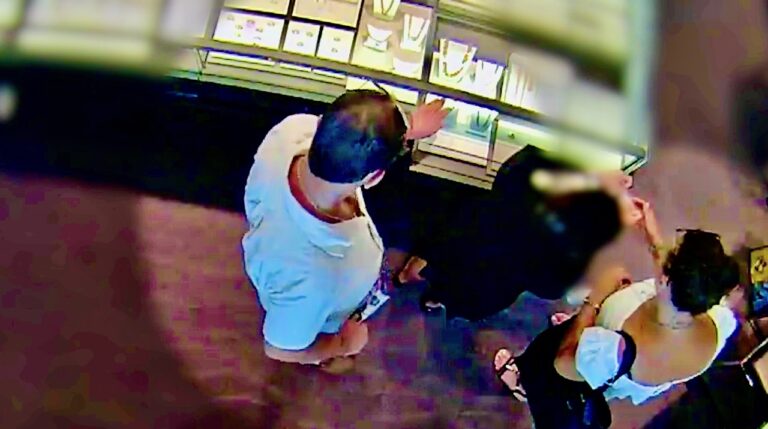
Police are seeking public assistance to identify two people following the theft of jewellery from a Gold Coast shop.
Around midday on February 21, a man and woman (pictured below) entered a jewellery store at a shopping centre in Coomera.
The male is believed to have accessed a drawer and removed a gold bracelet before leaving the store shortly after. The bracelet is valued at approximately $7,500.embed-container { position: relative; padding-bottom: 56.25%; height: 0; overflow: hidden; max-width: 100%; } .embed-container iframe, .embed-container object, .embed-container embed { position: absolute; top: 0; left: 0; width: 100%; height: 100%; }
The man is Caucasian, approximately 175cm tall with short dark hair and possibly aged in his fifties or sixties.
The woman is Caucasian with dark brown hair and dark eyes, and was seen wearing dark jeans and a white shirt.
Both the man and woman are believed to have New Zealand accents.
If you recognise these people or know of their whereabouts, please contact the police.