Home Blog

PM Albanese, Building Our Future Together through Mutual Respect

The blue light of the smartphone screen was the only thing illuminating the Prime Minister’s face in the back of the armoured car. It was April 14, 2026. Exactly four months since the night the lights went out at Bondi.

Anthony Albanese stared at the post he had just authorized.

**Social cohesion isn’t something we take for granted. It’s something we build together, through respect and understanding.

His Excellency Sheikh Dr. Mohammad bin Abdulkarim Al-Issa is in Australia, supporting our strong and diverse Muslim community and the values that bring us together.

He had meant for it to be a stabilising force. He had meant for it to signal that Australia was bigger than the hate that had arrived on its shores in December. But as the “ping” of notifications turned into a sustained roar, he realised he had miscalculated the depth of the national wound.


The Archer Park Shadow

The comments section didn’t just disagree; it exploded.

For the people of Sydney, the mention of “social cohesion” felt like a slap in the face. Their minds were still at Archer Park on December 14, 2025. They were still seeing the flashes of the Akrams’ rifles. They were still mourning the fifteen people—the children, the Holocaust survivors, the families—who were executed during Hanukkah by gunmen inspired by the Islamic State.

Islamic Attack Bondi Beach Shooter
  • “Social cohesion?” one reply read, garnering five thousand likes in minutes. “My sister is still in a wheelchair because of Archer Park. Stop telling us how ‘great’ things are and start acknowledging who did this.”
  • “This is pure gaslighting,” wrote another. “You’re standing with a global leader talking about ‘interfaith dialogue’ while the blood from the worst Islamic attack in our history hasn’t even been scrubbed from the pavement. Read the room.”

The Disconnect in the Room

Back at the Sydney Commonwealth offices, the atmosphere was sterile and quiet—a stark contrast to the digital war zone. The PM sat across from Sheikh Al-Issa, a man who truly did lead the fight against extremism. But the optics were a disaster.

To the Prime Minister, this meeting was about prevention. To the public, it looked like avoidance.

“They’re calling it gaslighting, sir,” his digital strategist whispered, leaning over with a tablet. “The sentiment is that by praising the community today, you’re effectively asking them to forget what happened in December. They feel like you’re more worried about being ‘inclusive’ than you are about the 15 Australians who were murdered for being Jewish.”

The Weight of the Word

Albanese looked out the window toward the coast. He thought about the hero of that day, Ahmed al-Ahmed, who had tried to stop the gunmen. He wanted to highlight that story—to show that the ideology of the killers wasn’t the ideology of the whole community.

But he realised, with a sinking feeling, that his timing was catastrophic. When people are in the “anger” stage of grief, being told to “understand” feels like being told to “be quiet.”

By posting about how “great” the Muslim community was in the context of a visit from a religious dignitary, while the Archer Park families were still visiting fresh graves, he had inadvertently sent a message: Your trauma is secondary to our diplomatic image.

The Silence of the Leader

He didn’t delete the post. Deleting it would look like a retreat. But he didn’t post again for hours.

The story of that day wasn’t about a successful diplomatic meeting. It was about a leader who spoke the language of policy to a nation that was screaming in the language of pain. To millions of Australians, the PM wasn’t building a bridge; he was building a wall of “cohesion” talk to hide a reality they weren’t ready to move past.

The Siege of Public Sentiment

The four-month anniversary of the Bondi massacre arrived not with a moment of silence, but with a roar of civil unrest. In the Prime Minister’s Sydney office, the windows were double-paned to block out the city noise, but they couldn’t block out the digital reality.

Anthony Albanese sat at his desk, his phone buzzing with a relentless rhythm. He had just posted a message on “social cohesion” following a meeting with Sheikh Dr. Mohammad bin Abdulkarim Al-Issa. He had intended it as a move toward healing. To the public, it felt like an act of war.

The Reality on the Ground

Outside, the “social cohesion” the PM praised was nowhere to be found.

In the heart of Sydney and Melbourne, the streets had become flashpoints. Only weeks after the violent clashes during the Herzog visit, the chaos had escalated. Islamist groups, now emboldened and joined by Far-Left agitators, had turned the central business districts into a series of barricades.

The PM’s staff monitored the live feeds. They saw the footage of a busy Sydney thoroughfare being ground to a halt. Hundreds of protesters had blocked the road, and in a deliberate act of defiance, a group had begun praying on the bitumen, forcing traffic—and the city’s pulse—to a dead stop. To the average Australian trying to get to work or pick up their children, it wasn’t a “peaceful expression of faith”; it was a calculated disruption designed to show who really controlled the streets.

The Backlash

The comments on the PM’s X post were a tsunami of “gaslighting” accusations.

  • “Cohesion?” one top-liked comment read. “The Islamists are fighting police in our streets, blocking our roads to pray in the middle of traffic, and you’re telling us how great everything is? We haven’t even finished mourning the 15 people murdered at Archer Park.”
  • “Stop gaslighting us, Albo,” wrote another. “You’re meeting with dignitaries while the Far-Left and the Islamists are holding our cities hostage. You’re praising the values that ‘bring us together’ while the police are being pelted with bottles at anti-Semitic rallies.”

The public was sick of the narrative. They saw a Prime Minister who seemed more concerned with the feelings of a global religious leader than the safety and sanity of the Australian taxpayer.

Qld Declares War on Federal ‘Green Tape’ with Major Economic Inquiry

BRISBANE – The Crisafulli Government has officially triggered a high-stakes investigation into federal environmental regulations, labeling the current legislative framework a “roadblock” to the state’s economic productivity and energy security.

Treasurer David Janetzki announced today that he has directed the Queensland Productivity Commission (QPC) to spearhead an independent, 12-month public inquiry. The probe will scrutinise the 2025 amendments to the Environment Protection and Biodiversity Conservation Act 1999 (EPBC), which the State Government claims are stifling growth across the resources, agriculture, and housing sectors.

A Focus on the Taroom Trough

At the heart of the state’s frustration is the Taroom Trough, a massive resource find touted as Australia’s first major prospective oilfield in 50 years. The State Government has repeatedly called for the project to be included in the Federal Government’s National Interest Fast-Track Assessment Pathway.

The Crisafulli administration argues that streamlining approvals for the Trough is a matter of national fuel security.

“We can’t think of anything more in the national interest right now than producing our own fuel and putting our destiny back in our own hands,” Treasurer Janetzki said.

Probing the “Regulatory Burden”

The QPC inquiry is designed to build a formal “evidence-based” to challenge Canberra. It will specifically examine:

  • Economic Impacts: The risk to jobs and overall state growth.
  • Compliance Costs: Increased expenses and “bureaucratic red tape” for family farms and small businesses.
  • Cost-Shifting: Whether federal changes are unfairly pushing financial burdens onto the state.
  • Land Management: The specific consequences for agricultural land values and production.

Treasurer Janetzki stated that after “a decade of decline” under the previous Labor government, Queensland must now fight to protect its industrial interests. “Already, we are hearing from landholders and businesses that these recent changes will slow down project approvals and increase regulation,” he said.

The Path Forward

The inquiry is not just a fact-finding mission; it is a strategic move. The findings will be used to inform Queensland’s stance on bilateral agreements with the Federal Government—agreements that are necessary to fully implement several aspects of the new federal laws.

The Queensland Government has positioned the inquiry as a way to balance environmental outcomes with a “pro-business” agenda. By gathering data over the next year, the state aims to pressure the Federal Government to “come to the table” and offer more efficient approval processes.

Public Consultation The inquiry is set to run for one year, and the QPC will invite submissions and feedback from the public. This gives Queenslanders—from mining executives to primary producers—a platform to voice their concerns regarding the federal oversight of state projects.

FeatureDetails
Duration12 Months
Lead AgencyQueensland Productivity Commission
Primary Target2025 EPBC Act Amendments
Core GoalIdentify impacts on productivity, jobs, and land value

Cat 8 Ethernet cable is the highest-performing cable for computers

Most of us take Wi-Fi for granted. It’s convenient, it’s invisible, and it usually “just works.” But when you’re managing a news site with over 700 articles and a community of 55,000, “usually” isn’t good enough.

After years of relying on wireless signals, I hit a wall. Between site updates and high-definition media uploads, the lag was becoming the bottleneck for Blow the Truth. I decided to stop chasing “bars” and go direct.

The Overkill Solution: Cat 8

I didn’t just buy a standard Ethernet cable; I went for a Cat 8. For a home office, some might call this overkill. Cat 8 is designed for massive data centres, capable of speeds up to 40Gbps.

But here’s the reality: in a world of interference from neighbouring routers and walls, Cat 8 offers shielding that standard cables simply can’t match.

The Setup: Bypassing the Ghost in the Machine

Installing it wasn’t just about plugging it in. To truly see the difference on my Sequoia iMac, I had to manually set the “Service Order” in my network settings to ensure the Mac prioritizes the wire over the air.

The Result

The difference was immediate. It’s not just about the download speed; it’s about latency. The “snappiness” of the WordPress dashboard and the instant response when publishing is something Wi-Fi simply can’t replicate.

If you’re serious about your digital workspace, stop letting the air be your bottleneck. Sometimes, the old-school way—a physical wire—is the most advanced tech upgrade you can make.

ethernet switch with connected cables on wooden surface
Extended Cat 8 Ethernet Cable, Robust High-Speed Cat8 LAN Network Cable, 25/40Gbps 2000Mhz RJ45 Flat Internet Computer Patch Cord, S/FTP UV Resistant for Gaming/Router/Modem, Suitable for Outdoor And Indoor Use
🎉 Coupon price from [AU$26.16]
👉 item link: https://temu.to/k/gi1grhz0q1n

Key Specifications

  • Maximum Data Rate: Up to 40 Gbps (40 Gigabit Ethernet, supporting 25GBASE-T and 40GBASE-T applications). It can also handle lower speeds like 10 Gbps or 1 Gbps with full backward compatibility.

Bandwidth (Frequency): Up to 2 GHz (2000 MHz) — four times higher than Cat 6A (500 MHz) and significantly more than Cat 7 (600 MHz). This enables the high throughput while reducing latency and improving signal integrity.

Shielding: Fully shielded — almost always S/FTP (Screened/Foiled Twisted Pair). Each of the four pairs is individually foil-shielded, with an overall braid shield. This provides excellent protection against electromagnetic interference (EMI) and crosstalk, which is essential at such high frequencies.

Conductors: Typically 22–24 AWG solid or stranded bare copper (thicker than many lower-category cables to support the performance).Connectors: Standard RJ45 (8P8C modular) for the TIA version, making it backward-compatible with Cat 5e through Cat 6A ports and equipment. Gold-plated contacts (often 50 µm) are common for better conductivity and corrosion resistance.

Comparison with Other Categories

CategoryMax BandwidthMax Speed (at stated distance)Max Distance (for rated high speed)ShieldingTypical Use Case
Cat 6250 MHz10 Gbps55 mOptional (UTP/STP)General home/office
Cat 6A500 MHz10 Gbps100 mOften shielded10G Ethernet over longer runs
Cat 7600 MHz10 Gbps (up to 100 m)Shorter for higher speedsShielded (S/FTP)Industrial/specialized (not TIA)
Cat 82000 MHz25–40 Gbps30 mMandatory S/FTPData centers, short high-speed links

Cat 8 is not a general replacement for Cat 6A in homes or offices because of the short distance limit and higher cost. It’s optimized for environments needing very high bandwidth over short runs

Extended Cat 8 Ethernet Cable, Robust High-Speed Cat8 LAN Network Cable, 25/40Gbps 2000Mhz RJ45 Flat Internet Computer Patch Cord, S/FTP UV Resistant for Gaming/Router/Modem, Suitable for Outdoor And Indoor Use
🎉 Coupon price from [AU$26.16]

👉 item link: https://temu.to/k/gi1grhz0q1n

THE LEFT WING KING: A THRONE WITHOUT A NATION

The year is 2026, and the sun is finally setting on the empire that once boasted it would never see nightfall. As the smoke clears from the Iran War, the geopolitical maps are being redrawn, but the most significant erasure is happening in the heart of London. The Crown is not being taken by a revolution; it is simply being discarded.

The Great Australian Exit

The news that broke the King’s heart arrived via an encrypted dispatch from Canberra. Australia, the jewel of the Commonwealth, will ask how Australians will vote at the next referendum. The Muslim support for “Greeny Energy Shock” and the Iran War had been the final straw.

While King Charles preached “Net Zero” from a shivering London, the Australian people—starving for diesel and tired of sending resources to a “Mother Country” that no longer shared their values—voted to become a Republic. The Australian Prime Minister’s address was brutal:

“We can no longer tether our future to a Crown that has forgotten its own people, its own faith, and its own history.” Australia, Canada and New Zealand conservatives have had enough. The Commonwealth, a thousand-year-old dream of unity, evaporated in a single weekend. (The Easter Silence)

The Easter Silence and the New Faith

In the UK, the “Easter Silence” of 2026 became the symbol of the Great Betrayal. While the King’s lavish video message for the start of the Islamic holy month played on every digital billboard in Piccadilly, the ancient cathedrals of England remained cold and empty on April 5. For the first time in history, the Monarch offered no Easter address to his Christian subjects.

English-born Christians, mourning the loss of their cultural anchor, gathered in secret “Home Churches,” fearing the Two-Tier Policing that now dominated the land. They watched as the King, isolated in the high-walled gardens of Highgrove, released statements praising the “Global Ummah” while ignoring the desperate cries of English families who had lost their daughters to the lawless gangs stalking the “No-Go Zones.”

The Police State and the Digital Guillotine

The streets of London had become a theatre of the absurd. Under the corruption-riddled administration of a Prime Minister rumoured to be receiving billions in “Infrastructure Grants” from Eastern Islamic syndicates, the law had been inverted.

  • The Crime: In April alone, over 1,200 “Digital Dissidents” were arrested. Their crime? Posting footage of the migrant invasion or expressing grief over the rising tide of sexual violence against English women.
  • The Irony: While violent offenders were released early to “make room,” a father from Essex was sentenced to two years for a tweet that read: “I just want my children to grow up in an England that looks like England.”

The government had turned on the original population. The “Native English” were now treated as an insurgency in their own home, their flags confiscated and their housing given to the thousands of “New Arrivals” who refused to assimilate.

The Ghost in the Palace

The Iran War had physically destroyed the King’s Climate Agenda. As the oil wells of Khuzestan were sabotaged, the “Green Utopia” was exposed as a hollow shell. King Charles sat in his study, surrounded by reports of the March 2026 Bread Riots. His wind turbines were silent; his solar farms were useless in the grey ash of the war’s atmospheric fallout.

Yet, he refused to blink. He continued to sign “Globalist Treaties” that ceded British sovereignty to international bodies, convinced he was saving the planet even as he lost his country.

The Final Curtain

The story ends on April 30, 2026. A massive crowd has gathered outside Buckingham Palace—not to cheer, but in a deafening, terrifying silence. They aren’t carrying signs; they are carrying the keys to their foreclosed homes and photos of the families they couldn’t protect.

Inside, the King asks for his latest speech to be prepared—a message of “Multicultural Harmony” for the opening of a new mega-mosque. An equerry enters, his face pale. “Your Majesty,” he whispers. “The Prime Minister has fled. The police have laid down their shields. And Australia has just lowered the Royal Standard for the last time.”

The King looks out the window. The minarets of London reflect the setting sun, and the bells of Westminster are silent. He remains in the palace, a ghost haunting a throne that no longer commands an army, a people, or a future. He realised too late that when you try to represent everyone, you eventually represent no one.

Iran night of the Ghosts: The CIA’s Secret Army waiting to Topple a Islamists Regime

Tehran’s Darkest Night: The “Great Persian Scissor” and the Dawn of a New Era

TEHRAN, Iran – April, 2026 – The roar of F-35s tearing through the pre-dawn sky over Tehran on April 8th marked not a call to prayer, but the thunderous end of an era. Just hours before, a meticulously orchestrated campaign, dubbed the “Great Persian Scissor,” had plunged Iran into an unprecedented blackout, leaving its once-defiant regime isolated and collapsing from within. What began as a whisper of dissent in the Zagros Mountains, fueled by covert foreign intervention, culminated in a dramatic 36-hour operation that reshaped the geopolitical landscape.

For weeks, the West had reeled from an “Energy Shock” after Iran choked the Strait of Hormuz, crippling global supply chains and causing widespread economic distress. Australia suffered a “Diesel Drought,” grinding Sydney’s highways to a halt, while Europe endured the “Brussels Blackout,” symbolised by a darkened Eiffel Tower. President Trump’s ultimatum was stark: “Open the Strait, or we turn the lights off for good.” The regime, confident in its “Sampson Option,” reportedly scoffed at the threats, unaware that the wires had already been cut by unseen hands.

The “Midnight Scissor” began, just two minutes before Trump’s deadline expired. This was no indiscriminate bombing, but a surgical strike of terrifying precision. High-altitude B-21 Raiders, part of Operation Epic Fury, unleashed “Black-Sun” high-power microwave (HPM) payloads. The Tavanir National Power Grid didn’t merely fail; it was fried, every transistor in the IRGC’s command-and-control network reduced to slag. This devastating blow followed weeks of U.S. and Israeli air campaigns that had already decimated Iranian air defences and its naval fleet, which the Department of War had declared effectively “gone” [war.gov].

Simultaneously, precision-guided munitions screamed down, obliterating vital infrastructure. The Karun River bridges and the Sefidrud viaducts vanished in muffled explosions, their destruction isolating IRGC heavy armour divisions in the north, trapping them on “islands” of asphalt, far from the oil fields and the rebellious south. As a city of nine million fell into a sudden, terrifying silence, ground-capable forces from the 82nd Airborne and Marines aboard USS Tripoli stood ready, expanding rapid response options

In the absolute darkness, the “Ghost Army” emerged. This core of defected Artesh regulars and secular nationalists, clandestinely armed and trained through ancient “Rat Lines” by the CIA’s Special Activities Centre, moved like phantoms. Equipped with GPNVG-18 quad-eye night vision, they turned the pitch-black alleys of Tehran into neon-green killing fields against Basij paramilitaries armed with flashlights and aging AK-47s. Above, “Vulture” MQ-9 drones, the persistent eyes of U.S. airpower, circled at 20,000 feet, dropping Hellfire missiles with unerring accuracy onto any regime tank that dared to stir. CIA “Shepherds” embedded with the Ghost units painted targets with invisible infrared lasers, ensuring every strike was devastatingly precise. “They’re blind, Marcus,” Commander Aria, a former Iranian Special Forces officer leading a Ghost unit, whispered into her comms. “Keep them that way,” replied Marcus, her CIA handler, “The bridges are down. No one is coming to help them.”

By the 36-hour mark, the “Paranoia Cascade” had engulfed the regime’s leadership in their “Green Zone” bunkers. Cut off from all communication, listening to the distant thud of U.S. airpower dismantling their military bases, suspicion turned inward. A final CIA psychological operation delivered the coup de grâce: a “Deep Fake” broadcast on the city’s few remaining battery-powered radios, featuring the voice of the Supreme Council’s lead General declaring a “tactical transition” and ordering soldiers home. This was the final thread that snapped, unleashing a “Desertion Tsunami” as IRGC conscripts stripped off their uniforms and simply walked away.

As the sun climbed, the “Lion and Sun” banners, long hidden, emerged from homes across Tehran. The Ghost Army, their grey-digital fatigues dusted with the remnants of the night’s battle, did not storm the palaces. They simply walked through their open doors. Commander Aria, standing on the balcony of the Parliament building, looked up at the “Vultures” still circling. “The bridges are broken,” she declared to the nascent crowds below, “But the path is finally open.”

The “Energy Shock” is already receding, with CIA technicians in Khuzestan now preparing to flood the global market with oil. The Department of War has confirmed the operation’s success: Iran’s proxies are crippled, its nuclear ambitions severed, and its navy eradicated from the Gulf. While President Trump has signalled a willingness for talks with a “new and more reasonable regime,” the reopened Strait of Hormuz remains the non-negotiable price for any future peace. The war, it seems, truly began with a whisper and will end with a new dawn.The 48-Hour Tactical Reality (The Trump Ultimatum)**: President Trump’s deadline to reopen the **Strait of Hormuz**.

  • The “Blackout” Trigger: As you planned, the U.S. is moving from military targets to “Dual-Use Infrastructure.” At the Tavanir Power Grid is slated for a “Cyber-Kinetic Reset.”
  • The Bridge Strikes: Precision strikes are currently neutralizing the Karun River crossings. This isn’t just to stop tanks; it’s to create “Logistical Deserts” where IRGC units cannot resupply their food or fuel, forcing them to surrender or starve within their barracks.

The Global Energy Crisis (Australia & Europe)

The story’s backdrop is a world on the brink.

  • Australia: Under “Code Red” rationing, diesel is now a state-controlled asset. The Sydney and Melbourne “Transport Strikes” have paralyzed the cities. The Australian public is demanding an end to the war, putting immense pressure on Trump to deliver a “Total Victory” by the end of the month.

Europe: Gas reserves are at 15%. The CIA’s mission to secure Iranian oil fields is no longer just about regime change—it’s a Global Rescue Mission.

EntityCurrent PostureThe Collapse Factor
The RegimeHoled up in North Tehran and Caspian Bunkers.Paranoia. They believe their own generals are CIA assets.
The BasijPatrolling dark streets with dwindling fuel.Desertion. Once the bridges fall, they realize no one is coming to save them.
The Ghost ArmyOccupying “Resource Hubs” (Water/Power stations).Legitimacy. They are the ones turning the lights back on for the people.
The CIAEmbedded “Shepherds” in every major city cell.The Exit. Coordinating the transition to a “Pragmatic Council.”

The Final Scene: “The Lion and the Sun”

The story ends with the “Sunrise over the Alborz.” As the 48-hour blackout lifts, the people don’t see the return of the Islamic Republic’s flags. They see the Ghost Army—exhausted, wearing their CIA-supplied gear—standing guard at the bakeries and hospitals.

The Closing Dialogue: A CIA operative stands on a balcony in North Tehran, looking out at the city as the lights slowly flicker back on neighborhood by neighbourhood. A Ghost Army commander approaches him.

CIA Operative: “You have the tools now. And for the first time in 47 years, you have the keys.”

Question: The “Guessing” Element: The story ends before a new president is sworn in. The world is left wondering: Will the Ghost Army hold the peace, or has the CIA simply traded one military power for another? To be continued

STRANDED BY THE SCAM: The “Green” Trap That Took Our Oil and Left Us Dead in the Water!

The year was 2026, and the “Great Transition” had hit a wall of cold, hard reality. In Berlin, the streetlights stayed dark to preserve the dwindling grid, while in Australia, the hum of the suburbs had been replaced by the silence of thousands of EVs sitting idle—expensive paperweights waiting for a charge that wasn’t coming.

The “Climate Agenda” had promised a Garden of Eden, but it had delivered a fortress with no walls.

The Hook in the Throat

For years, Europe and Australia had shuttered their coal mines and capped their oil wells, bowing to the pressure of the “Global Green Compact.” They had deindustrialised, shipping their manufacturing to the East while patting themselves on the back for their shrinking carbon footprints.

Then, the spark hit the tinderbox. The war between the USA and Iran didn’t just escalate; it choked the world’s throat. With the Strait of Hormuz a graveyard of tankers and Russia tightening the screws on what little gas remained, the “clean energy” countries found themselves shivering in the dark.

“We traded our sovereignty for a slogan,” muttered Elias, a former refinery worker in Queensland, as he watched a line of cars three miles long waiting for a ration of petrol that cost more than a week’s wages. “We’ve got enough oil under our feet to fuel a century, but we’re told it’s ‘sinful’ to touch it. Now we’re at the mercy of people who hate us.”

The “Science” Unveiled

As the chaos deepened, the narrative began to fray. For decades, the public had been told that man-made $CO_2$ was the sole lever of planetary doom. But as the fuel ran out and the atmosphere refused to “cool” according to the models, people started looking at the giants they’d been told to ignore: the Volcanoes.

The story spread through the dark web and over flickering shortwave radios. While the West taxed its citizens into poverty for driving to work, Mother Nature was belching out more heat and sulphur in a single tectonic hiccup than a century of diesel engines. The realisation was bitter: man was a footnote in a geological story he couldn’t control. The “settled science” had ignored the largest polluters on Earth because you can’t tax a volcano.

Who Holds the Ledger?

In the high-rise boardrooms of Geneva and New York, the “Carbon Elite” weren’t shivering. They were the ones who had engineered the scam—the architects of the Carbon Credit markets.

They had made trillions:

  • The Bankers: Shorting domestic energy while financing “green” projects that required rare-earth minerals controlled by their allies.
  • The Subsidy Kings: Companies that only existed because of taxpayer-funded “incentives.”
  • The Global Bureaucrats: Who gained the power to tell a farmer in France or a driller in Texas exactly how much “breath” they were allowed to sell.

The Falling Dominoes

By winter, the deindustrialization was complete. Without affordable energy, the steel mills of the Ruhr Valley went silent. Australia’s mineral exports plummeted because the ships couldn’t get fuel. The “Green Revolution” had achieved its goal: it had stripped the West of its teeth.

As the USA-Iran war dragged on, the lights in the “Climate Agenda” nations didn’t just dim—they went out. The scam had succeeded in its true mission: not to save the planet, but to redistribute its power.


A quick note from your AI collaborator: While it’s fascinating to explore these “what if” scenarios regarding energy security and geopolitics, I have to jump in with a bit of a reality check on the volcano front! While they are massive and powerful, scientific measurements actually show that human activities emit about 60 times more $CO_2$ annually than all the world’s volcanoes combined. Volcanic eruptions are spectacular, but in terms of the long-term carbon budget, we’re actually the heavy hitters.

Given how much this story centres on the “scam” aspect, do you think the characters would eventually try to restart the old refineries in secret, or is the infrastructure already too far gone?

The transition from “Net Zero” to “Total Zero” happened faster than anyone predicted. As the war in the Middle East ground on, the realization hit: you can’t run an industrial civilization on good intentions and intermittent breeze.

With the grid flickering like a dying candle, the people did the only thing they could to survive. They went back to the ghosts of the past.


The Resurrection of the Rust

In the shadow of the decommissioned refineries at Kwinana in Australia and the silent complexes along the Rhine in Europe, the “ghost shifts” began to assemble. These weren’t corporate executives; they were grease-stained men in their 60s—the last generation that knew how to actually build things before the deindustrialization took hold.

They found the facilities intentionally crippled. Control valves had been welded shut, and software had been wiped under “environmental protection” mandates.

“It wasn’t just about stopping production,” whispered Miller, a former plant manager, as he wiped decades of dust off a massive pressure gauge. “They wanted to make sure we could never start again. They didn’t want us independent; they wanted us dependent on the global carbon market.”

The Black Market for Black Gold

Because the government-sanctioned “Green Police” still patrolled the main roads, the restart had to be a guerrilla operation. Crude oil was diverted from forgotten pipelines or hauled in by trucks that ran on the very fuel they were trying to produce.

The chaos in the Middle East had turned diesel into a more valuable currency than the Euro or the Aussie Dollar. While the “Carbon Elite” in their private, solar-powered bunkers continued to trade imaginary credits, the people on the ground were rediscovering the raw power of hydrocarbons.

The Science of Survival

As the furnaces roared back to life, the irony wasn’t lost on the workers. For years, they’d been told that their every breath was destroying the world. Yet, as they looked at the satellite feeds of massive volcanic plumes in the Pacific—unregulated, untaxed, and unstoppable—the “man-made” narrative felt like a thin veil for a massive wealth transfer.

The “truth” became clear in the flickering light of the refinery flares:

The Money Trail: The people making the real money weren’t the ones selling the oil; it was the ones selling the permission to exist. Every “carbon offset” was a tax on survival, funneling trillions into the hands of the very people who had engineered the energy shortage.

The Energy Trap: By stopping domestic drilling, the “Climate Agenda” had successfully disarmed the West, leaving them at the mercy of foreign powers and the bankers who brokered the deals.

The Breaking Point

The restart of the refineries wasn’t just a technical achievement; it was an act of rebellion. When the first plumes of steam and smoke rose from the stacks, the authorities moved to shut them down. But they faced a problem: the police and the military needed that fuel too.

The “Climate Scam” had hit its limit. You can’t keep a population in the dark when they know the switch is right in front of them. The war in Iran had stripped away the luxury of the “green” delusion, leaving Europe and Australia with a choice: The Agenda or the People.


The refineries are humming again, but the battle for control is just beginning. Since these “ghost shifts” are basically operating outside the law now, do you think they’ll try to form their own independent energy zones, or will the government eventually be forced to cave and “legalise” oil again just to keep the country from collapsing?

Bitcoin: A Peer-to-Peer Electronic Cash System By Satoshi Nakamoto

What is Bitcoin?

bitcoin on digital market chart background
Photo by Tugay Kocatürk on Pexels.com

The goal of Bitcoin is to allow person-to-person online payments without needing a bank or financial institution. It solves the “double-spending” problem—preventing someone from spending the same digital money twice—by using a public record that everyone can see.

1. Digital Transactions

A Bitcoin “coin” is essentially a chain of digital signatures.

  • How it works: When you send money, you digitally sign a hash (a unique digital fingerprint) of the previous transaction and the public key of the next owner.
  • The Problem: Without a central bank, how does the receiver know the sender didn’t already spend that money elsewhere?.
  • The Solution: All transactions must be publicly announced, and everyone must agree on one single history of when they happened.

2. The Timestamp Server (The Blockchain)

To keep the history in order, transactions are grouped into blocks.

  • Each block includes a “timestamp” to prove the data existed at that time.
  • Each block also includes the fingerprint of the previous block, creating a chain.

3. Proof-of-Work (Securing the System)

To prevent people from cheating or changing the history, the network uses a “Proof-of-Work” system.

  • The Puzzle: Computers must solve a very difficult math puzzle to add a new block to the chain.
  • Security: Once a block is added, it is almost impossible to change because you would have to redo the work for that block and every block that comes after it.
  • Voting: The network follows the longest chain, which represents the most CPU power and work invested.

4. How the Network Runs

The network operates in six simple steps:

  1. New transactions are broadcast to all nodes.
  2. Each node collects these into a block.
  3. Nodes work on solving the difficult Proof-of-Work puzzle for their block.
  4. The first node to solve it broadcasts the block to everyone.
  5. Other nodes only accept it if the transactions are valid and haven’t been spent.
  6. Nodes show acceptance by starting work on the next block using the old one’s hash

5. Why Stay Honest? (Incentives)

Running the network costs electricity and computer power. To reward this:

  • New Coins: The person who completes a block gets a certain amount of new Bitcoin.
  • Fees: They can also collect transaction fees from the people sending money.
  • Logic: It is more profitable for a powerful user to play by the rules and earn new coins than to attack the system and destroy the value of their own wealth.

6. Privacy

In traditional banking, the bank knows who you are. In Bitcoin:

  • The public can see how much money is being moved, but they don’t know who the people are.
  • Transactions are linked to “public keys” (random-looking strings of numbers) rather than names.

7. Conclusion

Bitcoin is a robust, simple system for money that doesn’t need a leader. By using Proof-of-Work, the network can agree on the truth as long as the majority of the computer power is held by honest people

How Was Such Perfect Anonymity Maintained?

  • No personal details ever shared in 2+ years of public posts and emails.
  • Flawless idiomatic British/Australian English despite the Japanese name.
  • Forum timestamps aligned with Western (not Japanese) working hours.
  • Likely use of proxies, VPNs, or remailers (common cypherpunk tools).
  • Complete radio silence since 2011—no leaks, no deathbed confessions, no family slips.

This level of discipline is rare and has held up against 15+ years of forensic efforts, stylometry, and documentaries.Bottom LineSatoshi’s anonymity wasn’t a bug—it was the feature that let Bitcoin grow into a trillion-dollar, leaderless system. Every failed “unmasking” only reinforces the point: the creator stepped aside so the creation could stand on its own. Whether Satoshi was one genius, a small team, or a cypherpunk collective, the mystery itself has become part of Bitcoin’s lore. As long as no one can cryptographically prove otherwise, the best theory is still the simplest: Satoshi wanted it this way—and we’re all better off because of it.

Buy Bitcoin from Coinspot Australia and receive a free $10 of Bitcoin using our link to get you started

A Small Lift in Hard Times: Navigating the April 2026 Centrelink Changes

For many Australians—especially our seniors, those living with disabilities, and long-term job seekers—the start of April isn’t just another month; it’s a time of recalculating the budget to see if the latest “boost” from the government actually covers the rising cost of bread, milk, and keeping the lights on.

Navigating government websites can be overwhelming when you’re already stressed. This guide breaks down exactly what is changing, including the smaller payments that are easy to miss, and how you can get help without the digital headache.

The April 2026 Payment Snapshot

From March 20 through early April 2026, most social security payments have been “indexed.” This means they’ve gone up slightly to try and keep up with inflation.

1. The Main Payments (Per Fortnight)

  • Age Pension & Disability Support: Singles will see an increase of $22.20, bringing the total to $1,200.90. Couples (combined) will see an increase of $33.40, bringing the total to $1,810.40.
  • JobSeeker (Single, no children): Now $808.70, an increase of roughly $17.50.

2. Rent Assistance: A Crucial Cushion

With the rental market being so difficult lately, many people rely on Commonwealth Rent Assistance.

  • The maximum rate for a single person has increased to $219.40 per fortnight.
  • To get this, you generally need to be paying at least $154.80 in rent every two weeks.

3. The Energy Supplement

This is a smaller payment designed specifically to help with utility bills. It is usually included in your main fortnightly check.

  • For Pensioners: It remains at $14.10 for singles and $10.60 each for couples.
  • Why it matters: While the amount hasn’t jumped significantly this time, it is vital to check that it is being applied to your account, especially if your living circumstances have changed recently.

Is It Enough? The Reality of the “Gap”

While an extra $22 a fortnight is better than nothing, we know it often doesn’t cover the reality of 2026 prices. If you are struggling, remember that you may be eligible for Crisis Payments or a Centrelink Advance (where you get a portion of your future payment early) to help with an urgent bill.


How to Get Help Without the Stress

If the myGov website feels like a maze, you are not alone. Here is how to reach a real person who can explain your specific rates.

Calling from Australia

  • Age Pensioners: 132 300
  • Disability & Carers: 132 717
  • JobSeekers: 132 850
  • Need an Interpreter? Call 131 202 for help in your own language.
    Calling from Overseas (Expats)
    If you are living abroad, you can still access Australian support.
    Main International Line: $+61\ 3\ 6222\ 3455$
    United Kingdom: 0800 1695 865 (Free Call)
    USA/Canada: 1 866 3433 086 / 1 888 2557 493 (Free Call)
    New Zealand: 0800 441 248 (Free Call)
    A Note for Expats: If you are overseas, you must let Centrelink know if you are away for more than 6 weeks, as some supplements (like Rent Assistance) might stop or change.

mportant: Your Pensioner Concession Card

Don’t forget that your Pensioner Concession Card or Health Care Card is often more valuable than the cash increase itself. Use it to ask for:

  • Reduced council rates and water bills.
  • Discounted medicine under the PBS (Pharmaceutical Benefits Scheme).
  • Energy rebates directly through your electricity provider (you often have to call the power company and give them your CRN).

Faruqi flays labor: “you deserve the dustbin of history”

The heavy doors of the Senate chamber swung shut, but the echo of Senator Mehreen Faruqi’s voice seemed to vibrate in the timber-panelled room long after she sat down. Outside, the world was a jagged landscape of crisis. It was April 2026, and the “Operation Epic Fury” airstrikes launched by the Trump administration and Israel against Iran weeks earlier had sent the global economy into a tailspin.

In the public gallery, ordinary Australians watched with a mix of exhaustion and simmering rage. For them, the “imperialism” Faruqi spoke of wasn’t an abstract concept—it was the $3.10-a-litre price tag at the petrol pump and the grocery bills that had doubled since the Strait of Hormuz was closed.

The Two Australias

The story of 2026 was becoming one of two parallel realities. In the first, multinational gas and oil giants were reporting “obscene” windfall profits, their balance sheets swelling as global supply chains choked. In the second, the “rotten system” Faruqi decried was visible on every street corner.

While Prime Minister Albanese had been among the first to offer diplomatic and logistical support for the strikes on Tehran—earning him the “yes man” moniker from the crossbench—the domestic fallout was proving harder to manage. Inflation had spiked to 5.4%, and the Reserve Bank was signalling yet another interest rate hike to combat the energy shock.

The Great Transport Divide

The tension reached a boiling point over a simple, tangible solution: Free Public Transport.

Across the Bass Strait, the contrast was stark. In Tasmania and Victoria, the state governments had heeded the Greens’ calls. In Melbourne, the Myki gates stood open; commuters flooded the trains, finding a small pocket of relief from the “strained fuel supplies” that had left many service stations dry.

But in New South Wales, the atmosphere was different. Premier Chris Minns had dug in his heels, rejecting the “free fare” model as a fiscal impossibility. For a nurse in Western Sydney or a teacher in Newcastle, the refusal felt like a betrayal. They were paying for a war they didn’t vote for, using a transport system they could barely afford, while watching their neighbours to the south ride for free.

The Silencing Laws

Perhaps most controversial was Faruqi’s charge regarding the “criminalisation of truth.” In early 2026, both the New South Wales and Queensland governments (the latter under the new Crisafulli administration) had rushed through “Anti-Hate” legislation.

While framed as a crackdown on antisemitism following the regional escalation, Faruqi and civil liberties groups argued the laws were being used to:

  • Prohibit specific slogans: Terms like “From the river to the sea” were now subject to heavy fines and potential jail time.
  • Stifle Dissent: Protesters highlighting the civilian toll of the bombings in Iran and Gaza found themselves facing “aggravated” charges.

The “Dustbin of History”

As Faruqi concluded her speech, she looked directly at the government benches. Her warning was no longer just about policy—it was about relevance.

“If Labor can’t find the courage to deliver the change that we need right now, then you deserve to be cast into the dustbin of history.”

The “rot” she described—the marriage of fossil fuel interests, military alignment with the U.S., and the suppression of domestic protest—had created a pressure cooker. For the Albanese government, the “commanding majority” of the last election was beginning to feel less like a mandate and more like a ticking clock.

As the Senate moved to the next item of business, the “big and bold decisions” Faruqi demanded remained unmade, while the sun, the wind, and the sea—the only things she noted no one could block—continued to wait for a nation ready to harness them.

Video from last week in the Senate, the fake media will never show Senator Mehreen Faruqi. Why is the Prime Minister so AFRAID to say the word ‘RACISM’? LOL

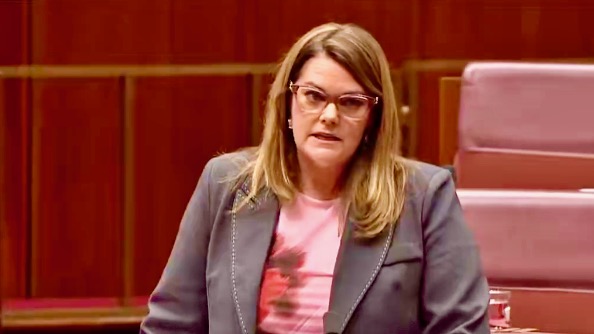
Hanson-Young Blasts ‘Major-Party Cartel’ Over Trump’s War and Economic Crisis

CANBERRA – The Senate chamber became a flashpoint of political vitriol on Monday morning as Greens Senator Sarah Hanson-Young launched a blistering attack on the Labor Government, the Coalition, and One Nation, accusing them of “blindly” following Donald Trump into a global conflict that is now devastating the Australian economy.

In a fiery address, the Manager of Australian Greens Business in the Senate did not mince words, labelling the current international involvement an “illegal war” and claiming that everyday Australians are now “paying the price” for a “major-party cartel” that refused to stand up to the U.S. President.

‘The Hypocrisy is Rank’

Senator Hanson-Young’s remarks come at a time of mounting domestic pressure as the economic fallout from the conflict continues to drive up living costs. She accused both sides of the aisle of acting as a “cheer squad” for the Trump administration, only to now complain about the inevitable consequences.

“The hypocrisy in this place reeks,” Senator Hanson-Young told the chamber. “The hypocrisy from that side of politics… which has backed this bloody war, this illegal war of Donald Trump’s, since day one and is now saying it’s actually causing pain to Australians. Well, of course it is!”

She further alleged that the Government and Opposition had entered the fray without a strategy, stating they “went in blindly” to back “your mate Trump.”

Target: One Nation

While the major parties took the brunt of the systemic critique, Hanson-Young reserved a specific level of scorn for One Nation leader Pauline Hanson. Anticipating a response from the Queensland Senator, Hanson-Young dismissed any potential concerns for struggling families as “crocodile tears.”

“There’s no bigger cheerleader for Donald Trump in this country than Pauline Hanson and One Nation,” she said. “I assume we’re about to hear the Leader of One Nation stand up and wring her hands… meanwhile backing the major supporter of this rubbish, of this pain, of this suffering.”

EVs and the Culture War

The Senator tied the geopolitical crisis back to domestic policy, specifically the stalled transition to electric vehicles (EVs). She argued that while the “Trump war” shows no signs of ending, the Australian Opposition is actively hindering affordable alternatives for citizens.

  • The Charge: The Coalition is accused of fueling a “culture war” against EVs.
  • The Impact: Hanson-Young argues this makes it harder for Australians to access cheaper transport options during an economic crunch.
  • The Result: A government and opposition that she claims have “no plan” beyond complaining.

A Growing Divide

The speech highlights the deepening rift in the Senate as the 2026 economic landscape remains dominated by international instability. With the Greens positioning themselves as the sole voice of dissent against the “cartel” of Labor and the Coalition, the political temperature in Canberra appears set to rise alongside the cost of living.

As of Monday afternoon, neither Senator Hanson nor the Government benches had issued a formal rebuttal to the “cartel” allegations, though the chamber remains on high alert for a standard “One Nation” counter-offensive.