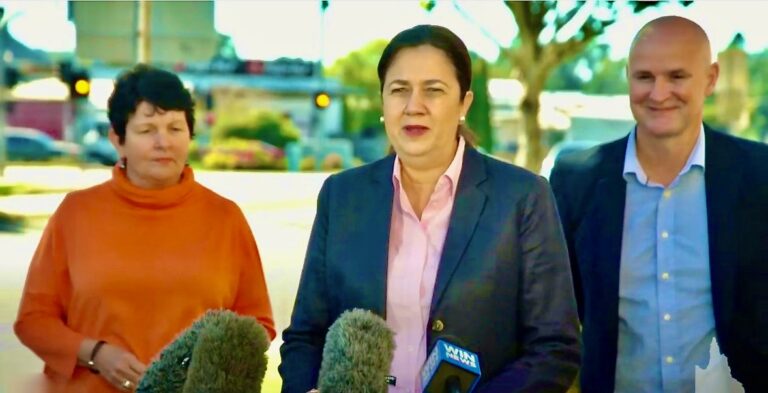
Businesses including Woolworths have been praised for helping the COVID response by delivering more than 60,000 free face masks to the Torres Strait and 12,000 to Palm Island and Doomadgee.
Deputy Premier Steven Miles thanked Woolies, Community Enterprise Queensland and Hinterland Aviation for their heart-warming efforts.
“When it became clear that some of our most remote and at-risk communities were struggling to source enough masks, we put the call out to business to help,” Mr Miles said.
“An industry solution was brokered last yesterday to supply 60,000 masks – at no cost – to community to the Torres Straits and Northern Peninsular Area.
“This is through collaboration between Woolworths, who will supply the masks from their staff supply, and Community Enterprise Queensland – who operate stores across the region.
“I want to say a big Queensland thank you to all involved. Masks are important and Woolies didn’t hesitate to lend a helping hand.”
Member for Townsville Scott Stewart said similar support was given to Palm Island.
“Nine thousand of 12,000 masks secured will arrive on Palm Island this morning with Hinterland Aviation waiving freight costs,” Mr Stewart said.
“The remaining three thousand masks have been set aside for Doomadgee.”
“When I became aware the Palm Island community was struggling to source enough masks, as the local member I was more than happy to try and find a resolution to this issue.
“It would be devastating if COVID-19 got into that community as there are many vulnerable people living on the island.
“That’s why it was important to get a quick resolution to the problem.
“Helping others in need is a Queensland thing to do. I’m very thankful to everyone involved.”
Woolworths Group, Head of COVID-19 Response, Ross Spencer said they were happy to help.
“When the call came in from the Queensland Government, our team didn’t hesitate to put their hand up to help.
“We’ve built up a good supply of face masks for our team and customers, so we were really well placed to support these remote communities with critical supplies at short notice.
“We’re grateful to the other businesses who have helped make this a reality and trust the donation will play an important role as part of the broader public health efforts on the islands.”
The 60,000 masks will be in Cairns this afternoon ready to be flown to Horn Island tomorrow morning. The distribution across the region will take place over the coming days.
Sources: Deputy Premier and Minister for State Development, Infrastructure, Local Government and Planning
you can leave your home for any purpose. You can travel anywhere in Australia. Please note other states and territories may have restrictions in place that prevent you from travelling to them
It is strongly recommended you wear a mask when outdoors if you are unable to stay more than 1.5m distance from other people, such as busy walkways and thoroughfares.
Masks do not need to be worn in some circumstances, including children under 12 years, if you have certain medical conditions, and in workplaces where it is not safe to do so.
You can remove your mask to consume food or drink.
Applications are now open to be part of Victoria’s new Anti-Racism Taskforce, which will play a key role in the development of a new state-wide strategy to prevent and crackdown on race-based discrimination and abuse.
Minister for Multicultural Affairs Ros Spence and Minister for Aboriginal Affairs Gabrielle Williams called on Victorians passionate about a strong, diverse and fair Victoria to apply.
The Andrews Labor Government has announced it will develop a new state-wide Anti-Racism Strategy to proactively prevent and address racism in Victoria because racism and discrimination, in any form, has no place in Victoria.
The Strategy will focus on a broad range of elements that underlay and perpetuate racial discrimination like unconscious bias, privilege, and the intersection of race and other forms of discrimination.
The new Anti-Racism Taskforce will provide advice and recommendations to the government to ensure the Strategy sets out a clear and targeted road map to reduce racism in Victoria.
The leadership of the Taskforce is still being finalised and will be supported by members who have a range of high-level skills and expertise.
Applications are encouraged from individuals with a diverse range of professional and lived experience to ensure the Taskforce reflects the diversity within our community. The Taskforce will also consult directly with communities to elevate a diversity of voices and perspectives.
For more information and to apply for a position on the Taskforce visit https://bit.ly/3wgDwz1
Applications close at 11:59pm on Friday 16 April 2021.
Quotes attributable to Minister for Multicultural Affairs Ros Spence
“We want passionate, committed Victorians to help us fight racism and develop a state-wide plan to prevent it.”
“Preventing and cracking down on race-based discrimination and abuse is vital to building a stronger, fairer Victoria.”
Quotes attributable to Minister for Aboriginal Affairs Gabrielle Williams
“Sadly, racism and hate speech increased during the pandemic – and addressing it will be a critical part of our recovery.”
“The voices of Aboriginal and Torres Strait Islander communities will be a critical part of Victoria’s new Anti-Racism Taskforce.”
Today, Joe Biden invited 40 world leaders to the Leaders Summit on Climate he will host on April 22 and 23. The virtual Leaders Summit will be live streamed for public viewing.
President Biden took action his first day in office to return the United States to the Paris Agreement. Days later, on January 27, he announced that he would soon convene a leaders summit to galvanize efforts by the major economies to tackle the climate crisis.
The Leaders Summit on Climate will underscore the urgency – and the economic benefits – of stronger climate action. It will be a key milestone on the road to the United Nations Climate Change Conference (COP26) this November in Glasgow.
In recent years, scientists have underscored the need to limit planetary warming to 1.5 degrees Celsius in order to stave off the worst impacts of climate change. A key goal of both the Leaders Summit and COP26 will be to catalyze efforts that keep that 1.5-degree goal within reach. The Summit will also highlight examples of how enhanced climate ambition will create good paying jobs, advance innovative technologies, and help vulnerable countries adapt to climate impacts.
By the time of the Summit, the United States will announce an ambitious 2030 emissions target as its new Nationally Determined Contribution under the Paris Agreement. In his invitation, the President urged leaders to use the Summit as an opportunity to outline how their countries also will contribute to stronger climate ambition.
The Summit will reconvene the U.S.-led Major Economies Forum on Energy and Climate, which brings together 17 countries responsible for approximately 80 percent of global emissions and global GDP. The President also invited the heads of other countries that are demonstrating strong climate leadership, are especially vulnerable to climate impacts, or are charting innovative pathways to a net-zero economy. A small number of business and civil society leaders will also participate in the Summit.
Key themes of the Summit will include:
Galvanizing efforts by the world’s major economies to reduce emissions during this critical decade to keep a limit to warming of 1.5 degree Celsius within reach.
Mobilizing public and private sector finance to drive the net-zero transition and to help vulnerable countries cope with climate impacts.
The economic benefits of climate action, with a strong emphasis on job creation, and the importance of ensuring all communities and workers benefit from the transition to a new clean energy economy.
Spurring transformational technologies that can help reduce emissions and adapt to climate change, while also creating enormous new economic opportunities and building the industries of the future.
Showcasing subnational and non-state actors that are committed to green recovery and an equitable vision for limiting warming to 1.5 degree Celsius, and are working closely with national governments to advance ambition and resilience.
Discussing opportunities to strengthen capacity to protect lives and livelihoods from the impacts of climate change, address the global security challenges posed by climate change and the impact on readiness, and address the role of nature-based solutions in achieving net zero by 2050 goals.
Further details on the Summit agenda, additional participants, media access, and public viewing will be provided in the coming weeks.
The President invited the following leaders to participate in the Summit:
Prime Minister Gaston Browne, Antigua and Barbuda
President Alberto Fernandez, Argentina
Prime Minister Scott Morrison, Australia
Prime Minister Sheikh Hasina, Bangladesh
Prime Minister Lotay Tshering, Bhutan
President Jair Bolsonaro, Brazil
Prime Minister Justin Trudeau, Canada
President Sebastián Piñera, Chile
President Xi Jinping, People’s Republic of China
President Iván Duque Márquez, Colombia
President Félix Tshisekedi, Democratic Republic of the Congo
Prime Minister Mette Frederiksen, Denmark
President Ursula von der Leyen, European Commission
President Charles Michel, European Council
President Emmanuel Macron, France
President Ali Bongo Ondimba, Gabon
Chancellor Angela Merkel, Germany
Prime Minister Narendra Modi, India
President Joko Widodo, Indonesia
Prime Minister Benjamin Netanyahu, Israel
Prime Minister Mario Draghi, Italy
Prime Minister Andrew Holness, Jamaica
Prime Minister Yoshihide Suga, Japan
President Uhuru Kenyatta, Kenya
President David Kabua, Republic of the Marshall Islands
President Andrés Manuel López Obrador, Mexico
Prime Minister Jacinda Ardern, New Zealand
President Muhammadu Buhari, Nigeria
Prime Minister Erna Solberg, Norway
President Andrzej Duda, Poland
President Moon Jae-in, Republic of Korea
President Vladimir Putin, The Russian Federation
King Salman bin Abdulaziz Al Saud, Kingdom of Saudi Arabia
Prime Minister Lee Hsien Loong, Singapore
President Matamela Cyril Ramaphosa, South Africa
Prime Minister Pedro Sánchez, Spain
President Recep Tayyip Erdoğan, Turkey
President Sheikh Khalifa bin Zayed Al Nahyan, United Arab Emirates
Nominations are now open for the 2021 Victorian Refugee Awards, which recognise the achievements and contributions of Victorians from refugee and asylum seeker backgrounds.
The annual awards honour people, businesses and organisations who have excelled through study, work, entrepreneurial or volunteer efforts in Victoria. Multiple awards will be presented across four categories – Young Leader, Achievement, Leadership and Business.
The awards will be a key part of Refugee Week, which will run from Sunday 20 June to Saturday 26 June this year.
Refugee Week raises awareness about issues affecting refugees and celebrates their contribution to our county and our community. The theme for this year is Unity – The Way Forward, which calls for the spirit of unity as communities recover from the isolation endured in 2020.
In addition to the Awards, the Victorian Multicultural Commission (VMC) is supporting a series of community events over the week to share refugee experiences, delivered by the VMC Regional Advisory Councils.
Nominations must be submitted online by 11.59pm on Saturday 24 April and individuals can self-nominate.
Quotes attributable to Minister for Multicultural Affairs Ros Spence
“The Victorian Refugee Awards is a great opportunity to recognise the achievements of Victorians from refugee and asylum seeker backgrounds and the contribution they have made – and continue to make – to our state.”
“I encourage Victorians to get involved by nominating someone for an award and by celebrating Refugee Week later this year.”
Quotes attributable to Victorian Multicultural Commission Chairperson Viv Nguyen
“We’re excited to relaunch Victorian Refugee Awards and encourage you to nominate yourself or someone else for one of the four categories.”
“At times refugees and people seeking asylum are harmed by myths, stereotypes and misunderstandings – that’s why showcasing the diversity and achievements of refugees across Victoria during Refugee Week is so important.”
The Greater Brisbane region has now entered a three-day lockdown and increased restrictions are in place across Queensland as evidence of community transmission of the UK strain of COVID-19 continues to emerge.
The Greater Brisbane region includes:
Brisbane City Council;
Logan City Council;
Moreton Bay Regional Council;
Ipswich City Council; and
Redland City Council.
Premier Annastacia Palaszczuk said the three-day lockdown would be reviewed on Wednesday and allow Queensland Health to carry out vital contact tracing.
“This is the UK strain. It is highly infectious. We need to do this now to avoid a longer lockdown,” the Premier said.
“Just like the lockdown in January, this is designed to be a circuit breaker to limit community spread as much as possible.”
Queensland Chief Health Officer Dr Jeannette Young said the three day lockdown would limit community spread of COVID-19.
“With significant community transmission and many venues of concern throughout Greater Brisbane, this lockdown is essential to protect the community,” Dr Young said.
“We need this time to allow our contact tracers to get in touch with close contacts, identify any at risk locations and alert the community.
“It’s really important people follow the restrictions. I know it’s difficult, but we don’t implement these measures lightly – we want to keep Queenslanders safe,” she said.
Health Minister Yvette D’Ath said it was important that people with COVID symptoms continued to get tested.
“We have had over 11,000 tests in the last 24 hours so we thank everyone for coming forward for those tests and we want that to continue,” the Minister said.
“It’s important to follow the health advice to keep you and your family safe and the rest of Queensland.”
Greater Brisbane restrictions
From 5pm Monday 29 March to 5pm Thursday 1 April 2021, people in Greater Brisbane (Brisbane City Council, Logan City Council, Moreton Bay Regional Council, Ipswich City Council and Redland City Council) will be required to stay at home except for essential reasons. The restrictions will be reviewed on Wednesday night.
You can only leave your residence (which includes temporary accommodation such as a holiday rental) for limited permitted purposes such as: obtaining essential goods or services, including healthcare
exercise
attending essential work or childcare
assisting vulnerable persons
You should stay in your local area wherever possible.
You can only have two visitors to your residence (excluding volunteers and workers). Anyone residing at the residence from 5pm 29 March 2021 will be considered a member of the household.
You can exercise away from your home with your household group and/or one other person not from your household.
You must carry a face mask at all times when you leave home, unless you have a lawful reason not to. You must wear a mask in indoor spaces, such as:
shopping centres and supermarkets
hospitals and aged care facilities
indoor workplaces (where safe to wear a mask and you can’t physically distance)
public transport, taxis and rideshare, and waiting places or queues for this transport
airports and travelling on planes.
Masks do not need to be worn in some circumstances, including children under 12 years, where people have certain medical conditions, and in workplaces where it is not safe to do so. Masks do not to be worn outside when exercising unless you cannot socially distance.
A person may remove their mask when sitting down to eat, undertaking strenuous exercise and for employment purposes.
Non-essential businesses are not allowed to operate. Cinemas, entertainment and recreation venues, hairdressers, beauty and personal care services, gyms and places of worship will all close.
Schools will close until next term, except for the children of essential workers and vulnerable children. Childcare centres will remain open.
Restaurants and cafes can provide take away or home delivery services only.
Funerals will be limited to 20 people, and weddings will be limited to 10 people, including the celebrant and the couple.
Statewide restrictions on aged care, hospitals, disability care and correctional facilities will apply with no personal visitors allowed during the lockdown period.
Anyone attending these facilities in Greater Brisbane, including staff, must wear a mask. People will still be able to visit their loved ones who are at end of life.
Anyone who was in Greater Brisbane on or since Saturday 20 March 2021 is required to follow the same lockdown rules even if they are no longer in Greater Brisbane. You must only leave your home for the essential reasons and wear a mask.
You can return to your home outside of Greater Brisbane, but you must follow the same lockdown rules when you return home, regardless of where your destination is.
Those leaving the Greater Brisbane area during this time may do so for essential reasons or to return home, but must also remain at their residence and limit their movements until the lockdown period has ended.
If you live outside Greater Brisbane, you can transit through Greater Brisbane without stopping.
Rest of Queensland restrictions
Due to travel outside of Greater Brisbane of some cases during their infectious period, the below restrictions will apply to the rest of Queensland:
Gatherings will be restricted to 30 people in homes
Anyone attending food or beverage establishments such as restaurants, cafes and pubs must be seated.
Personal visitors will not be allowed in aged care, hospitals, disability care and correctional facilities and there will be increased PPE requirements.
Queenslanders living outside of Greater Brisbane, and who have not been in Greater Brisbane at any time since 20 March, must carry a face mask at all times when they leave home, unless they have a lawful reason not to. You must wear a mask in indoor spaces, such as:
shopping centres, supermarkets, retail outlets and indoor markets
hospitals and aged care facilities
hospitality venues such as restaurants and cafés (not required for patrons while seated; customer facing staff only)
churches and places of worship
libraries
indoor recreational facilities and gym (except if doing strenuous exercise)
indoor workplaces (where safe to wear a mask and you can’t physically distance)
public transport, taxis and rideshare, and waiting places or queues for this transport
airports and travelling on planes.
General advice
If you are unable to stay more than 1.5m distance from other people in an outdoor setting (eg – busy walkways and thoroughfares), it is strongly recommended to where a mask.
Masks do not need to be worn in some circumstances, including children under 12 years, where people have certain medical conditions, and in workplaces where it is not safe to do so.
Queensland Health has also issued a Public Health Alert for parts of Greater Brisbane and Central Queensland regions in relation to the latest cases. For the latest information related to these locations, visit the Queensland Health website.
Anyone with any COVID-19 symptoms, no matter how mild, should get tested immediately and isolate until you receive a negative result.
Symptoms include fever, cough, sore throat, runny nose, fatigue or loss of smell and/or taste.
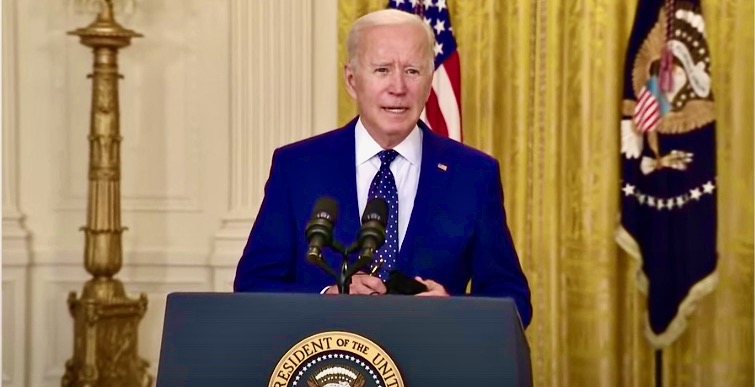
THE PRESIDENT: Please, please sit down. Thank you. Thank you. Good afternoon. Before I take questions, I want to make — give you a progress report to the nation on where we stand 65 days into office here on vaccinations and a few other top priorities for the American people.
First, on vaccinations: On December 8th, I indicated that I hoped to get 100 million shots in people’s arms in my first 100 days. We met that goal last week by day 58 — 42 days ahead of schedule.
Now, today, I’m setting a second goal, and that is: We will, by my 100th day in office, have administered 200 million shots in people’s arms. That’s right: 200 million shots in 100 days.
I know it’s ambitious, twice our original goal, but no other country in the world has even come close — not even close — to what we are doing. And I believe we can do it.
And today, we’ve made a historic investment in reaching the hardest-hit and the most vulnerable communities, the highest-risk communities — as a consequence of the virus — by investing an addition $10 billion in being able to reach them.
I also set a goal, before I took office, of getting a majority of schools in K through 8 fully open in the first 100 days. Now, thanks to the enormous amount of work done by our administration, educators, parents, local, state education officials and leaders — a recent Department of Education Department survey shows that nearly half of the K-through-8 schools are open now full time, five days a week, for in-person learning. Not yet a majority, but we’re really close. And I believe, in the 35 days left to go, we’ll meet that goal as well.
As of yesterday, more than 100 million payments of $1,400 have gone into people’s bank accounts. That’s real money in people’s pockets, bringing relief instantly, almost. And millions more will be getting their money very soon.
One final note: Since we passed the American Rescue Plan, we’re starting to see new signs of hope in our economy. .embed-container { position: relative; padding-bottom: 56.25%; height: 0; overflow: hidden; max-width: 100%; } .embed-container iframe, .embed-container object, .embed-container embed { position: absolute; top: 0; left: 0; width: 100%; height: 100%; }
Since it was passed, a majority — a majority of economic forecasters have significantly increased their projections on the economic growth that’s going to take place this year. They’re now projecting it will exceed 6 percent — a 6 percent growth in GDP.
And just this morning, we learned that the number of people filing for weekly unemployment insurance fell by nearly 100,000 persons. That’s the first time in a year the number has fallen below the pre-pandemic high.
So there are still too many Americans out of work, too many families hurting, and we still have a lot of work to do.
But I can say to you, the American people: Help is here, and hope is on the way.
Now I’ll be happy to take your questions.
Zeke, the Associated Press.
Q Thank you, Mr. President. You mentioned your progress on COVID-19. I’d like to ask you about some of the other issues facing your presidency. One of the defining challenges you face in the coming months is how to deliver on your promise to Americans on issues like immigration reform, gun control, voting rights, climate change. All of those right now are facing stiff, united opposition from Republicans on Capitol Hill. How far are you willing to go to achieve those promises that you made to the American people?
THE PRESIDENT: Well, I’m going to — look, when I took office, I decided that it was a fairly basic, simple proposition, and that is: I got elected to solve problems. And the most urgent problem facing the American people, I stated from the outset, was COVID-19 and the economic dislocation for millions and millions of Americans. And so that’s why I put all my focus in the beginning — there are a lot of problems — put all my focus on dealing with those particular problems.
And the other problems we’re talking about, from immigration to guns and the other things you mentioned, are long-term problems; they’ve been around a long time. And what we’re going to be able to do, God willing, is now begin, one at a time, to focus on those as well, and — whether it’s immigration or guns or a number of other problems that face the country.
But the fundamental problem is getting people some peace of mind so they can go to bed at night and not stare at the ceiling wondering whether they lost their health insurance, whether they’re going to lose a family member, whether they’re going to be in a position where they’re not going to be — they’re going to lose their home because they can’t pay their mortgage, or that millions of people are going to get thrown out of their homes because of the inability to — to pay their rent.
So we’re going to move on these one at a time, try to do as many simultaneously as we can. But that’s the reason why I focused as I have.
And here’s the deal: I think my Republican colleagues are going to have to determine whether or not we want to work together, or they decide that the way in which they want to proceed is to — is to just decide to divide the country, continue the politics of division. But I’m not going to do that; I’m just going to move forward and take these things as they come.
Q And just to — to follow up, Mr. President, can your presidency be a success if you can’t make progress on those four challenges: climate change, immigration reform, gun control, voting rights?
THE PRESIDENT: Well, I plan on making progress on all of them, but that’s going to be for the American people to decide.
I think — you know, I doubt whether — maybe you did; maybe others did. I thought — many of you thought there was no possibility of my getting the plan I got passed, passed, without any Republican votes. A pretty big deal. It got passed. Growing the economy. People’s lives are changing.
So let’s see what happens. All I know, I’ve been hired to solve problems — to solve problems, not create division.
Okay. How about Yamiche?
Q Thanks so much, Mr. President. You’ve said over and over again that immigrants shouldn’t come to this country right now; this isn’t the time to come. That message is not being received. Instead, the perception of you that got you elected — as a moral, decent man — is the reason why a lot of immigrants are coming to this country and entrusting you with unaccompanied minors.
How do you resolve that tension? And how are you choosing which families can stay and which can go, given the fact that even though, with Title 42, there are some families that are staying? And is there a timeline for when we won’t be seeing these overcrowded facilities with — run by CPB [sic], when it comes to unaccompanied minors?
THE PRESIDENT: Well, look, I guess I should be flattered people are coming because I’m the nice guy; that’s the reason why it’s happening — that I’m a decent man or however it’s phrased. That — you know, that’s why they’re coming, because they know Biden is a good guy.
The truth of the matter is: Nothing has changed. As many people came — 28 percent increase in children to the border in my administration; 31 percent in the last year of — in 2019, before the pandemic, in the Trump administration. It happens every single, solitary year: There is a significant increase in the number of people coming to the border in the winter months of January, February, March. That happens every year.
In addition to that, there is a — and nobody — and, by the way, does anybody suggest that there was a 31 percent increase under Trump because he was a nice guy and he was doing good things at the border? That’s not the reason they’re coming.
The reason they’re coming is that it’s the time they can travel with the least likelihood of dying on the way because of the heat in the desert, number one. Number two, they’re coming because of the circumstances in-country — in-country.
The way to deal with this problem — and I started to deal with it back when I was a United States senator — I mean, Vice President — putting together a bipartisan plan of over $700 million to deal with the root causes of why people are leaving.
What did Trump do? He eliminated that funding. He didn’t use it. He didn’t do it. And in addition to that, what he did — he dismantled all the elements that exist to deal with what had been a problem and — and has been — continued to be a problem for a long time. He, in fact, shut down the — the number of beds available. He did not fund HHS to get people to get the children out of those — those Border Patrol facilities where they should not be and not supposed to be more than a few days — a little while. But he dismantled all of that.
And so what we’re doing now is attempting to rebuild — rebuild the system that can accommodate the — what is happening today. And I like to think it’s because I’m a nice guy, but it’s not. It’s because of what’s happened every year.
Let me say one other thing on this. If you take a look at the number of people who are coming, the vast majority, the overwhelming majority of people coming to the border and crossing are being sent back — are being sent back. Thousands — tens of thousands of people who are — who are over 18 years of age and single — people, one at a time coming, have been sent back, sent home.
We’re sending back the vast majority of the families that are coming. We’re trying to work out now, with Mexico, their willingness to take more of those families back. But we — that’s what’s happening. They’re not getting across the border.
And those who are coming across the border, who are unaccompanied children, we’re moving rapidly to try to put in place what was dismantled, as I said. For example, of all the children who are coming across the border, over 70 percent are either 16 or 17 years old. We’re not talking about people ripping babies from mothers’ arms or little three-year-olds standing on the border. Less than — I think it’s one and a half percent fall in the category of the very young.
So what we’re doing is we’re providing for the space, again, to be able to get these kids out of the Border Patrol facilities, which no child — no one should be in any longer than 72 hours.
And today, I went to — for example, I used all the resources available to me, went to the Defense Department, and — and the Secretary of Defense has just made available Fort Bliss — 5,000 beds be made easily available. Five thousand beds on the Texas border.
So we’re building back up the capacity that should have been maintained and built upon that Trump dismantled. It’s going to take time.
And the other thing we’re doing, I might add — am I giving you too long an answer? Because if you don’t want the details —
Q (Inaudible.)
THE PRESIDENT: No, no, but I mean — I don’t know how much detail you want about immigration. Maybe I’ll stop there and fin- —
Q My follow-up question is: One, if you could talk a little bit about which families — why they’re being allowed to stay. The families that are being allowed to stay, why they’re being allowed to stay.
And in addition to that, when it comes to the filibuster, which is what Zeke was asking about, there’s — immigration is a big issue, of course, when it — related to the filibuster, but there’s also Republicans who are passing bill after bill, trying to restrict voting rights. Chuck Schumer is calling it an “existential threat” to democracy. Why not back a filibuster rule that at least gets around issues including voting rights or immigration?
Jim Clyburn, someone who — of course, who you know very well, has backed the idea of a filibuster rule when it comes to civil rights and voting rights.
THE PRESIDENT: Well, look, I’m going to deal with all of those problems. The question is, the priorities as they come and land on my plate.
Let’s go to the first question you asked — the first of the second question you asked. And that is: What about dealing with families? Why are not — some not going back? Because Mexico is refusing to take them back. They’re saying they won’t take them back — not all of them.
We’re in negotiations with the President of Mexico. I think we’re going to see that change. They should all be going back, all be going back. The only people we’re not going to let sitting there on the other side of the Rio Grande by themselves with no help are children.
And what we’re doing there, and it’s an important point to understand — I know you understand; I don’t mean to say it that way — an important point to focus on: The vast majority of people under the age of 18 coming to United States come with a telephone number on a wristband or come with a telephone number in their pocket in the United States — a mother, a father, a close relative, a grandmom or a grandpop.
What was happening before is it was taking literally weeks and weeks, and maybe even months, before anybody would pick up the phone and call to see if there really was someone there. Well, we’ve set up a system now where, within 24 hours, there’s a phone call made as that person or that child crosses the border. And then a verification system is being put in place as of today to determine quickly whether or not that is a trafficker being called or that is actually a mom, a dad, and/or a close relative. They’re establishing that right off the bat.
If it, in fact, is Mom or Dad, Dad says — to take the extreme case — “I got a birth certificate.” Then guess what? We’re getting that kid directly to that parent immediately.
And so that’s going to reduce significantly — there’s two ways to reduce child populations in circumstances that are not acceptable, like being held at a Border Patrol station. One is to get them to the place where they have a relative and set a date as to when a hearing can be held. The second way to do it is put them in a Health and Human Services facility that we’re occupying now — both licensed beds around the country that exist, as well as, for example, federal resources like Fort Bliss — to get them safely in a place where they can be taken care of while their fate is determined.
Q And can you answer the filibuster (inaudible)?
THE PRESIDENT: Filibuster. Filibuster. You know, with regard to the filibuster, I believe we should go back to a position on the filibuster that existed just when I came to the United States Senate 120 years ago. And that is that — it used to be required for the filibuster — and I had a card on this; I was going to give you the statistics, but you probably know them — that it used to be that, that from between 1917 to 1971 — the filibuster existed — there was a total of 58 motions to break a filibuster that whole time. Last year alone, there were five times that many. So it’s being abused in a gigantic way.
And, for example, it used to be you had to stand there and talk and talk and talk and talk until you collapsed. And guess what? People got tired of talking and tired of collapsing. Filibusters broke down, and we were able to break the filibuster, get a quorum, and vote.
So I strongly support moving in that direction, in addition to having an open mind about dealing with certain things that are — are just elemental to the functioning of our democracy, like the right to vote — like the basic right to vote. We’ve amended the filibuster in the past.
But here’s the deal: As you observed, I’m a fairly practical guy. I want to get things done. I want to get them done, consistent with what we promised the American people. And in order to do that in a 50-50 Senate, we’ve got to get to the place where I get 50 votes so that the Vice President of the United States can break the tie, or I get 51 votes without her.
And so, I’m going to say something outrageous: I have never been particularly poor at calculating how to get things done in the United States Senate. So the best way to get something done, if you — if you hold near and dear to you that you like to be able to — anyway —
I — we’re going to get a lot done. And if we have to — if there’s complete lockdown and chaos as a consequence of the filibuster, then we’ll have to go beyond what I’m talking about.
Okay. Hang on. Sorry. Oh, Seung Min — Ms. Kim.
Q Thank you, Mr. President, to follow up on the filibuster: So do you believe it should take 60 votes to end a filibuster on legislation or 51?
THE PRESIDENT: (Laughs.) If we could end it with 51, we would have no problem. You’re going to have to — the existing rule — it’s going to be hard to get a parliamentary ruling that allows 50 votes to end the filibuster, the existence of a filibuster.
But it’s not my expertise, in what the parliamentary rules and how to get there are. But our preoccupation with the filibuster is totally legitimate, but in the meantime, we got a lot we can do while we’re talking about what we’re going to do about the filibuster.
Let me get here. Okay, Cecilia Vega.
Q I’d like to circle back to immigration, please. You just listed the reasons that people are coming, talking about in-country problems, saying that it happens every year; you blamed the last administration. Sir, I just got back last night from a reporting trip to the border where I met nine-year-old, Yossell, who walked here from Honduras by himself, along with another little boy. He had that phone number on him —
THE PRESIDENT: Astounding.
Q — and we were able to call his family. His mother says that she sent her son to this country because she believes that you are not deporting unaccompanied minors like her son. That’s why she sent him alone from Honduras.
So, sir, you blamed the last administration, but is your messaging — in saying that these children are and will be allowed to stay in this country and work their way through this process — encouraging families like Yossell says to come?
THE PRESIDENT: Well, look, the idea that I’m going to say — which I would never do — “if an unaccompanied child ends up at the border, we’re just going to let him starve to death and stay on the other side” — no previous administration did that either, except Trump. I’m not going to do it. I’m not going to do it.
That’s why I’ve asked the Vice President of the United States, yesterday, to be the lead person on dealing with focusing on the fundamental reasons why people leave Honduras, Guatemala, and El Salvador in the first place. It’s because of earthquakes, floods. It’s because of lack of food. It’s because of gang violence. It’s because of a whole range of things.
That — when I was Vice President and had the same obligation to deal with unaccompanied children, I was able to get it slowed up significantly by working with the heads of state of those communities to do things like — in one of the major cities, the reason people were leaving is they couldn’t walk in the street because they were getting — their kids were getting beat up or shot or in gang violence.
Well, what I was able to do is not give money to the head of state, because so many are corrupt, but I was able to say, “Okay, you need lighting in the streets to change things? I’ll put the lighting in.” We got a contractor. We got the type of lighting. We paid directly to the contractor; it did not go through the government. And violent crime significantly was reduced in that city. Fewer people sought to leave.
When this hurricane occurred — two hurricanes — instead of us going down and helping in a major way, so that people would not have reason to want to leave in the first place because they didn’t have housing or water or sustenance, we did nothing. We’re going to do a lot in our administration. We’re going to be spending that 700-plus million dollars a year to change the life and circumstances of why people leave in the first place.
That mother did not sit around with — on the kitchen table and say, “You know, I got a great idea: The way I’m going to make sure my son get taken care of is I’m going to put a…” — how old was he, or she?
Q He’s — he’s nine. I also met a 10-year-old.
THE PRESIDENT: A nine-year-old. “I’m going to send him on a thousand-mile journey across the desert and up to the United States because I know Joe Biden is a nice guy and he’ll take care of him.”
What a desperate act to have to take. The circumstances must be horrible. So we can do something about that. That’s what the Vice President is going to be doing: what I did. When President Obama asked me to come and deal, I was in — I was in Turkey at the time, and he said, “You got to come home and take care of this.” So we put together a plan and it had an impact.
And so, the question here is whether — how we go ahead and do this; what we do. There’s no easy answer
Q A quick follow, if I may. Do you want to see these unaccompanied minors staying in this country, or should they be deported eventually?
THE PRESIDENT: Well, the judgment has to be made whether or not — and in this young man’s case, he has a mom at home; there’s an overwhelming reason why he’d be put in a plane and flown back to his mom.
Q Final follow, sir. You mentioned circumstances that must be horrific. The Customs and Border Protection facility in Donna, Texas — I was there — is at 1,556 percent capacity —
THE PRESIDENT: Yep.
Q — right now, with mostly unaccompanied minors. There are kids that are sleeping on floors. They are packed into these pods. I’ve spoken to lawyers who say that they — some of these children have not seen the sun in days. What’s your reaction — what is your reaction to these images that have come out from that particular facility? Is what’s happening inside acceptable to you? And when is this going to be fixed?
THE PRESIDENT: Is — that’s a serious question, right?
Is it acceptable to me? Come on. That’s why we’re going to be moving a thousand of those kids out quickly. That’s why I got Fort Bliss opened up. That’s why I’ve been working from the moment this started to happen to try to find additional access for children to be able to safely — not just children, but particularly children — to be able to safely be housed while we follow through on the rest of what’s happening.
That is totally unacceptable.
Ken.
Q Thank you, Mr. President. I wanted to ask you about Afghanistan. You face a May 1st deadline for the withdrawal of U.S. troops from that country. As a candidate, in foreign affairs, you wrote that it is past time to end these forever wars. Can you commit to the American people that by May 2nd the U.S. will no longer have forces in Afghanistan?
THE PRESIDENT: The answer is that it’s going to be hard to meet the May 1 deadline. Just in terms of tactical reasons, it’s hard to get those troops out. So, what we’ve been doing — what I’ve been doing and what Secretary Blinken has been doing — has been — we’ve been meeting with our allies, those other nations that have NATO Allies who have troops in Afghanistan as well. And if we leave, we’re going to do so in a safe and orderly way.
We’re in consultation, I said, with our allies and partners in how to proceed. And Secretary Blinken is meeting in Brussels this week with our NATO Allies, particularly those who have forces there.
And General Austin is — just met with Ghani and I’m waiting for the briefing on that. He is the — the “leader,” quote, in Afghanistan and Kabul. And there’s a U.N.-led process that’s beginning shortly on how to mechanically get people — how to end this war.
But it is not my intention to stay there for a long time. But the question is: How and in what circumstances do we meet that agreement that was made by President Trump to leave under a deal that looks like it’s not being able to be worked out to begin with? How is that done? But we are not staying a long time.
Q You just said “if we leave.” Do you think it’s possible that we–
THE PRESIDENT: We will leave. The question is when we leave.
Q Do you — sorry — do you believe, though, it’s possible we could have troops there next year?
THE PRESIDENT: I — I can’t picture that being the case.
Okay. Kristen.
Q Thank you very much, Mr. President. Given the conditions that were just laid out at the migrant facilities at the U.S. border, will you commit to allowing journalists to have access to the facilities that are overcrowded moving forward?
THE PRESIDENT: I will commit when my plan, very shortly, is underway to let you have access to not just them, but to other facilities as well.
Q How soon will journalists be able to have access to the facilities? We’ve obviously been allowed to be inside one, but we haven’t seen the facilities in which children are packed together to really give the American people a chance to see that. Will you commit to transparency on this issue, Mr. President?
THE PRESIDENT: I will commit to transparency, and — as soon as I am in a position to be able to implement what we are doing right now.
And one of the reasons I haven’t gone down — I have all my — my chief folks have gone down — is I don’t want to become the issue. I don’t want to be, you know, bringing all of the Secret Service and everybody with me to get in the way. So this is being set up, and you’ll have full access to everything once we get this thing moving.
Q Okay. And just to be clear: How soon will that be, Mr. President?
THE PRESIDENT: I don’t know, to be clear.
Q Okay. And do you bear responsibility for everything that’s happening at the border now? I hear you talking a lot about the past administration. You decided to roll back some of those policies, did you move too quickly to roll back (inaudible) policies?
THE PRESIDENT: To roll back what? I’m sorry.
Q Did you move too quickly to roll back some of the executive orders of your predecessor?
THE PRESIDENT: First of all, all the policies that were underway were not helping at all — did not slow up the amount of immigration — and there’s many people coming.
And rolling back the policies of separating children from — from their mothers, I make no apology for that. Rolling back the policies of “Remain in Mexico,” sitting on the edge of the Rio Grande in a muddy circumstance with not enough to eat and — I make no apologies for that.
I make no apologies for ending programs that did not exist before Trump became President that have an incredibly negative impact on the law, international law, as well as on human dignity. And so, I make no apologies for that.
Q If I could just ask you about foreign policy, Mr. President. Overnight, we learned that North Korea tested two ballistic missiles. What, if any, actions will you take? And what is your red line on North Korea?
THE PRESIDENT: Let me say that, number one, U.N. Resolution 1718 was violated by those particular missiles that were tested — number one. We’re consulting with our allies and partners. And there will be responses — if they choose to escalate, we will respond accordingly.
But I’m also prepared for some form of diplomacy, but it has to be conditioned upon the end result of denuclearization. So that’s what we’re doing right now: consulting with our allies.
Q Just a very quick follow-up —
THE PRESIDENT: You’ve only got another hour now, okay?
Q Diplomacy: Can you define what you mean? And former President Obama warned the incoming President Trump that North Korea was the top foreign policy issue that he was watching. Is that how you assess the crisis in North Korea?
THE PRESIDENT: Yes.
Okay. Hang on a second here, Kristen. Nancy, CBS.
Q Thank you very much, Mr. President. I want to go back to voting rights. And as Yamiche mentioned, Republican legislatures across the country are working to pass bills that would restrict voting, particularly, Democrats fear, impacting minority voters and young voters — the very people who helped to get you elected in November.
Are you worried that if you don’t manage to pass voting rights legislation that your party is going to lose seats and possibly lose control of the House and the Senate in 2022?
THE PRESIDENT: What I’m worried about is how un-American this whole initiative is. It’s sick. It’s sick. Deciding in some states that you cannot bring water to people standing in line, waiting to vote; deciding that you’re going to end voting at five o’clock when working people are just getting off work; deciding that there will be no absentee ballots under the most rigid circumstances.
It’s all designed — and I’m going to spend my time doing three things: One, trying to figure out how to pass the legislation passed by the House, number one. Number two, educating the American public. The Republican voters I know find this despicable. Republican voters, the folks out in — outside this White House. I’m not talking about the elected officials; I’m talking about voters. Voters.
And so I am convinced that we’ll be able to stop this because it is the most pernicious thing. This makes Jim Crow look like Jim Eagle. I mean, this is gigantic what they’re trying to do, and it cannot be sustained.
I’m going to do everything in my power, along with my friends in the House and the Senate, to keep that from — from becoming the law.
Q Is there anything else you can do about it besides passing legislation?
THE PRESIDENT: The answer is “yes,” but I’m not going to lay out a strategy in front of the whole world and you now.
Q And then, on a related note, have you decided whether you are going to run for reelection in 2024? You haven’t set up a reelection campaign yet, as your predecessor had by this time.
THE PRESIDENT: (Laughs.) My predecessor need do [sic] — needed to. My predecessor. Oh God, I miss him.
Q Have you — have you —
THE PRESIDENT: No, the answer is “yes.” My plan is to run for reelection. That’s my expectation.
Q And then, on — on one other note, on bipartisanship: Your old friend, Mitch McConnell, says you have only spoken to each other once since you took office and that you have moved far left since taking office. Do you see it the same way he does? Have you rejected bipartisanship?
THE PRESIDENT: No, I haven’t at all. I’ve been meeting — when is the last time a President invited the opposite party down at least a half a dozen times to talk about issues? Everything from how we work — we’re working with a group of 20 members of the Senate right now and House on how we reestablish our ability to make computer chips and how we get ahead of the game, how we can work together. And we’re working together on a bunch of things.
But, look, I know Mitch well; Mitch knows me well. I would expect Mitch to say exactly what he said. But this is a matter of making sure that — I would like Republican — elected Republican support, but what I know I have now is that I have electoral support from Republican voters. Republican voters agree with what I’m doing.
And so, unless Mitch says the last thing I did is — the last piece of legislation is so far left — well, then he ought to a look at his party. Over 50 percent of them must be over that edge as well because they support what I did.
Okay. Where am I here? Let me see. Kaitlan.
Q Thank you very much, Mr. President. I have a question for you, but first I’d like to follow up on a question from Yamiche, and that’s on the filibuster.
THE PRESIDENT: That counts as a question, but go ahead.
Q Okay. I’ll make it quick. It’s a quick question.
THE PRESIDENT: No, no — you can.
Q Regarding the filibuster: At John Lewis’s funeral, President Barack Obama said he believed the filibuster was a “relic” of the Jim Crow era. Do you agree?
THE PRESIDENT: Yes.
Q And if not, why not abolish it if it’s a relic of the Jim Crow era?
THE PRESIDENT: Successful electoral politics is the art of the possible. Let’s figure out how we can get this done and move in the direction of significantly changing the abuse of even the filibuster rule first. It’s been abused from the time it came into being — by an extreme way in the last 20 years. Let’s deal with the abuse first.
Q It sounds like you’re moving closer to eliminating the filibuster. Is that correct?
THE PRESIDENT: I answered your question.
Q You also just made some news by saying that you are going to run for reelection.
THE PRESIDENT: I said, “That is my expectation.”
Q So is that a “yes” that you are running for reelection?
THE PRESIDENT: Look, I — I don’t know where you guys come from, man. I’ve never been able to travel. I’m a great respecter of fate. I’ve never been able to plan four and half, three and a half years ahead for certain.
Q And if you do —
THE PRESIDENT: It —
Q If you do run, will Vice President Harris be on your ticket?
THE PRESIDENT: I would fully expect that to be the case. She’s doing a great job. She’s a great partner. She’s a great partner.
Q And do you believe you’ll be running against former President Trump?
THE PRESIDENT: Oh, come on. I don’t even think about — I don’t — I have no idea. I have no idea if there will be a Republican Party. Do you? I know you don’t have to answer my question, but, I mean, you know, do you?
I mean, look, this is — the way I view things — I’ve become a great respecter of fate in my life. I set a goal that’s in front of me to get things done for the people I care most about, which are hardworking, decent American people who are getting — really having it stuck to them.
I want to change the paradigm. I want to change the paradigm. We start to reward work, not just wealth. I want to change the paradigm.
If you notice — don’t you find it kind of interesting that my Republican friends were worried about that the cost and the taxes that had to be had — if there is any tax to be had, as they talk about it — in dealing with the — the act that we just passed which puts money in people’s pockets — ordinary people.
Did you hear them complain when they passed close to a $2 trillion Trump tax cut — 83 percent going to the top 1 percent? Did you hear them talk about that all? I love the fact that they’ve found this whole idea of concern about the federal budget. It’s kind of amazing.
When the federal budget is saving people’s lives, they don’t think it’s such a good idea. When the federal budget is feathering the nest of the wealthiest Americans — 90 of the Fortune 500 companies making billions of dollars not paying a cent in taxes; reducing taxes to the point that people who are making — you know, if you’re a husband and wife, a schoolteacher and a cop, you’re paying at a higher rate than the average person making a billion dollars a year is — something is wrong. Their newfound concern.
I’m concerned — look, I meant what I said when I ran. And a lot of you still think I’m wrong, and I respect that. I said, “I’m running for three reasons: to restore the soul, dignity, honor, honesty, transparency to the American political system; two, to rebuild the backbone of this country — the middle class, hardworking people, and people struggling to get in the middle class. They built America, and unions built them.” The third reason I said I was running was to unite the country. And, generically speaking, all of you said, “No, you can’t do that.” Well, I’ve not been able to unite the Congress, but I’ve been uniting the country, based on the polling data. We have to come together. We have to.
So, from my perspective, you know, it’s a — to me, it’s about just, you know, getting out there, putting one foot in front of the other and just trying to make things better for people — just hardworking people. People get up every morning and just want to figure out how to put food on the table for their kids, to be able have a little bit of breathing room, being able to have — make sure that they go to bed not staring at the ceiling, like my dad, wondering whether — since he didn’t have health insurance, what happens if mom gets sick or he got sick. These are basic things. Basic things.
And I’m of the view that the vast majority of people, including registered Republicans, by and large, share that — that same — that same view, that same sense of what is — you know, what’s appropriate.
Justin. Justin Sink, Bloomberg.
Q Thanks, Mr. President. I wanted to ask about your relationship with China now that you’ve been in office for a couple months. There’s obviously the meeting in Alaska that was a little theatrical, and there’s the continued human rights abuses.
So, today, I’m wondering: Are you more likely than you were when you came into office to maintain tariffs on China? Are you considering banning imports of forced-labor products? And would you consider cutting off U.S. investment or Chinese access to international payment systems?
THE PRESIDENT: Well, look, they’re each specifically legitimate questions, but they only touch a smidgen of what the relationship with China really is about.
I’ve known Xi Jinping for a long time. Allegedly, by the time I left office as Vice President, I had spent more time with Xi Jinping than any world leader had, because President Obama and the Chinese President Hu decided we should get to know one another since it was inappropriate for the President of the United States to spend time with the vice president of another country. But it was obvious he was going to become the new leader of China.
So, I spent hours upon hours with him alone with an interpreter — my interpreter and his — going into great detail. He is very, very straightforward. Doesn’t have a democratic — with a small “D” — bone in his body. But he’s a smart, smart guy. He’s one of the guys, like Putin, who thinks that autocracy is the wave of the future and democracy can’t function in an ever — an ever-complex world.
So, when I was elected and he called to congratulate me, I think to the surprise of the China experts who were — his people were on call as well as mine, listening — we had a two-hour conversation. For two hours.
And we made several things clear to one another. I made it clear to him again what I’ve told him in person on several occasions: that we’re not looking for confrontation, although we know there will be steep, steep competition.
Two, that we’ll have strong competition but we’ll insist that China play by the international rules: fair competition, fair practices, fair trade.
Thirdly, in order to compete effectively, I indicated that we’re going to deal with China effectively, and we’re going to need three things to do that. I tell him, our people. First, we’re going to invest in American workers and American science. I said that all through the campaign and I say it again. And we’re — and I’m setting up my administration to be able to do that, which is that, you know, back in the ‘60s, we used to invest a little over 2 percent of our entire GDP in pure research and investment in science. Today, it’s 0.7 percent. I’m going to change that. We’re going to change that.
The future lies in who can, in fact, own the future as it relates to technology, quantum computing, a whole range of things, including in medical fields. And so what I’m going to do is make sure we invest closer to 2 percent.
One of the reasons why I’ve set up the — the PAB [PCAST] — the President’s board with scientists and the like, again — is we’re going to invest in medical research — cancer, Alzheimer’s, diabetes, the things — industries of the future — artificial intelligence, quantum computing, biotech. And we’re going to make real investments. China is out investing us by a longshot, because their plan is to own that future.
The third — the second thing we’re going to do is we’re going to reestablish our alliances. And I’ve been very clear with him, it’s not anti-Chinese. And we’ve talked about it.
I want to make sure that, for example, later today, after this — as a matter of fact, shortly after this, which is fine; we’ve been going close to an hour. I’m happy to go longer. But one of the things that I’m going to be doing, I’m going to be speaking with the 27 heads of state in Europe and very shortly — I think within the next hour or so. I don’t know the exact time.
And earlier this month — and apparently it got the Chinese’s attention; that’s not why I did it — I met with our allies and how we’re going to hold China accountable in the region: Australia, India, Japan, and the United States — the so-called Quad. Because we have to have democracies working together.
Before too long, I’m going to have — I’m going to invite an alliance of democracies to come here to discuss the future. And so we’re going to make it clear that in order to deal with these things, we are going to hold China accountable to follow the rules — to follow the rules — whether it relates to the South China Sea or the North China Sea, or their agreement made on Taiwan, or a whole range of other things.
And the third thing, and the thing that I admire about dealing with Xi is he understands — he makes no pretense about not understanding what I’m saying any more than I do him — I pointed out to him: No leader can be sustained in his position or her position unless they represent the values of the country. And I said as — “And, Mr. President, as I’ve told you before, Americans value the notion of freedom. America values human rights. We don’t always live up to our expectations, but it’s a values system. We are founded on that principle. And as long as you and your country continues to so blatantly violate human rights, we’re going to continue, in an unrelenting way, to call to the attention of the world and make it clear — make it clear what’s happening.”
And he understood that. I made it clear that no American President — at least one did — but no American President ever back down from speaking out of what’s happening to the Uighurs, what’s happening in Hong Kong, what’s happening in-country.
That’s who we are. The moment a President walks away from that, as the last one did, is the moment we begin to lose our legitimacy around the world. It’s who we are.
So I see stiff competition with China. China has an overall goal, and I don’t criticize them for the goal, but they have an overall goal to become the leading country in the world, the wealthiest country in the world, and the most powerful country in the world. That’s not going to happen on my watch because the United States are going to continue to grow and expand.
Q All right. Just to follow up on the meeting of democracies: Is that where you expect, in a multilateral way, to make these decisions about sanctions? Or —
THE PRESIDENT: No, that’s not where I make the decision; that’s where I make sure we’re all on the same page. All on the same page. Look, I predict to you, your children or grandchildren are going to be doing their doctoral thesis on the issue of who succeeded: autocracy or democracy? Because that is what is at stake, not just with China.
Look around the world. We’re in the midst of a fourth industrial revolution of enormous consequence. Will there be middle class? How will people adjust to these significant changes in science and technology and the environment? How will they do that? And are democracies equipped — because all the people get to speak — to compete?
It is clear, absolutely clear — and most of the scholars I dealt with at Penn agree with me around the country — that this is a battle between the utility of democracies in the 21st century and autocracies.
If you notice, you don’t have Russia talking about communism anymore. It’s about an autocracy. Demand decisions made by a leader of a country — that’s what’s at stake here. We’ve got to prove democracy works.
Q And, Mr. President, sorry, I know you haven’t had a chance to address the tragedies in Georgia and Colorado. You had said to stay tuned for actions that you might take on gun control. Wondering if you’ve made a decision either about sending the manufacturer liability bill that you had promised on day one to Capitol Hill, or executive actions like going after ghost guns or giving money to cities and states to battle gun control.
THE PRESIDENT: All the above. It’s a matter of timing.
As you’ve all observed, successful presidents — better than me — have been successful, in large part, because they know how to time what they’re doing — order it, decide and prioritize what needs to be done.
The next major initiative is — and I’ll be announcing it Friday in Pittsburgh, in detail — is to rebuild the infrastructure — both physical and technological infrastructure in this country — so that we can compete and create significant numbers of really good-paying jobs. Really good-paying jobs.
And some of you have been around long enough to know that used to be a great Republican goal and initiative. I still think the majority of the American people don’t like the fact that we are now ranked, what, 85th in the world in infrastructure.
I mean, look, the future rests on whether or not we have the best airports that are going to accommodate air travel, ports that you can get in and out of quickly, so businesses decide.
Some of you, if you were ever local reporters, and you found your governor or mayor trying to attract business to your community, what’s the first thing that businesses asked? “What’s the closest access to — access to an interstate highway? How far am I from a freight rail? Is the water — is the water available? Is there enough water available for me to conduct my business?” All the things that relate to infrastructure.
We have somewhere — I asked the staff to write it down for me, and they did — not for this, but for a longer discussion. We have somewhere, in terms of infrastructure — we have — we rank 13th globally in infrastructure. China is investing three times more in infrastructure than the United States is.
Bridges: More than one third of our bridges — 231,000 of them — need repairs. Some are physical safety risks or preservation work. One in five miles of our highways and major roads are in poor condition. That’s 186,000 miles of highway. Aviation: 20 percent of all flights — 20 percent of all flights weren’t on time, resulting in 1.5 million hours lost in production. Six to ten million homes in America still have lead pipes servicing their water lines. We have over 100,000 wellheads that are not capped, leaking methane.
What are we doing? And, by the way, we can put as many pipefitters and miners and — to work capping those wells at the same price that they would charge to dig those wells.
So, I — I just find it frustrated — frustrating to talk about.
Last point I’ll make on the infrastructure — and I apologize for spending more time on it, but — is that if you think about it, it’s the place where we will be able to significantly increase American productivity, at the same time providing really good jobs for people. But we can’t build back to what they used to be. We have to build — the environment has — global warming has already done significant damage.
The roads that used to be above the water level — didn’t have to worry about where the drainage ditch was — now you got to rebuild them three feet higher. Because it’s not going to go back to what it was before; it will only get worse, unless we stop it.
There’s so much we can do. Look at all of the schools in America. Most of you live in the Washington area now. But in your hometowns — I don’t know where you’re all from — how many schools where the kids can’t drink the water out of the fountain? How many schools are still in the position where there’s asbestos? How many schools in America we’re sending our kids to don’t have adequate ventilation? How many homes, buildings, office complexes are wasting billions of barrels of oil over time because they can’t hold in the heat or the air conditioning because it leaks through the windows that are so porous and the connections? It’s amazing.
So there’s so much we can do that’s good stuff, makes people healthier, and creates good jobs.
And I think that I got one more question here. Janet from Univision.
Q Thank you, Mr. President. We, too, have been reporting at the border. And just like Cecilia, we ran into a pair of siblings who came in on Monday, who were detained by CBP — had the phone number for their mother who lives in the U.S. We have contacted the mother. That’s the only way they know her kids are here because CBP, today, Thursday, has not contacted that mother. So when can we expect your promise of things getting better with contacting and expediency and processing?
THE PRESIDENT: Well, they’re already getting better, but they’re going to get real — they’ll get a whole hell of lot better real quick, or we’re going to hear of some people leaving, okay?
We can get this done. We’re going to get it done.
I had a long meeting with the entire team and several Cabinet-level officers the other night. We’re going to be moving, within the next — within the next week, over 100,000 — I mean, 1,000 people out of the Border Patrol into safe, secure beds and facilities. We’re going to significantly ramp up. We’re already out there contacting everyone, from getting some of the employees at HHS — and there’s a lot of them doing other things — and move them into making those calls. We’re in a — we’re in the process of rearranging and providing for the personnel needed to get that done.
But I admire the fact that you were down there; you’re making the calls yourself. It’s real.
The next thing that has to happen though — as you well know has to happen — there have to be some certitude that this is the — actually mom, dad, or whomever. And there’s ways to do that. There’s ways to do that — a little bit like determining whether or not you got the right code for your credit card, you know? “What was your dog’s name?” kind of a thing. I’m being a bit facetious, but not really. And also seeking harder data, from DNA to — to birth certificates, which takes longer.
So, I want to do this as quickly as humanly possible and as safely as possible.
Q As you well know, treating the root cau- — causes in Latin America doesn’t change things overnight. How do you realistically and physically keep these families from coming to the U.S. when things will not get better in their countries right away?
THE PRESIDENT: Well, I can’t guarantee that. But I know, you know, that old thing: The journey of 1,000 miles starts with the first step.
You know as well as I do; you cover it: You have serious — it’s not like somebody at a sitting hand-hewn table in Guatemala — I mean, in — in somewhere in Mexico or in Guadalupe, saying, “I got a great idea. Let’s sell everything we have. Give it to a coyote. Have him take our kids across the border and into a desert where they don’t speak the language. Won’t that be fun? Let’s go.” That’s not how it happens. People don’t want to leave.
When my great grandfather got on a coffin ship in the Irish Sea, expectation was: Was he going to live long enough on that ship to get to the United States of America? But they left because of what the Brits had been doing. They were in real, real trouble. They didn’t want to leave. But they had no choice. So you got — we can’t — I can’t guarantee we’re going to solve everything, but I can guarantee we can make everything better. We can make it better. We can change the lives of so many people.
And the other thing I want to point out to you and I hope you point out: I realize it’s much more heart wrenching — and it is — to deal with a five- and six- and seven-year-old. But you went down there, and you saw: The vast majority of these children — 70 percent — are 16 years old, 17 years old, and mostly males. Doesn’t make it — that doesn’t make it good, bad, or indifferent. But the idea that we have tens of thousands of kids in these God-awful facilities that are, really, little babies crying all night — and there’s some; that’s true. That’s why we got to act.
And yesterday, I asked my team — both the director of the two agencies, as well as others — I asked them what would they, in fact — and I asked their opinion because they’re the experts — but I said, “Focus on the most vulnerable immediately.”
But there’s no reason why, in the next month, as people cross the border, that phone call can’t be made in the first 48 hours and begin.
Q If I may ask one last question: Have you had any talks with Senate Republicans who are threatening this administration with not considering the immigration legislation that was passed in the House until the situation at the border has been resolved?
THE PRESIDENT: No, because I know they have to posture for a while. They sort of got to get it out of their system. This is a — but I’m ready to work with any Republican who wants to help solve the problem and make the situation better.
But, folks, I’m going. Thank you very, very much. I appreciate it. Thank you.
SOURCE: White House Creative Commons rest of the World
Senator. Sarah HANSON-YOUNG (South Australia) Australians are appalled at what they’re seeing happening here in Parliament House. Women and men around this country were shocked when they heard the incredibly brave account from Brittany Higgins of her story of being raped in this building, in her workplace, just metres from the Prime Minister’s office. Following Brittany’s story, the extremely serious allegations that have been made against the Attorney-General, Christian Porter, have rocked the nation. I received the dossier of evidence and the account of the accusations put forward by the woman at the centre, alleging that Christian Porter had raped a 16-year-old girl when he was 17. Tragically, that woman has now taken her own life. Women across Australia have had enough. We’ve had enough of the violence, enough of the harassment, enough of the excuses and enough of the boys’ club.
If a person has any science training and a cursory understanding of how we produce energy by burning coal, natural gas or oil and how we can get some energy from the sun and wind, they would quickly recognize that the nation can not trade one for the other. Yet that is exactly what the liberal democratic/socialist party plans for us. Their millions of left-wing followers, without taking time to use what ever common sense they might have, buy the plan hook line and sinker.
The mistake those of us educated in the field of energy physics make is thinking the leadership of the our increasingly socialist leaders are dumb enough to think their plan will work to maintain America’s standard of living. In fact they and their radical environmentalist supporters know full well their plan can not work.They know full well that ALL ENERGY WILL HAVE TO BE RATIONED BY GOVERNMENT. That is exactly what they want. How better to control society than control the energy, electricity and fuel they are allowed us to use. They want to bring our entire population to its knees and have us dependent on government dictates.When their lights are off, their appliances do not work, their cars do not run, their homes are cool in the winter and warm in the summer and the prices of their food goes through the roof, they must turn to government for help. Your new leaders are definitely not dumb but they surely are evil.
On January 27 here at CFACT.orgI wrote about the mysterious grid of electricity that supports our life style in these United States. Weakening that grid until we all cry “Uncle Sam” for help with their energy supply is the intention of our new government.
Most of us are happy to depend on a watch to tell time and an automobile for transportation and a TV for entertainment without needing or desiring to understand exactly how they work. The same has been true for the elements of our electric grid. However as it appears our new government’s energy plan is going to force us into brownouts and blackouts, you might appreciate knowing what will go on behind the curtain of our utility operators to minimize the damage.
One aspect of the grid that most of us are unaware of is that the supply of electricity must equal the demand at all times. At any point when this is not the case the grid will collapse. It is not possible for the supply to almost meet demand. The universal laws of electrical engineering make this a reality that most of us will have difficulty getting our arms around. There is an analogy in medicine, however that the reader could more easily relate to, supplied by my colleague Terigi Ciccone.
Think of a patient that is permanently connected to an IV tube, 24-7-365 that has to receive the right amount of medication to stay alive. But the medication delivery schedule changes as each hour progresses like the below diagram. It must increase starting slowly around 6:00 AM then starts decreasing around 9:00 AM, levels off for many hours and then starts increasing about 4:00 PM and must cut back after 8:00 PM and then another long low level. Now the amount of medication delivered must also be very precisely metered, like plus/minus 0.001 ML. If it’s above or below this tight range the patient may go into a coma (brownout) or if it goes way outside the range the patient may die (Blackout.)
On a large electric grid the lack of a small amount of solar or wind can cause a grid to crash, just as imprecise medication can lead to dire consequences. If all the available supply from natural gas, coal, nuclear or hydro is at maximum availability but only one percent or less of the online supply of wind or solar becomes unavailable because the wind stops blowing or the sun stops shining the grid will crash. No battery backup system has ever become economical or even practical.
This very situation occurred recently in South Australia where the last coal-fired power plant was closed. A storm caused the supply of electricity from wind to suddenly stop. The entire state suffered a 24 hour blackout.
Blackouts over wide areas for extended periods shouldn’t be confused with short interruptions caused by the failure of equipment. An underground cable may fail in a community, which shuts the electricity off to a community of homes in an area within a city. Many of us have experienced this for a short or long period, but this is not the failure of power to millions of homes and businesses that the grid provides.
Your electricity from a utility in a government regulated market has only four possible methods to avoid a crash if electricity from wind or solar suddenly becomes unavailable.
1- They can shed load by lowering the voltage on the entire system creating widespread brownouts or create rolling blackouts in their service area. This would be a short term solution.
2- When demand substantially exceeds supply for longer periods utilities will have established arrangements with customers who can shed load without hurting their operations. Examples would include a chain store getting a favorable electric rate in exchange for allowing a shut down for a short period. It could be a super market willing to shut down some lights or a manufacturer willing to reduce non essential lighting.
3- A more drastic long term response is the rolling blackout where areas of a city are entirely shut off for a period of time then brought back on line and the blackout shifted to another area. This is common in third world countries which is the direction our new government is willing to take us.
4- The final option is the one being used at present at nearly all utilities using wind and or solar as part of their energy portfolio. They have gas turbines standing by in spinning reserve ready to come on line in seconds when the wind does not blow or the sun does not shine and pick up that undependable load. Of course the new administration wants to eliminate all fossil fuel use in America so we will see how that works out.
The bottom line which will play out in the coming two years is complete failure of all their plans and punishment to the average American citizen which could well make their term in power a very short on.
Significant portions of this article have been excerpted from the 2020 book THE LOOMING ENERGY CRISIS: Are Blackouts Inevitable, with permission of the author Donn Dears. It is highly recommended by this writer.
Source: CFACT Senior Science Analyst Jay Lehr has authored more than 1,000 magazine and journal articles and 36 books. Jay’s new book A Hitchhikers Journey Through Climate Change written with Teri Ciccone is now available on Kindle and Amazon.
One of the core values and beliefs that should bring us together as Americans is standing against hate and racism, even as we acknowledge that systemic racism and white supremacy are ugly poisons that have long plagued the United States. We must change the laws that enable discrimination in our country, and we must change our hearts.
Racism, xenophobia, nativism, and other forms of intolerance are not problems unique to the United States. They are global problems. They are human problems that we all need to recognize, name, and dismantle. Today, on the International Day for the Elimination of Racial Discrimination, all nations and people should recommit to the fundamental truth that every human being has inherent dignity and deserves to be treated with fairness. We must recognize the ways that racism, gender discrimination, and other forms of marginalization intersect with and compound one another. And, we must all strive to eliminate inequities in our policies, remove barriers to full participation in our societies, and push for open and inclusive processes that respect all people everywhere.
Under my Administration, the United States will lead the conversation on these painful issues—at home, in international institutions, and around the world. That is why, on my first day in office, I signed an Order establishing a whole of government approach to equity and racial justice. We will not shy away from engaging in the hard work to take on the damaging legacy of slavery and our treatment of Native Americans, or from doing the daily work of addressing systemic racism and violence against Black, Native, Latino, Asian American and Pacific Islander, and other communities of color. Neither will we fail to speak out against the horrific mistreatment of the Rohingya in Burma, the Uyghurs in China, or any racial discrimination we see in the world.
Hate can have no safe harbor in America. It should have no safe harbor anywhere in the world. We must join together to make it stop.