President Donald Trump Speaks at Rally in Delaware, Ohio God in Heaven bring back our real President!!! And protect President Trump from the evil, corrupt, cheating, vile DemocRATS! Shall justice come for our stolen vote! Keep praying Patriots!
Shiba Inu token (Dogecoin killer) is another meme coin similar to Dogecoin, focused on building a decentralised cryptocurrency created in August 2020 by an anonymous person or group known as “Ryoshi. It is named after the Shiba Inu a Japanese breed of dog originating in the Chūbu region, the same breed that is depicted in Dogecoin‘s symbol, itself
ShibaSwap is a decentralised exchange that will be launched as part of the SHIB ecosystem. Originally a satirical cryptocurrency based on the Dogememe.Shiba Inu has been characterized as a “meme coin” and a pump and dump scheme.
SHIB is the utility token of the SHIBA INU platform and will be used as an incentive for using ShibaSwap
There have also been concerns about the concentration of the coin with a single “whale” wallet controlling billions of dollars worth of the token, and frenzied buying by retail investors motivated by fear of missing out (FOMO).
Shiba Inu was created in August 2020, dubbing itself the (Dogecoin killer).On 13 May, Vitalik Buterin donated more than 50 trillion SHIB (worth over $1 billion at the time) to the India COVID-Crypto Relief Fund. Through integration with Amazon Smile, the team launched a community effort to rescue Shiba Inu dogs worldwide.
The exchange price of the cryptocurrency notably surged in early October 2021. Its value increased 240% over the week.However, over the first week of November, the price fell by approximately 30%
The team plan to build a vibrant ecosystem built around Defi, art, community & more.
The Armed Forces of the Russian Federation and the people’s militia of the Donetsk People’s Republic have liberated Mariupol. The remaining nationalists are hiding in the industrial area of the Azovstal steel plant.
Mariupol is a major industrial centre and the main transport hub on the Sea of Azov. In 2014, the Kiev regime declared the city the temporary capital of the Donetsk Region, and during the subsequent eight years it has been turned into a powerful stronghold and the base of far-right Ukrainian nationalists. In fact, it was the capital of the Azov Battalion.
A large amount of heavy weaponry and military hardware have been deployed in the city, including tanks, the Smerch and Uragan multiple rocket launcher systems, heavy artillery systems and the Tochka-U missile complexes. Tochka-U has a range of 120 kilometres, while the distance from Mariupol to Russia’s city of Taganrog is 94 kilometres and approximately the same to Rostov, the capital of the Southern Federal District.
The city has been stocked with missiles, munitions, fuel and lubricants, and food provisions for lengthy hostilities. The main infrastructure facilities, including the seaport and the waterway, have been mined and blocked with floating cranes. The majority of vessels there belong to foreign states.
As for armoured vehicles, there were 179 tanks and armoured fighting vehicles there, 170 various guns and mortars, including multiple rocket launchers which I have already mentioned, the Smerch and Uragan systems. When the city was surrounded on March 11, there were more than 8,100 troops of the Ukrainian Armed Forces and nationalist units in the city, as well as foreign mercenaries, who formed a large group. During the operation to liberate the city, over 4,000 of them have been neutralised, 1,478 have surrendered, and the remaining group of over 2,000 has been blocked in the industrial area of the Azovstal plant.
In their resistance efforts, the nationalists used almost all residential buildings as fortified emplacements. Armoured vehicles and artillery were placed on ground floors, and snipers took up positions on upper floors. There were separate units armed with ATGMs as well. The residents were brought to the middle floors and basements and used as human shields. It was done in almost every block of flats.
When retreating, the Ukrainian army and the nationalist battalions in Mariupol and other Ukrainian cities were using civilians as a cover. We are aware of four instances when, in order to cover their retreat, they made people leave the basements. The latest incident was literally four days ago, when we were liberating the port area and they made almost everyone leave high-rise buildings so that they could flee leaving behind ruins, including completely destroyed socially important and cultural sites.
While liberating Mariupol, the Russian army and the people’s militia units from the DPR took every precaution to save civilian lives. Mr President, as you instructed, humanitarian corridors have been created daily since March 21 to evacuate civilians and foreign nationals.
Servicemen of the Ukrainian Armed Forces and militants from nationalist battalions were encouraged to lay down their arms. Of course, they were guaranteed life, safety and medical help.
We remained in daily communication with Deputy Prime Minister of Ukraine [Irina] Vereshchuk with regard to planned humanitarian acts, which included corridors and transport, both ambulances and buses. Occasionally, up to 100 such buses and 25 to 30 ambulances were made available per day.
Foreign diplomatic missions got in touch with us in various ways because their nationals were there. By the way, we have been able to free and evacuate many of them from Mariupol as part of these humanitarian initiatives. We provided official notifications to the Office of the UN High Commissioner for Refugees, the relevant OSCE structures, the International Committee of the Red Cross and other international organisations stating the time and place of these initiatives. In some instances, we even insisted on their presence to make sure that all the humanitarian rules are complied with to the extent it was possible, considering the constant and never-ending fire coming from the nationalist battalions and the Ukrainian Armed Forces.
Despite the resistance of the fighters and all others, we were able to evacuate 142,711 civilians from Mariupol after you issued instructions to this effect. We freed all hostages at the seaport, including sea crews. Those who took them hostage damaged their communications systems so that they could not get in touch with anyone. The port was mined, and the waterway blocked. I hope that these ships will now be able to leave this port.
As of today, the Russian Army and the Donetsk People’s Republic’s people’s militia control all of Mariupol, reliably blocking Azovstal territory with what remains of the nationalist forces and foreign mercenaries.
Over the past two days, again as per your instructions, we declared a ceasefire between 2 pm and 4 pm, stopped all military action and opened humanitarian corridors to enable civilians who may be at Azovstal to leave.
We prepared about 90 buses for them, and 25 ambulances. Of course, considering all the distortions we face, we installed Russian Aerospace Forces cameras and received the stream almost in real time here at the command centre. No one left Azovstal. However, other civilians, over 100 of them, were able to leave. This was a major effort for us over the past few days, and we carried it out together with all the relevant international organisations.
The city is now calm, which allows us to begin efforts to restore order, enable people to return to their homes and bring peaceful life back to the city. As for those hiding at Azovstal, we have reliably sealed its perimeter, and need three or four days to complete this effort at Azovstal.
This concludes my report.
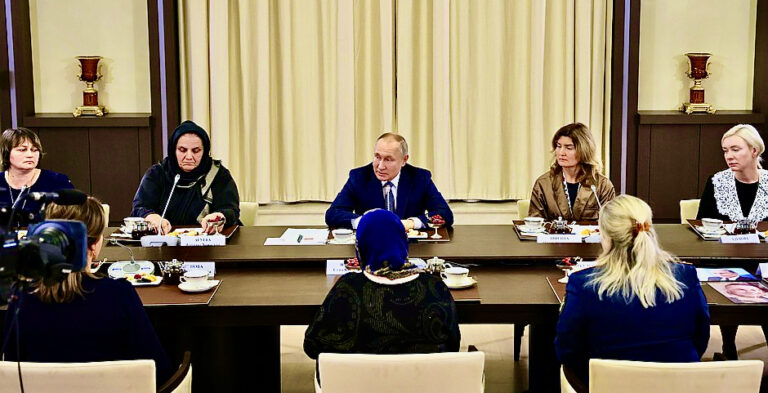
President of Russia Vladimir Putin: I believe it would be inadvisable to storm this industrial zone.
I order you to cancel it.
Sergei Shoigu: Yes, sir.
Vladimir Putin: This is the case when we have to prioritise preserving the lives and health of our soldiers and officers. Of course, this is our constant priority, but even more so in this case. There is no need to penetrate these catacombs and crawl under these industrial facilities.
Seal off the industrial zone completely.
Sergei Shoigu: Yes, sir.
Vladimir Putin: You must offer all those who have not laid down their weapons to do so. Russia guarantees them their lives and dignity as per the relevant international legal instruments. All the wounded will get medical assistance.
You successfully completed the combat effort to liberate Mariupol. Let me congratulate you on this occasion, and please convey my congratulations to the troops. I am also asking you to submit proposals on bestowing state decorations on the service personnel who distinguished themselves. Of course, as usual, there will be various decorations, but I want everyone to know that they are all heroes for us and for all of Russia.
In this context, we need to make sure that we fulfil all the social commitments to our service personnel, especially the wounded and the families of our fallen comrades.
However, I believe that this would not be enough. We have to do more and come up with additional support measures, and in some case to consider ways of perpetuating the memory of those of our comrades who displayed heroism and sacrificed their lives so that our people in Donbass live in peace and to enable Russia, our country, to live in peace. These people deserved this by what they did and the way they honoured their oath.
I am asking you to work on this matter within the Defence Ministry, while I will issue the corresponding instructions to the Presidential Executive Office. I will talk to my colleagues in the regions, and they will work with the municipalities across Russia.
Assuming control over Mariupol, a major city in the south of the country, is obviously a success. Congratulations.
The Andrews Labor Government is laying the groundwork for more housing to support workers in Ararat, creating jobs and supporting the region as it continues to grow.
Minister for Regional Development Mary-Anne Thomas today visited the Ararat East Development Zone to view works underway and meet with workers who have moved to town as part of a resettlement program.
Both initiatives are backed by a $1.88 million investment from the Labor Government’s Regional Workforce Pilots.
Ararat is one of four sites across the state to benefit from the pilots, designed to test solutions to workforce shortages that threaten economic recovery and growth.
A lack of housing is a key driver of shortages, with Ararat rental vacancies falling from 1.5 per cent in March 2020 to 0.3 per cent in February this year.
In the past two years, the region’s job vacancies have risen by 123 per cent. Works at the Ararat East Development Zone will create homes for up to 317 people.
The Government has provided $950,000 towards the project which is set to support 134 jobs during the construction phase. Ararat Rural City Council has also contributed $300,000 to the project.
Ararat is also home to a worker resettlement program which is backed by $650,000 in funding – a partnership between Ararat Rural City Council and the Wyndham Community and Education Centre to support new migrants by connecting them with community services, housing, and local employers.
A coordinator role has also been developed and will provide local support for the resettlement program and the participants involved.
The pilots support other existing Government investments designed to create more jobs and attract more workers to the region, including the Opportunities Pyrenees, Ararat and Northern Grampians (OPAN) project.
This project has been supported by $550,000 funding through the Central Highlands Regional Partnership, which involves mapping existing and future housing and skills shortages to support business needs.
In nearby Stawell, the Regional Infrastructure Fund supported the Sloane Street Housing Project with $500,000 for the development of essential infrastructure to enable the construction of more than 100 homes.
The initiatives build on the Government’s historic $5.3 billion Big Housing Build to construct more than 12,000 new secure and modern, social and affordable homes throughout the state – with $1.25 billion being invested in regional Victoria.
Quote attributable to Minister for Regional Development Mary-Anne Thomas
“We understand that workforce and housing shortages are a real issue in Ararat – which is why we are investing in a range of initiatives while supporting migrant workers to settle in town.”
Trump Media & Technology Group CEO Devin Nunes joins Newsmax’s Chris Salcedo to discuss Big Tech censorship and provide an update on the latest technological development made to Truth Social on April 21, 2022 Watch Video Below👌
What exactly is Truth Social’s “Big Tent” approach?
Think of a giant outdoor event tent at your best friend’s wedding. Who’s there? The combination of multiple families from all over the United States, and the world. Uncle Jim from Atlanta is a proud libertarian. Aunt Kellie from Texas is a staunch conservative. Your cousin John from California is a die-hard liberal. And guess what? They’re all together to have an amazing time and share their different viewpoints on the world. Although we don’t always agree with each other, we welcome these varied opinions and the robust conversation they bring.
Truth Social on iPhone
Let your voice be heard. Sign up, join the conversation, and share your unique opinion by posting a Truth, Re-Truth, photo, news story, or video link to communicate with your friends, customers, and the world. Stay informed about breaking news while staying directly connected with the people who influence you – don’t be shocked if they take your Truth viral!
Key Features
Profile – Express your unique personality by setting up a profile, avatar, and background. Begin to track your personal connections through follower and following counts as well as history for your posts and likes.
Truth Feed – Get the scoop on the latest thoughts and activities from the people, organizations, and news outlets that interest you. The Truth Feed contains posts from all those you follow brought to life with the help of thumbnail photos, links, and more.
Search – Truth Social really starts to become interesting as you connect with others. Search for a voice that you find interesting and easily follow them right from the search list or view their profile first before deciding.
Notifications – Stay engaged as you build a following. See who’s following you and who’s interacting with your Truths.
More than a year after COVID-19 vaccines became widely available in nursing homes nationwide, the facilities have gone a long way toward blunting the virus’s threat to their most vulnerable residents.
Today, 88% of nursing home residents and 89% of employees are fully vaccinated, outstripping the rate among the general public. Even as cases soared to record levels in January with the rise of the omicron variant, the death rate of nursing home residents was a fraction of what it was during the surge at the end of 2020.
But with the pandemic now in its third year, thousands of workers have found a way to avoid getting vaccinated, claiming what experts say are questionable medical exemptions from a federal mandate for health care employees, which went into effect this year.
Although few reasons exist for claiming a medical exemption, nearly 20,000 nursing home workers nationwide, or about 1 in 100, have obtained them, according to a ProPublica analysis of federal data. That rate is three times that of nursing home residents, a notably vulnerable group, who didn’t get the vaccine for medical reasons.
Dr. Jana Shaw, a pediatric infectious disease specialist at SUNY Upstate Medical University in Syracuse who studies vaccine hesitancy, said she thinks medical exemptions are being abused. “Previous research has shown, as we started mandating vaccinations, people will find avenues to get out of the obligation of getting vaccinated,” she said.
For every million doses of the vaccines available in the U.S., there have been fewer than six incidents that were serious enough to warrant not getting the vaccine, the Centers for Disease Control and Prevention found.
The consequences of an unvaccinated staff can be deadly. A recent study by a group of U.S. university researchers found that higher vaccination rates among nursing home employees could have reduced COVID-19 deaths among residents by nearly one-half during a two-month period last summer. The virus has now killed more than 150,000 nursing home residents and staff since the pandemic began.
About 1.7 million of 1.9 million nursing home workers across more than 15,000 U.S. facilities have gotten fully vaccinated since the shots became available in early 2021, according to CDC data as of late March. Since the announcement of a federal mandate for health care workers, more than 500,000 of those workers got their vaccinations, raising the national vaccination rate from 65% in September to 89% in late March.
But staff vaccination rates vary by state and by facility. One in six nursing facilities has a vaccination rate of less than 75%, according to CDC data. Nursing homes in Rhode Island, for example, have a vaccination rate of 99%; nursing homes in Montana have a vaccination rate of 77%.
The number of staff members who have claimed a medical exemption, meanwhile, has increased from about 9,400 when the mandate was announced to just under 20,000 as of late March. The data is self-reported by nursing homes and may contain some errors.
Many of the employees claiming medical exemptions cluster in the same nursing homes: In 27 of Ohio’s more than 900 nursing homes, over 15% of employees have claimed medical exemptions — more than in any other state. And in California, where only 4% of the state’s nursing home workers are unvaccinated, 23 facilities have claimed exemptions for 15% or more of their staff.
In more than a dozen facilities, a third to a half of the staff members have said they have a medical reason to forgo getting vaccinated. Those clusters have raised questions among scientists, said Tim Leslie, a researcher at George Mason University who has studied vaccination rates.
“That suggests some level of organization to achieve that outcome,” he said.
The CDC recommends that even people who had a nonserious allergic reaction to a dose of the COVID-19 vaccine take the full course. Only those with truly life-threatening allergies to the vaccine or one of its ingredients should avoid it, the CDC has said.
A far larger group — 164,000 workers — has declined to get the vaccine for another reason, which can include a religious objection. The federal government doesn’t track the number of religious exemptions.
Between medical exemptions and workers who refuse the vaccine for other reasons, more than 1 in 5 nursing home workers in Montana, Wyoming and Ohio have yet to get vaccinated — the highest rates in the country, according to the CDC data.
In a statement, the American Health Care Association/National Center for Assisted Living, which represents long-term care facilities, said nursing homes are committed to getting their employees vaccinated. It noted that unvaccinated workers must take precautions to prevent the spread of infection.
“Each hesitant staff member has their own unique reason(s) for choosing not to get the vaccine,” the statement said. “Despite rampant misinformation spreading online, the industry has made significant progress. We have found that it takes a multi-pronged, persistent approach to help increase vaccination rates.”
Facilities with unvaccinated workers face graduated penalties that could result in losing federal funding as a “final measure,” according to the Centers for Medicare and Medicaid Services, the federal agency that regulates nursing homes. The agency has the data to identify facilities with unusually high rates of medical exemptions, but it has instructed state inspectors to review the exemptions only during routine visits rather than during special inspections. It could be months before visits are made to some facilities.
CMS has told inspectors not to examine religious exemptions.
The gaps in vaccination, the potential abuse of exemptions and the current enforcement program have advocates for residents concerned that too many nursing home workers will remain unvaccinated.
“If you don’t really believe it should be a mandate, don’t make a mandate,” said Tony Chicotel, a staff attorney with California Advocates for Nursing Home Reform. “If you do think it should be a mandate, then enforce it.”
In a statement, a CMS spokesperson said that the agency “remains pleased by progress to-date” and that its goal is to bring nursing homes into compliance rather than discipline facilities. It said, too, that exemptions “could be appropriate in certain limited circumstances.”
“No exemption should be provided to any staff for whom it is not legally required or who requests an exemption solely to evade vaccination,” the statement said.
At least one facility has been cited by state regulators for an employee claiming a false medical reason to forgo the vaccine. Inspectors issued a deficiency to Premier Washington Health Center in Washington, Pennsylvania, after an employee obtained a medical exemption for multiple sclerosis. The condition is not among those the CDC lists as qualifying for an exemption; the employee was later granted a different exemption, according to the state’s inspection report.
Officials at Premier Washington did not respond to requests for comment.
In Michigan, 20 facilities that until initially reported large numbers of exemptions are operated by NexCare WellBridge Senior Living, which has 26 nursing homes in the state, according to its websites. The company reported that more than 500 of its roughly 3,300 employees had claimed a medical exemption as of Feb. 27. Only 32 residents in those facilities didn’t get the vaccine because of medical reasons as of that date.
The company revised its data after ProPublica questioned it. The company’s facilities are now reporting 54 medical exemptions across 10 facilities; 16 facilities are now reporting no medical exemptions.
Holli Titus, a company spokesperson, said in a statement that exemption requests “are not indicative of the nursing home, but of our country’s (and certain regions’) overall vaccine hesitancy.”
“NexCare and WellBridge remain confident that state surveyors will find our vaccination records in order and in compliance with federal regulations,” she said, adding later that the reporting process for vaccinations “caused confusion” among nursing home companies. The company “will continue to evaluate the reporting process and make adjustments if more clarification becomes available.”
Leslie, the health researcher, said people who are reluctant to get vaccinated will seek ways around the mandates. He observed this among California schoolchildren after the state in 2015 eliminated a personal-belief exemption for vaccines kids must get to attend school. The following year, the rate of medical exemptions nearly tripled, according to his research.
Leslie found that the increase was even higher in counties that had previously reported the highest rates of personal exemptions, suggesting that some parents who were hesitant to get their children vaccinated had found physicians willing to grant them medical exemptions.
“We were surprised at the level of medical exemptions, and we were concerned that they had turned into another avenue for hesitant parents,” he said.
The nation’s nursing homes will soon face another challenge: waning immunity of those who have received COVID-19 vaccines. The U.S. Food and Drug Administration has authorized second boosters for people 50 and older and for some immunocompromised adults. But many nursing home staff members and residents still have not received their first booster shot.
Only 44% of nursing home employees have received a booster shot, driven in part by delays in their initial vaccinations. In contrast, 69% of nursing home residents have received their first booster.
In its statement, CMS said that it considers workers who have completed the initial vaccine series to be fully vaccinated, a definition the CDC also uses, and that boosters remain optional. It did not say if it would require boosters in the future.
Dr. Brian McGarry, a health services researcher at the University of Rochester Medical Center in New York who has studied the effectiveness of COVID-19 vaccines in nursing homes, called lags in administering boosters to residents a “policy failure,” especially when compared with previous efforts to quickly get residents vaccinated in early 2021.
“The right time to do it would be before the omicron wave, and we missed the boat on that,” he said.
With that wave fading, most U.S. cities have relaxed coronavirus restrictions, even as experts warn that a more transmissible subvariant has become the dominant strain. That is prompting fears that another surge is looming.
“The mandate was the last push,” Shaw, the New York physician, said. “I don’t think we have much more left.”
Albanese has dropped Labor’s pledge to boost Jobseeker. With unemployment low, is that actually fair enough?
One of the first things Labor’s Bob Hawke did on being swept to office in March 1983 was to lift the unemployment benefit in April, seven weeks later, without even waiting for his first budget.
One of the first things Labor’s Anthony Albanese did during the first week of this election campaign was to let it be known that Labor was no longer committed to lifting the unemployment benefit at any time up to and including his first budget.
A promise to review the payment made in the last election by then Labor leader Bill Shorten was no longer operative.
Hawke’s 1983 increase was the first of many. Over 12 years the Hawke and Keating governments lifted the real value of unemployment benefits 27%.
Albanese said last week Labor had no plan to lift what is now called JobSeeker in its first budget. Government debt was “heading toward a trillion dollars”.
The single rate of JobSeeker is A$642.70 a fortnight, about $46 a day.
Is JobSeeker enough?
Some JobSeekers get more. Single parents and those aged 60 and over who have been on payments for nine months can get up to $691 per fortnight. Partnered jobseekers can get $585.30 each.
There is also a small Energy Supplement of 63 cents to 86 cents per day, and rent assistance offering single people renting privately up to $145.80 per fortnight and renters sharing with other people up to $97.20 per fortnight.
And for some months during the pandemic the temporary Coronavirus Supplement introduced in March 2020 almost doubled the base rate.
Calculations by the ANU Centre for Social Research and Methods suggest this cut the share of Jobseeker recipients in poverty from 67% to just under 7%.
But the boost was short-lived. By 2021 the supplement had been removed entirely and replaced with a much smaller increase of $50 a fortnight.
Research by Anglicare found that, while it lasted, the supplement allowed families to pay rent, access nutritious food and avoid emergency relief services
As shown in the chart, that $50 a fortnight has done little to redress the extent to which the living standards of people on unemployment benefits have been falling behind. For the last three decades, they have done little more than increase in line with prices, while the living standards of wage earners have grown strongly.
The base rate has fallen from 84% to 66% of the poverty line, defined as half the median income over that time, even taking account of the latest increase.
And Jobseeker has also fallen further behind the minimum wage
Even for those able to receive the maximum rate of rent assistance, unemployment payments have fallen from 57% of the net minimum wage at the start of the 2000s to 50% now. This is on top of a fall of four percentage points during the 1990s.
This makes it difficult to make a case that unemployment payments are generous enough to discourage jobseekers from seeking the minimum wage.
Compared to the high-income countries Australia normally compares itself with, the JobSeeker “net replacement rate” is low, about the lowest in the OECD.
The net replacement rate is the assistance provided to a single person aged 40 who has been unemployed for two months as a proportion of the average wage.
Australia’s minister for social services has argued these comparisons are not relevant, because Australia’s social security system is based on different principles than those in most other countries.
Australian income support is unrelated to previous earnings. This is correct, but it does not change the fact that when Australian workers lose their job, their income drops by far more than workers in other OECD countries.
Moreover, when the government announced the $50 a fortnight increase in February 2021, the prime minister justified it by saying that this would move the replacement rate back to where it had been under the Howard Government.
It would be:
41.2% of the national minimum wage, which puts us back in the realm of where we had been previously
While this is similar to the replacement rate at the end of Howard’s term, it is nothing like the replacement rate at the start of the term.
But unemployment has fallen…
At just 4%, unemployment is now much lower than the 5.2% that prevailed at the time of the 2019 election when Labor promised to review JobSeeker.
But the number of people receiving Jobseeker and Youth Allowance (Other) is actually higher than it was back then; there were 935,000 people receiving these payments in February 2022, compared to 765,000 in May 2019.
The reasons for this difference are complex, but a significant factor is that a very large share of people receiving unemployment payments are not required to seek jobs and have a reduced capacity to work.
Among them are people whose access to the disability support pension has been cut and Australians who would have been of pension age before the age was lifted.
What would Labor actually do?
On almost any measure, JobSeeker is too low, as the inquiry promised by Labor in 2019 would have discovered.
those who work hard to create a better life for themselves. Labor is the party for those who want to get ahead, as well as the party of compassion for those doing it tough
It goes on to pledge that
Labor will make sure people who are looking for work get the financial support they need to live a life of dignity through a strong social security system as well as the support they need to find and keep a job
This offers some hope, but, unlike in 2019, no guarantees.
Dog owners are reminded of the dangers of feeding their pet chocolate over the coming Easter long weekend.
Minister for Agricultural Industry Development and Fisheries and Minister for Rural Communities Mark Furner said while the Easter break was a great time for families, the family pet could suffer if allowed to eat Easter treats.
“Even a small amount of chocolate can make our dogs very sick,” Mr Furner said.
“It contains the substance ‘theobromine’, which affects a dog’s nervous system and heart and can cause extreme distress.
“Darker chocolate has more theobromine than milk or white chocolate, and large amounts of chocolate can actually be life-threatening to dogs.
“Small dogs are at a greater risk, but all breeds can suffer violent reactions including restlessness, hyperactivity, trembling, vomiting, diarrhea, increased heart rate and seizures.
“Parents should ensure that their children understand this and not be tempted to share Easter chocolate with the family dog.
“Dogs can be very opportunistic, so it’s important to keep opened chocolate out of their reach.
“If you think your dog has eaten chocolate, seek immediate veterinary advice.”
Source: Minister for Agricultural Industry Development and Fisheries and Minister for Rural Communities
French election: as Marine Le Pen makes it to second round, the left-wing vote is what troubles President Emmanuel Macron
THE CONVERSATION
After the first round of the 2017 presidential election in France, economist Thomas Piketty suggested that while there were four candidates on very close scores at the head of the field (Emmanuel Macron, Marine Le Pen, François Fillon and Jean-Luc Mélenchon), in reality France was divided into three political camps: a socialist and more-or-less eurosceptic left, a pro-European and liberal centre and right, and a nationalist far right. The results of the first round for this year’s presidential election suggest he was right.
You can listen to more articles from The Conversation, narrated by Noa, here.
Despite a poor campaign, centrist president Macron has emerged in first place, with 27.8% of the vote – three points up on 2017 and better than final opinion polls predicted.
Macron hoped that a late entry into the official campaign, leaving six weeks of playing the president-candidate, would allow him to use his management of the pandemic as a platform and focus on the electorate’s key concerns – the cost of living and pensions reform. The Ukrainian war got in the way, with Macron focusing too much on being president and not enough on being the candidate. A brief burst of rallying round the flag saw him surge past 30% before dropping back to a predicted score around 26%. Every vote above that on Sunday will have been seen as a bonus.
Less is more
By contrast, the general view is that Le Pen ran a good campaign – not the best, but good – by focusing less on the far-right aspects of her programme and instead posing as the candidate speaking for the economically hard pressed, struggling to make ends meet. This also meant, paradoxically, making less of an effort to look like a president in waiting and putting her pro-Putin past (and present?) to one side by simply refusing to address it. Local and low-key were the watch words and they have worked, lifting her from 21% in 2017 to 23.15% now. But the score is nevertheless a disappointment.
Le Pen’s cause has benefited enormously from the presence of the other far-right candidate, Eric Zemmour. His outspoken campaign helped her seem more moderate even though she isn’t. But Zemmour’s low score of barely 7% suggests that Le Pen might not pick up as many votes from his departure from the race as she might have hoped. Even throwing in the 2% of the vote garnered by Nicolas Dupont-Aignan (another far-right candidate) and part of the vote for the mainstream right’s Valérie Pécresse suggests Le Pen will come up short again in the second round.
The death of the French right?
Pécresse’s tailspin has been a key subplot of the election. When she won the nomination for the mainstream right-wing Les Républicains last December, she was touted as a significant threat to Macron, but her campaign tanked. In the end, she sunk as low as to drop below the 5% vote threshold at which candidates get half their election expenses reimbursed by the state. On reflection, that Pécresse came away with just 4.8% isn’t so much of a surprise. Les Républicains is still a party full of heavyweights who are still household names, but most are throwbacks to the Nicolas Sarkozy years and votes these days are routinely lost to the parties led by Macron and Le Pen in both local and national elections.
The votes still in play
The award for the best performance goes to Jean-Luc Mélenchon, the left-wing La France Insoumise candidate who hauled himself past Pécresse and Zemmour to 21.95% (19.9% in 2017), despite hovering around 12-14% for much of the campaign. There was even a point late on Sunday evening when he very nearly closed the gap with Le Pen.
This is a remarkable achievement, suggesting the French left is not dead. Mélenchon remains divisive, but while he is not naturally a man to bring together the various factions of the left under his leadership, he has rallied their voters. The big question now is whether his voters will turn out to vote for Macron. Other left-wing candidate Anne Hidalgo and the Green party’s Yannick Jadot have asked theirs to do so but Mélenchon has not followed suit. As in 2017, Mélenchon has not declared himself for Macron, but instead flipped the question around. “Not a single vote for her” is the line.
This is why everything is still in play for the second round. The old certainty of republican discipline to block the far-right seems less sure. Many left-wing voters find Macron unpalatable at best. Turnout therefore becomes a key pressure point in the two weeks ahead. There may not be a concern that many left-wing votes would go to Le Pen but Mélenchon’s position means that Macron will have to give those voters a reason to turn out for him rather than stay at home.
By the same token, however, Mélenchon has little to gain, even in the general election that follows in June, from being the man who made Le Pen president. The stakes could scarcely be higher.
On to the second round
Now Macron and Le Pen will face off in the second round on April 24. Le Pen’s team has planned a very different itinerary to 2017. Less frenetic, fewer personal appearances, a period of rest before the head-to-head election with Macron.
The president’s handlers, meanwhile, will be hoping that without the noise of the first-round campaign, he can make his programme audible and intelligible, while reining in his alarming tendency to put his foot in his mouth. The margins are too tight for Macron to go, in his vocabulary, pissing anyone else off.
President of Russia Vladimir Putin: Colleagues, good afternoon.
Today’s agenda focuses on the situation in the aviation industry. We have long wanted to discuss these issues holistically, and today we will talk about it in more detail. However, I would like to begin with something we discussed last week..embed-container { position: relative; padding-bottom: 56.25%; height: 0; overflow: hidden; max-width: 100%; } .embed-container iframe, .embed-container object, .embed-container embed { position: absolute; top: 0; left: 0; width: 100%; height: 100%; }
Today I signed an Executive Order establishing the rules for trading Russian natural gas with so-called unfriendly states. We have offered our counterparties from these countries a clear and transparent procedure. To purchase Russian natural gas, they will have to open ruble accounts with Russian banks to be used to pay for gas distribution starting tomorrow, on April of this year.
If no payment is made, we will consider this a default on the part of the purchaser – with all the ensuing consequences. No one sells us anything without payment, and we are not doing charity either. This means the current contracts will be suspended.
I emphasise this again – in a situation where the Western countries’ financial systems are being used as a weapon, when companies from these countries refuse to fulfill their contracts with Russian banks, enterprises, and individuals, when our dollar and euro assets are frozen, it makes no sense to use those countries’ currencies.
In fact, what has been happening? We supplied resources to our European customers – in this case, gas. They received it and paid in euros – which they later had frozen. Thus, we have reasons to believe that some of the gas supplied to Europe was essentially provided free of charge.
Obviously, this cannot continue, especially considering that, should we continue to supply gas under the same process, euro or dollar payments could once again be blocked. This development is quite possible, especially given that some Western politicians have been talking about it publicly. Moreover, EU heads of governments have been suggesting similar approaches. This kind of risk is, of course, unacceptable to us.
If we look at this issue from a general perspective, converting to gas payments in Russian rubles is an important step towards reinforcing our financial and economic sovereignty. It has been our long-term plan to consistently and gradually move in this direction, increasing the share of national currency transactions in foreign trade – that is, in our currency and the currency of our reliable partners.
You may have already heard that many long-time energy suppliers in the world market are also talking about diversifying transaction currencies.
To reiterate, Russia values its business reputation. We fulfill and we will continue to fulfill our obligations under all contracts, including our gas contracts. We will continue to supply gas as agreed and, I would like to stress, at the rates specified in the effective long-term contracts.
I want to stress that these rates are several times lower than the current rates on the spot market. What does this mean? In simple terms, Russian gas means cheaper energy, heat and power in European homes, affordable fertilisers for European farmers and, consequently, cheaper food. Finally, it means higher competitiveness for European companies and higher wages for European citizens.
However, judging by the statements made by some politicians, they are willing to disregard their citizens’ interests so they can enjoy the good graces of their overseas master and overlord. This is the opposite of populism. People are urged to eat less, put on more clothes, and use less heating, give up on travel – presumably for the benefit of the people who are demanding this kind of voluntary deprivation as a sign of some abstract North Atlantic solidarity.
This is not the first year that we have been observing such questionable approaches and actions in the economic, energy and food policy of the Western countries.
Incidentally, the food crisis will inevitably be followed by another one, another wave of migration, primarily to the European countries.
Regardless of this, the decisions that are being made, one after another, are pushing the global economy towards crisis. They are leading to the disruption of production and logistics chains, an increase in global inflation and the aggravation of inequality, to a decline in the living standards of millions of people, and to the tragedy of mass famine in the poorest countries, as I have just said.
Naturally, the question arises: Who is responsible for this? Who will be held accountable for this?
Obviously, the United States will again try to resolve its problems – just its own problems – at the expense of others. In part, it will trigger a new wave of emission and budget deficits. The deficit has soared enormously and inflation is setting records in both the leading European countries and in the United States. In the process, they are trying to blame us for their own economic mistakes; they are always looking for someone to blame. This is perfectly clear, we are aware of this.
I would add that the United States will also try to make money on the current global instability, as it did during WWI and WWII, and its aggressions against Yugoslavia, Iraq and Syria, to name a few. Global markets are falling while the stock value of the companies from the US military-industrial complex is going up all the time. Money is flowing away to the United States, depriving the other regions of the world of development resources.
Attempts to do everything possible to push Europe towards expensive American liquid natural gas fall into the same category. As a result, the Europeans are not only compelled to dip into their pockets but actually to undermine the competitiveness of European companies with their own hands, to remove them from the global market. For Europe, this means large-scale de-industrialisation and the loss of millions of jobs. Another consequence is a drastic reduction in living standards against the backdrop of price increases on food, petrol, electricity, housing and utilities.
This is the price the ruling Western elite are telling people to pay, as I said, for their ambitions and short sighted actions – both in politics and the economy, including the economic war that they are trying to unleash, or in fact have already unleased against Russia.
This did not start just now, nor in the past month. Illegal sanctions and restrictions have always been imposed on our country, for many years. The goal is to curb Russia’s development, undermine our sovereignty, and weaken our industrial, financial and technological potential.
I will repeat that all these sanctions have been prepared in advance and would have been imposed in any case. I would like to emphasise this point. In effect, these are sanctions against our right to freedom, to be independent, to be Russia. They are imposed because we do not want to dance to their tune and to sacrifice our national interests and traditional values.
The “collective West” does not seem willing to abandon its policy of economic pressure on Russia. Moreover, it is certainly going to try to find more reasons for sanctions, or rather pretexts. One can hardly count on any change in their approach, at least in the near future.
In this regard, I am asking the Government, the Bank of Russia, and the regional governments, to consider this while planning their systemic efforts to promote economic growth and support specific sectors, to keep in mind that the sanctions are not going anywhere, just like in previous decades. Such is the objective reality.
What I would like to note here, and I want you to bring this to all your colleagues’ attention, when reviewing each specific industry or sector, we need to focus not only on overcoming the challenges of this year, but also work out long-term development plans based on the internal capabilities of our economy, on Russia’s science and education systems. We must primarily rely on private business initiatives and healthy competition, striving to maximise the employment of our industrial facilities, to develop new competencies and generally increase Russia’s international competitiveness.
At the same time, to make sure that the economic policy is effective, we need to look at key indicators like the preservation and creation of jobs, the reduction of poverty and inequality, the improvement of people’s quality of life, and the availability of goods and services. We also focused on these indicators when we were discussing the situation in construction and housing last week.
Today we will continue the series of industry-related meetings. As I have said, the aviation industry is on our agenda today, which plays a crucial role in the development of Russian industry, its high-tech areas. It is certainly of particular importance for transport services, which ensure the connectivity of the regions of our vast country.
Allow me to remind you that Russian air carriers and aircraft manufacturers were among the first to feel the consequences of the improper decisions by the Western countries. A month ago, European and American companies unilaterally refused to meet their obligations under their contracts with aviation and service companies from Russia. In fact, they deceived their Russian partners by stopping the supply, leasing, maintenance and insurance of aircraft. In addition, the European countries closed their airspace to our planes.
I will leave aside, for now, the impact of this decision on the foreign companies themselves, including damaged reputations and direct losses. I will merely note that Russian companies have fulfilled their agreements in full and were ready to continue doing so.
However, the Western countries took these steps and we must certainly respond to them. I suggest proceeding from the premise that we will not be maintaining cooperation with our former partners in the near future. We will not close ourselves off from anyone; we will not be a closed country, but we have to proceed from the realities that are taking shape.
We have every opportunity to see that Russian aviation not only overcomes the current difficulties but also receives a new impetus for development.
First, we must support our airlines so they can maintain their sustainable and rhythmic operation, to keep jobs and make air service accessible to the Russian people. As I have said, these are operational, urgent measures.
As for long-term plans, we must obviously adjust the strategy for the development of our aviation industry with reliance on our own resources and due account for the new conditions that bring a host of opportunities for Russian aircraft makers, design bureaus, and suppliers of materials, components and parts.
The share of domestic aircraft should increase drastically during the current decade (and this is, of course, an opportunity for our aircraft equipment manufacturers). Naturally, it is necessary to achieve high quality, reliability and efficiency in the process. This is also important for Russian airlines, including private companies that should also develop as dynamic and profitable businesses. Of course, this matters a lot for passengers – they must be able to buy tickets at affordable prices – something we will talk more about later – while the level of safety, comfort and services must match the highest standards. I am referring now not only to interregional flights but also to the development of small aviation and services to difficult-to-access, remote areas.
I would like to ask you today to speak in detail about solutions that will allow our industry to develop the production of a broad range of domestic aircraft. We are endlessly discussing this issue with you. It is also important to make sure that technical maintenance and aircraft repair meet the highest requirements.
Let us start working. I will give the floor to Mr Savelyev. Go ahead, please.
Vladimir Putin: A few things I would like to say in conclusion.
As I said at the start of our meeting, it is certainly necessary to support operations of the Russian air companies, but it is of fundamental importance not to do this at the expense of passengers, as our colleagues have just said. I fully share this view. This certainly should be kept in mind. It is necessary to make air tickets widely available to people and on this basis to expand the potential of air transport, rather than force people to incur additional costs.
Let me outline a specific target: this year, the volume of domestic service should grow in comparison to what it was last year, and the passenger traffic, as of the yearend – we have just discussed this and I fully agree with this figure – should reach no less than 100 million people.
Therefore, in addition to the state support measures already in effect, including the reduced-fare tickets for travel to the Russian Far East and other regions, I ask the Government to launch the large-scale programme we have just spoken about, a programme to compensate part of the air fare for domestic flights. I am referring to flights to be performed, as it was also mentioned, between April and October of this year, the most active flying period.
The Minister of Transport has just described the specific parameters of this programme (I am aware of the debates on this matter), but, of course, I suggest that we primarily be guided by this. Nevertheless, the figure that is being mentioned – 65 billion [rubles], or 47 billion, or 113 billion, since there is no unity in the Government as to how to calculate these subsidies – let us, for starters, put the figure at 100 billion. If we have in view even ten percent of the reserves, the resultant figure will be exactly 110 billion. But we should also be mindful of the fact that this money comes in with a delay, as Mr Belousov said, and so we will be able to see, during the next four to six weeks, how this programme is implemented and, if necessary, allocate additional funds as needed. But I suggest that the calculations be based on the methodology proposed by the Ministry of Transport.
The second point: many international and domestic flights for which people have bought tickets have been cancelled (we have just spoken about this). Yesterday and today, we discussed these matters with the colleagues. It is certainly necessary to reimburse these expenses. But if in previous periods, we issued certain certificates, today it is more difficult to implement this programme because many routes are closed and we will limit people’s opportunities to use these certificates. Therefore, it is necessary to hand out the money – I accept this and I ask the Government to launch this mechanism shortly.
Third, so far, we have temporarily restricted flights to certain airports in central and southern Russia. In this connection, I suggest reimbursing regional airports for their expenses throughout their forced downtime. This will make it possible to retain their personnel, and the airports will be able to resume normal operations as quickly as possible. We must also allocate funds for these purposes in full volume. As far as I understand, our colleagues did not voice disagreement on this matter.
Fourth, lease and letter of credit payments remain a substantial financial burden for the air companies. Naturally, we have to reduce this burden. Speaking of letters of credit, I support the concept proposed by the Government and coordinated with the Bank of Russia. As for the lease payments, let me remind you that a substantial share of them was supposed to be made to companies from the so-called unfriendly countries, and they have violated their contractual obligations. In this connection, I ask the Government to draft a package of measures for resolving the issue of lease payments, naturally, taking into account the national residential status of any specific leasing company.
Fifth, new air traffic trends considered, I ask the Government to approve, by June 1, 2022, a comprehensive programme for developing the air transport sector until 2030. It is important that the programme assess future freight and passenger traffic volumes, and that it specify the routes network. It is necessary to determine the number of the required aircraft and their types, as well as measures to expand maintenance and repairs, including components, tyres, etc., using this data. I would like to note that it is necessary to formalise the Russian industry’s obligations regarding the delivery of aircraft and components to Russian airlines and delivery deadlines.
It was for this reason that I asked a representative of our largest aircraft building company about it. This should be done in the near future, as soon as possible, rather than sometime in the foreseeable future.
And, of course, this programme should prioritise air traffic safety. We must stipulate an exhaustive list of measures for this purpose.
I would like to repeat that it is necessary to draft a comprehensive programme for transforming the air transport sector, together with the allocated budgetary funds, by June 2022. I ask our colleagues to strictly adhere to this deadline.
I would like to thank those who prepared today’s meeting. I ask you to heed our agreements and matters that transcended the framework of our current discussion in your work. If necessary, you should formulate these aspects in the form of separate instructions.
Now something that is not directly linked with aviation industry or not linked at all – shipping services. I would like to ask the Minister of Transport to evaluate the situation with the use of Sovcomflot vessels by Russian consignors. They have their own freight and chartering problems. Sovcomflot also has trouble using these vessels. It is necessary to combine the capabilities and requirements of Russian consignors and carriers. I ask you to analyse this matter and to submit your proposals.