Secretary Kayleigh McEnany: Hello. Sorry to keep you all waiting. Before I begin, it is day 42 of the botched New York City primary, where still there is no election results in one congressional race. This, as the New York Times notes, is due to, quote, “the deluge of 400,000 mail-in ballots,” previewing the, quote, “challenges facing the nation as it looks towards conducting the November general election with mass mail-in voting.”
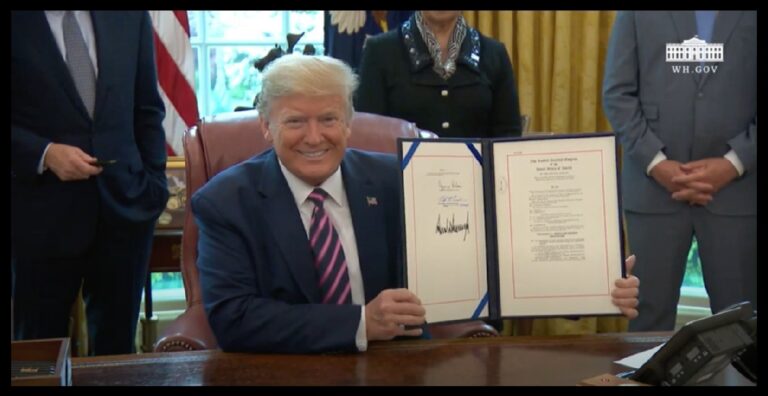
Now I’d like to highlight the Trump administration’s actions on telehealth, which the President detailed yesterday. The President signed an executive order to make regulatory reforms, allowing for greater access to telehealth and toward making it permanent.
Trump administration has cut red tape, allowing telehealth services for seniors and for other Americans. Thirty-five percent of Medicare beneficiaries took advantage of the President’s reform, seeking telehealth services over the phone rather than through video conference. A simpler and smarter way to go about things is now available to Medicare beneficiaries.
The President also took executive action to boost rural healthcare services. According to a 2019 study by Navigant, rural hospitals would be devastated by Medicare for All, otherwise known as a government takeover of healthcare. And under that analysis, they found that if Democrats had their way, 55 per cent of rural hospitals or 1,037 hospitals across 46 states would be at high risk of closure.
The President’s executive order calls for strategic investments in our rural communications infrastructure, which will expand telemedicine and rural broadband access. Democrats seek to deny Americans their healthcare freedom, but President Trump is working hard to save your healthcare by guaranteeing protections for people with preexisting conditions, eliminating the highly unpopular individual mandate of Obamacare, stopping surprise medical billing, increasing transparency, and lowering drug prices.
President Trump will continue to work hard to enact these healthcare principles by requiring price transparency; allowing states to purchase drugs from other countries, and improving Medicare to lower drug prices and reduce out of pocket costs for seniors; and by ending surprise medical billing, and making companies compete for your business by providing more options and more affordable plans.
Lastly, later today, Advisor to the President, Ivanka — Senior Advisor to the President, Ivanka Trump, will be joined by Attorney General Barr; Director of the Domestic Policy Council, Brooke Rollins; executives from organizations that combat human trafficking; and survivors from across the country for a roundtable to highlight newly awarded Department of Justice grants to provide safe, stable housing to survivors of human trafficking.
DOJ will award over $35 million in Housing Assistance Grants for victims of human trafficking to provide supportive housing and appropriate services to survivors of human trafficking.
And with that, I’ll take questions. Yes.
Q Thank you, Kayleigh. Two questions about the coronavirus. The president of the Minneapolis Federal Reserve, he said two days ago that he believed that the only way to have a real strong, robust economic recovery would be to shut the country down again for a month to six weeks.
I know that this idea of short-term pain for long-term gain has been shot down before by President Trump, but has it been given any more consideration, given the recent flare-ups across the country?
MS. MCENANY: No. And I would refer you to what Dr. Fauci said back in May. He said, “We can’t stay locked down for such a considerable period of time that you might do irreparable damage and have unintended consequences, including consequences for health.” And several of those consequences I’ve outlined for you before. For instance, the fact that, in any given year, you have 120,000 Americans who die from drug overdose or suicide. And we saw during the lockdown previously that we saw overdoses nationally jump by 18 percent in March and 29 percent in April, 42 percent in May.
Overdoses do go up, suicides do go up, cancer cases are missed, as Dr. Scott Atlas has pointed out that, “In the U.S. alone, there are 150,000 new cancer cases that arise every month among patients…most have not been seen.” And that was referring to the lockdown.
The American Cancer Society also noted that, during the pandemic, they’ve seen an 80 percent drop in cancer cases being identified.
So there are many health consequences. Those are three of what are a long list.
Q But — so no matter how bad it gets, you don’t think there’s any way that President Trump would look at a nationwide lockdown?
MS. MCENANY: I’m certainly not going to engage in hypotheticals, but, no, the President is not considering a national lockdown. What he is encouraging is mitigation efforts like wearing a mask, which is patriotic; like social distancing; and engaging in these really commonsense, safe measures to safely reopen and avoid the health consequences of a lockdown.
Q Okay. And one more thing about the negotiations going on today on Capitol Hill. Given the amount of money that is involved, the amount of Americans that would be impacted by this next stimulus bill, why isn’t President Trump, more — more personally involved or at least more — more visible in these negotiations?
MS. MCENANY: Well, he is through his Chief of Staff and through his Secretary of the Treasury. He’s regularly updated. I was just in the Oval Office with him, and the Chief of Staff was updating him on that very measure.
But, right now, the Democrats are being fundamentally unserious. They’ve offered no concessions, they’ve offered no plans. If anything, they’re moving the opposite way. And to demonstrate their unseriousness: Their $3 trillion plan, they’ve now said, “Oh, it needs to be $3.4 trillion.” When the President has had a very narrow, specific focus right now, it’s extending unemployment insurance, it’s making sure Americans don’t get evicted.
And when Democrats, as I noted on Friday, were offered the Martha McSally bill, which would have been extending unemployment insurance for at least seven days while these negotiations continue, that was rejected by Chuck Schumer, which should tell you exactly where Democrats stand: and it’s against hardworking Americans who lost their jobs through no fault of their own.
Yes.
Q Thanks, Kayleigh. The President, about 10 minutes ago, tweeted about vote-by-mail, absentee voting. He says, “…In Florida, the election system is Safe and Secure, Tried and True.” What, in his view, changed? Was he advised by Republicans that he was potentially suppressing his own vote by stoking unfounded fears about mail-in voting? And will he admit now what is the fact that voting across the country by mail is
“safe and secure” and “tried and true”?
MS. MCENANY: Well, the President has always said that absentee voting for a reason is different than mass mail-out voting like what Nevada is seeking to do, which leads to mass fraud.
Q But in his tweet, he says it’s the same thing.
MS. MCENANY: And also, I’d refer you to the campaign on this, but there was a victory in Florida with regards to ballots. So I believe that’s what he was referencing. Would refer you to the campaign for details on that. But he’s been unmistakably clear that when you have this mass mail-out voting, like what Nevada wants to do, the consequences are real.
When the Las Vegas Journal-Review was reporting — did extensive and very good reporting on Nevada’s first all-mail primary election, they note that there were photos of ballots tossed in trash cans, littering apartment mailbox areas, dozens pinned on the complex’s bulletin boards in various apartment complexes, and you have a postal worker who said that when she went to go deliver some of these ballots, in several cases, people had moved or died. She kept 65 ballots on her first delivery, 100 on her second. It is rife with fraud and with delay, and that is what the President stands firmly against. He wants a free and fair election.
Q But extensive research shows that there is — that fraud in vote-by-mail systems is extraordinarily rare. The President votes by mail, you vote by mail, and a dozen other top Trump administration officials vote by mail.
MS. MCENANY: So, with regard to the absentee system, that’s right.
And there is ample evidence of fraud. I would point to you the best example of this and very recent was May 12th: New Jersey’s special election in Paterson, New Jersey, where one in five mail-in ballots were found to be fraudulent in the election. New Jersey officials were charged in that case. And resident Ramona Javier said this: “This is corruption. This is fraud.” There are eight relatives and immediate neighbors she knows of listed as having voted but who insist they never even received a ballot. There are ample examples of fraud. And we can get those to you — more than just Paterson, New Jersey.
Q Another question on different issue. What can the administration tell us about the deadly explosion in Beirut? What led to it, in your understanding?
MS. MCENANY: So that was breaking as I came out. We’re tracking it closely. And just rest assured that we’re taking a very good look at that.
Yes.
Q Kayleigh, thank you. The environmental bill the President signed this morning, it was passed overwhelmingly by both houses of Congress. Both Republicans and Democrats signed on to that legislation. Can you explain why there were no Democrats at the ceremony or even mentioned in the President’s remarks?
MS. MCENANY: The President is very proud of what happened today: the single largest investment in America’s national parks and public lands in history. The most significant conservation achievement since Teddy Roosevelt. It won the support of more than 850 conservation groups. And it provides $900 million a year in permanent funding to the Land and Water Conservation Fund.
And you’re asking about recognition of congressional Democrats right now, and the only thing that we’re recognizing about congressional Democrats right now is how appalling it is that there are Americans who are going without paychecks, because they refuse to partner with Martha McSally, Republicans, and the President in ensuring that those payments go out.
Yes.
Q Kayleigh, the President has said in recent — as recently in this Axios interview, that he believes that there — that many people believe that there’s disadvantages to testing. Can you walk us through what those disadvantages are, and if, as he stated back in June, he still believes that testing is overrated and makes the U.S. look bad?
MS. MCENANY: So I would note what the President refers to with regard to testing is that — you know, the media doesn’t often acknowledge that when you do do the most testing in the world, lead the world in testing, that you do identify more cases. So that is what he refers to with testing. And he’s made that point a few times.
But, look, we lead the world in testing. The President is very proud of this. The administration is very proud of this. We’ve done more than 60 million tests. On track, according to HHS, to do 100 million by September. That’s extraordinary.
And when you compare that to the next highest number — India, in the ballpark of about 16 million tests — what we’ve done in this country is impressive. And the President is very proud of that effort.
Q But does he still believe that testing in the U.S. is overrated?
MS. MCENANY: The President, again, points out that the media refuses to acknowledge that when you test so much, you do identify more cases. That’s the point he was making. And he’s very proud that — actually, since March 12th, we have increased daily testing by 32,000 percent. Worth mentioning this is a novel virus; there wasn’t a test. And this President led the way in getting emergency use authorizations to, one, identify working tests, and then to surge the testing capacity by 32,000 percent since March 12th. And that’s thanks to President Trump.
Yes.
Q Thanks, Kayleigh. On TikTok, the President has argued that the United States should receive money in return for a potential sale, but he hasn’t really explained how. Under what authority could the Treasury collect fees from China, from Microsoft, or from any other U.S. buyer to get this done, as the President demanded?
MS. MCENANY: Okay, so I’m not going to get ahead of the President on any official action, but he has made that point. And he and both Secretary Pompeo have said that the U.S. action — that the U.S. will take action in the coming days on Chinese apps, including TikTok — TikTok, excuse me, due to the national security risk. And we all agree that there needs to be a change, especially with TikTok collecting significant amounts of private data on users. It’s unacceptable, but I won’t get ahead of the President on what those actions look like.
Yes.
Q Thanks very much. I wanted to ask, also on TikTok, about — Beijing has said that it may hit U.S. firms as a response to sort of slammed — this sma- — you know, smash and grab of TikTok. What do you say to that, in regard to China?
And secondly, China has not complied with its commitments under the U.S.-China phase one trade deal. We’re reporting today that, you know, they’ve only completed 5 percent, for instance, of the energy purchases in this first half of the year. Can you just sort of say?
MS. MCENANY: Yeah, we encourage China to fulfill their obligations in the phase one China deal and to fulfill their end of the agreement.
But the President remains keenly focused on TikTok and protecting the private data of millions of people in this country. And PRC’s, the People’s Republic of China’s, laws require Chinese companies to cooperate with PRC’s security and intelligence services, enabling the CCP to access foreign-user data. And what this means is that these entities ultimately answer to the CCP, which actively undermines U.S. interests and is hostile to American values and the rights of individuals. And the President will stand firmly against China on this.
Yes, Jon.
Q Thank you, Kayleigh. I wanted to ask you about the COVID relief bill. The President has suggested, if there is no agreement that is reached, the President would act unilaterally. As you know, the power of the purse resides with Congress. So what would the President do unilaterally? Explain what he could do unilaterally, as it relates to providing relief to American families and American businesses.
MS. MCENANY: Yeah, again, I won’t get ahead of the President on determining what that action would look like or would be. I will leave that to him to determine.
But would I say is this — is, you know, right now, we have Secretary Mnuchin and Chief of Staff Mark Meadows once again asking Nancy Pelosi and Chuck Schumer to come to the table. The ball is in their court here. We’ve made at least four offers; they’ve made zero offers. It’s unacceptable for hardworking Americans.
Q And then, Kayleigh, on mail-in voting, which you talked about at the very top of the briefing, the President suggested yesterday that he has the right to write some sort of an executive order as it relates to mail-in balloting. Can you explain what would empower the President in the Constitution to take some sort of executive action as it relates to mail-in voting?
MS. MCENANY: Again, I won’t get ahead of the President on his actions and what those actions would be, and I’m not going to get engaged in a hypothetical as to what the actions would be and what authorities they would be based upon for yet-to-be announced actions.
But just to once again underscore the President’s concern, when you look at the delays in voting in Pennsylvania — a very good report by CBS, Zach Hudak. He got a quote from Luzerne County manager, David Pedri, who oversaw — or who identified some of these delays that they saw in Pennsylvania with mass mail-in voting. And he said this, quote: “I have this nightmare of CNN, Fox, CBS, and everyone else waiting for these things to come in on election night and we don’t have them.” It is very hard to speed up this process, and Luzerne’s experience was replicated across the state.
So, as we’ve seen in Pennsylvania, as we’ve seen in New York, as we see across the country, the President is very concerned about delays and outright fraud.
Q And then one final thing, Kayleigh, on TikTok, if I may: The President said yesterday in the briefing that was — that took place right here in the briefing room — the United States “should get a very large percentage of that price because we’re making it possible.” And that was referring to Microsoft’s proposed purchase of TikTok.
I’ve never heard of that before, and maybe you could explain that to me how the government could get a percentage of a price of a private transaction. Can you explain how the President would be able to do that?
MS. MCENANY: Again, I’m not going to get ahead of the President, again, on this action.
Yes, Francesca.
Q Thank you, Kayleigh. I want to ask you something about the executive orders, but I do want to follow up on Kristin’s question and just get a better understanding of what the President is doing personally to make sure that those extra unemployment benefits are reinstated. Is he calling senators on Capitol Hill? Does he have any plans to meet with Nancy Pelosi or Chuck Schumer personally? And is the White House concerned that all parties will be blamed if there is no deal and voters will just stay home in November?
MS. MCENANY: No one has worked harder to ensure that those payments get to Americans than this administration. Chief of Staff Mark Meadows, Secretary of Treasury Steve Mnuchin have been on the Hill many, many days now, trying to get this deal worked out.
But it is Democrats, it is Nancy Pelosi, it is Chuck Schumer that are making an absolute mockery of this process. Rather than coming towards us and to a clean extension of unemployment insurance, they are moving beyond what their initial request was of $3 trillion, and then they move to $3.4 trillion. They wanted $100 billion for schools, and we offered $105 billion, to which they rejected. They are making a mockery of this process.
We’re still engaging with them, but this President has been clear: He’s ready to act on this, and it is of paramount importance to him.
Q Is he calling them?
MS. MCENANY: And again, why would you reject Martha McSally’s clean extension? Democrats are fundamentally unserious, and they’re making a mockery of the process.
Q Kayleigh, is he calling them?
MS. MCENANY: Yamiche.
Q Okay, then if you don’t want to — if you don’t want to move on that —
MS. MCENANY: Yamiche. Okay.
Q With the regards to the executive orders, the President has signed a flurry of those recently. He said yesterday that he expects to have a healthcare plan by the end of the month and also an immigration plan by next month. Does the White House feel a sense of pressure to get everything on the President’s to-do list done before November?
MS. MCENANY: No, but the President moves at a very rapid pace, and he wants to get as much of his agenda accomplished this term and going into next term. This President has done a lot already, but he will work on COVID and, alongside that, many other issues, as he routinely does.
This administration often is accomplishing items on two or three different topics in a day, as you can see today with the human trafficking, the event this morning — and then, also, I have an announcement: The President will have a COVID briefing at 5:30.
But I do want to just step back and say this, with regard to COVID: I think it’s really important to put the successes of this administration in context, and I got some new information from HHS just before I came out here. You know, this was a novel virus. There were no tests. There were no therapeutics. But what did this administration do? We, as I noted earlier, surged testing — increased it by 32,000 since March. HHS is projecting 100 million tests completed by September. Because of President Trump’s tearing down of red tape, there are — more than 230 clinical trials of potential COVID drugs and biological products are underway, and over 510 are in the planning stages. Today, NIH announced two separate COVID treatment trials, ACTIV-2 and ACTIV-3, and these are monoclonal antibody treatments.
And also, by September, we have secured more than half a million courses of treatment of remdesivir. That is one of the several therapeutics that this President has achieved in finding for the American people to treat this novel disease — this novel virus. And the vaccine, again, moving to phase three clinical trial at the fastest rate for any novel virus in history.
This could only be accomplished by President Trump — by a businessman in the White House who is not only on the race to get a vaccine — we have two in phase three clinical trial — but is securing 100 million doses in advance so that we’re ready to ship them out. This President has been hard at work on COVID, along with a number of other issues, and those EOs will be forthcoming.
Yes.
Q You called on me. Can I please go?
Q Thank you.
MS. MCENANY: (Calls on the next reporter.) Yes.
Q Israel — Israel reopened —
Q (Inaudible.)
MS. MCENANY: No, you can go ahead. I called on you.
Q Israel opened schools — Israel opened schools — Israel opened schools, and they got —
Q Please go.
Q — and they had issues with that. There were outbreaks; students got sick.
MS. MCENANY: I called on you.
Q What do you think of the fact that Israel opened schools and had to close?
MS. MCENANY: Yamiche, you — you — I had called on you, and you didn’t ask your question, so then I proceeded to call on Andrew.
Q (Inaudible) ask to speak over another reporter; I wasn’t going to do that.
MS. MCENANY: Go ahead, Andrew.
Q So do you not want to answer my question now that I was not being rude to another reporter?
MS. MCENANY: Go ahead, Andrew.
Q Okay. The President said in his interview with Axios that he was doing everything he can do to address the virus. Is that really true? I mean, is there nothing more that he can do at this point?
And also, is he willing — so does that suggest that he’s willing to accept the number of deaths that we’re seeing every day?
MS. MCENANY: No, we’re hard at work each and every day to defeat the invisible enemy. And, in fact, just to give you an update on some of the actions we’ve taken: Right now, there are currently 28,220 U.S. government personnel deployed for COVID-19 response. On top of that, next week — Dr. Birx has visited states across the country, and next week, she’ll be visiting Indiana, Ohio, Kentucky, Tennessee, and Virginia.
We’re hard at work at, again, getting more EUAs for more treatments and therapeutics and testing. So we — every day, we’re rapidly looking at how we can make this the most robust response in the history of this country. And I think that we’ve done that, when you look at remdesivir and the therapeutics at play.
And the case fatality rate is really indicative of what this President has done. When we have the lowest case fatality rate — one of the lowest in the world, below the average of the world and below Europe — that shows that our therapeutics are working: remdesivir, convalescent plasma, and dexamethasone.
This President is hard at work, and he’ll continue to work hard on this.
Q But how can you say you’re doing everything that you can possibly do when there are still waits for getting test results back; when you have declined to impose a national mask mandate; when you’re saying that you won’t shut down the entire country again?
MS. MCENANY: So with regard to testing and the timing, when we identify a problem, we quickly identify a solution. And when there were delays in testing, we immediately identified pooled testing as a way to increase the speed of testing. We already lead the world in testing, so to increase the speed, we moved towards pooled testing, and that’s the flexibility with which this administration adapts to problems we identify on the ground, and we rapidly develop a solution to ameliorate the problem.
Yes.
Q Thank you, Kayleigh. Would the President like to see Mitch McConnell put the 600-dollar extension of the unemployment benefits through the end of the year on the Senate floor to put the Democrats in the spot of having to vote for that clean extension?
MS. MCENANY: So I haven’t talked to him about that proposal, and I don’t want to get into the middle of the negotiations. But what I — it’s safe to say is there’s been one proposal — one clean proposal to extend unemployment insurance. That was put forward by Martha McSally. The President was ready to sign it, and it was rejected by Chuck Schumer and Nancy Pelosi.
Q Can I follow up and just ask on a —
MS. MCENANY: Yes, you may.
Q — on a slightly separate topic whether or not the White House has a view on whether or not members of the media, a pool, should be allowed to cover the Republican National Convention’s official proceedings in Charlotte, which apparently, as of right now, because of the space limitations, the convention committee is saying that that’s not going to be possible.
MS. MCENANY: Yeah, I’m not read into the convention discussions, but I certainly will inquire about that and follow up with you and find out what the status is.
Yeah. (Inaudible.) Yes.
Q Thank you so much, Kayleigh. Do you have anything with regards to the massive explosion in Beirut that occurred earlier?
MS. MCENANY: Again, that was breaking as I came out here, and safe to say we are monitoring the situation.
Yes.
Q Thanks for calling on me. I wanted to give my question over to Yamiche.
MS. MCENANY: Sure. That’s fine.
Q Thank you so much. So my question is — I have two questions. The first question is: Israel opened its schools back up. They thought they had the virus under control. That virus then spread and it became an outbreak. Students got sick. They had to close schools down. How worried are you that what happened in Israel might happen here, given the fact that there are experts in Israel who say they made a mistake there?
MS. MCENANY: Well, I would refer to our experts. And CDC Director Robert Redfield answered about schools on the Hill last week, and he said this: “I don’t think I can emphasize it enough, as the Director of the Centers for Disease Control, the leading public health agency in the world: It is in the public health interest [that] these K-through-12 students…” get back to schools that are open for face-to-face learning. “I want these kids back in school…It is paramount to the health of the child.”
Q And the President just tweeted to — you answered a question about this — mail-in voting or absentee voting, whatever you call it — he is saying that, essentially, it’s the same thing. So why is it now something that can be done in Florida but not in other states? Why is that the appropriate thing to do?
MS. MCENANY: He’s not saying — he’s always made the distinction: Mass mail-out voting —
Q He’s not, in his tweet.
MS. MCENANY: — is with Nevada, where ballots are mailed en masse out to the voter rolls. So in a place like L.A., for instance, where 112 percent of L.A. County is registered, ballots go out, and at least 12 percent of those we know are not active voters.
So that is the distinction from absentee voting, which is where you proactively request an absentee ballot. There’s a difference there. And the President —
Q He’s not making the difference, though.
MS. MCENANY: — the President repeatedly makes the difference. And he is also noting — as I told Jeff, you can follow up with the campaign on this — but there was a victory in the courts in Florida, and that’s what he was referencing in the tweet.
Yes.
Q Thanks, Kayleigh. You mentioned extending the eviction moratorium and the unemployment insurance. On Saturday, Trump tweeted “Payroll Tax Cut plus Dollars!” Is a payroll tax cut still on the table?
MS. MCENANY: The President would love to see the payroll tax holiday because it would, in fact, benefit low- and middle-income Americans the most. But, right now, his keen and laser focus is unemployment insurance and evictions. Those are the preeminent priority, especially with that Friday deadline that Nancy Pelosi missed.
Chanel.
Q Thank you, Kayleigh. This administration has worked to — has identified human trafficking as a crisis and has worked to combat it. The National Center on Sexual Exploitation has identified TikTok an online — online platform that enables sexual exploitation of young people, especially in America. Would this administration ever consider — if TikTok became a U.S. asset, would this administration ever consider rules or imposing rules that would help mitigate this risk against young people on the platform TikTok?
MS. MCENANY: Yeah, I haven’t spoken to the President about that specific fact scenario, but absolutely it is a priority for this administration to combat human trafficking and the exploitation of children. So we would certainly take a close look at that. But I — I have not talked to him about that specific fact pattern.
I would like to end just by highlighting a troubling trend that I think we’ve seen play out across the country, and I believe we have a few graphics to illustrate this. It pertains to the “Defund the Police” movement.
And when you look at, across the country, the ties of defunding the police with increases in violence, it’s a cause for concern. As we saw in the beginning of this administration, violent crime was starting to come down, and then bring in the “Defund the Police” movement.
In Los Angeles, you had L.A. Mayor Eric Garcetti proposing a cut of $150 million from the LAPD. L.A. Mayor Garcetti said this: “It starts someplace, and we have to say we are going to be who we want to be, or we’re going to continue being the killers that we are,” was his quote, in support of the defund movement. And as a result, we saw a 14 percent rise in homicides this year over last year.
In Minneapolis, the “Defund the Police” movement was afoot as well, with a unanimous vote in Minneapolis City and their council to dismantle the police. And you had Minneapolis City council member Jeremiah Ellison saying, “This is one action of many that we need to take on the road to a more equitable and just system that keeps people safe.” In fact, it did not keep people safe. We’ve seen a 94 percent increase in homicides compared to last year in Minneapolis.
And then, finally, in New York City, “Defund the Police” — you had the New York City Council voting to cut police budget by $1 billion. You had Congresswoman Alexandria Ocasio-Cortez saying, “Defund the police means defunding the police. It does not mean budget tricks or funny math.” So it wasn’t enough for AOC. But you did have New York City Mayor Bill de Blasio saying, “We think it’s the right thing to do.” It was absolutely not the right thing to do, as we’ve seen a 177 percent increase in shootings from July 2019 in New York.
When you defund the police, there are consequences. And that’s where the Democrats of today stand. And, unfortunately, we’ve seen a corresponding rise in violence in these Democrat cities, and it’s not acceptable.
Attribution: This article royalty-free license WhiteHouse.gov under the Creative Commons Attribution 3.0 License.