In recent weeks we’ve laid out our state’s careful plan for the gradual easing of restrictions. A cautious and considered approach that has relied on data to help guide our decisions.
Today, because of the progress we’ve made – and the evidence base we’ve built – I can confirm those proposed changes will go ahead. It also means we’re able to bring forward a number of other changes too.
From 11:59pm on 21 June, libraries, community centres and halls will be able to open to 50 people. Religious ceremonies can also increase to 50.
From next Monday, pubs and clubs will be able to host up to 50 seated patrons, with no requirement to purchase a meal with your drink, however you’ll need to give your contact details and table service restrictions will still apply. And from 20 July, TABs will band electronic gaming areas at pubs, clubs and the casino will be reopened with strict distancing, cleaning and hygiene requirements.
Recognising the lower rate of transmission amongst younger people, all sports training and competition will resume for those 18 and under. Non-contact sports competition can also begin across every age group.
Indoor sports centres and physical recreation spaces like gyms will be able to open to 20 people per space, with a cap of up to 10 per group for those over the age of 18.
Local footy teams, soccer clubs and other contact sports will be able to resume training for over 18s from 13 July. And from 20 July, full competition can begin too. Supporting this gradual return to sport, clubs and community facilities will also be able to reopen their changerooms.
The same will apply to holiday accommodation and camping sites, with communal spaces like showers and kitchens soon to be available to visitors.
In line with our previously proposed changes, and from 11:59pm on 21 June, restaurants and cafes will also be able to increase the number of patrons to 50. Cinemas, concert venues, theatres and auditoriums can open, also with up to 50 people per space.
The same increased limit will apply to our galleries, museums and amusement parks.
And from 22 June, ski season and ski accommodation will also open.
As always, timing on any future changes remains subject to the advice of our Chief Health Officer.
Because as far as we’ve come – it’s not over yet.
And for every small step we take, our own personal responsibility grows.
It’s why we’re asking Victorians: keep washing your hands. Keep maintaining your distance. Download COVIDSafe.
And if you can keep working from home – you must do that too.
We still want to limit the number of people moving around our state and help protect those who do have to go to the workplace.
We’re also asking Victorians to keep getting tested.
We’ve been able to make these changes because testing gives us the insight and information we need.
In fact, if Victoria was its own nation, our testing rates would be amongst the highest in the world.
But we can’t afford a backwards step. These changes – and any further that follow – must be determined in accordance with the data.
That’s why, in addition to ongoing testing, we’re stepping-up our targeted testing too. Zeroing in on communities with low testing rates or high case numbers.
If you have symptoms, no matter how mild, you must get tested.
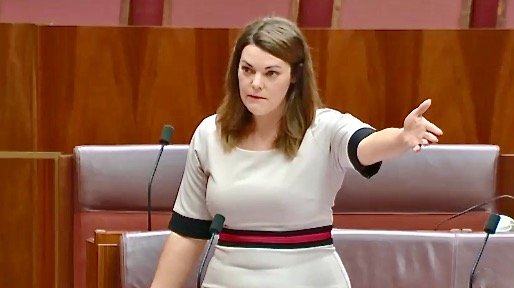
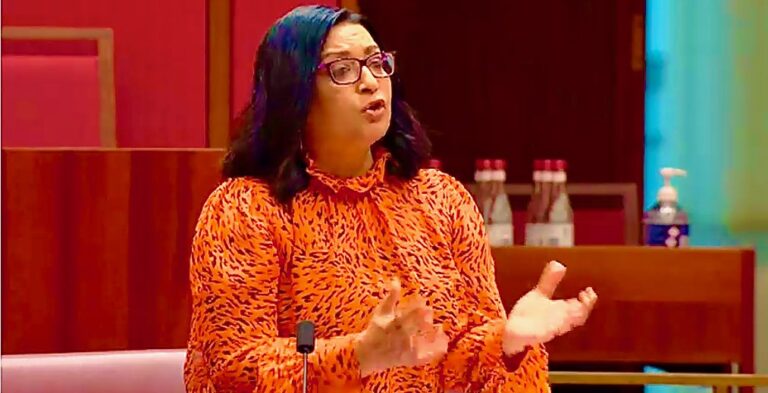
Sarah Hanson Young: Some months ago, late in the evening, when we were debating the rescue packages being put forward by the government, I stood in this place and argued that there needed to be an arts-and-entertainment-industry-specific package before more jobs were lost and before more businesses went to the wall. Sadly, that didn’t happen. Some people, of course, have been able to access JobKeeper, but many within the industry have been left out in the cold. But the big question will come in September when JobKeeper ends. The arts and entertainment industry will not be in a position come September to resume and to snap back as the government continues to insist. It just won’t be.
So several months on I’m now pleading with the government again and for all in this place to insist that the Minister for Finance, who has the ability on rules that have already been agreed to by this place and the other, fund a specific package for arts and entertainment. I understand that this is an amendment that is quite separate to the rest of this bill, but it is important, it is urgent and we are facing an arts and entertainment emergency. It’s totally lawful to do it. It’s about whether you want to.
I specifically haven’t put a figure in this amendment, because I want that to be based on the best advice that Treasury, the finance minister and the arts minister have and on what the Prime Minister is willing to cough up. This amendment requires the government to at least spend something on an industry that is going bust day after day. Every day we wait for something to be put on the table is another day another Australian artist, entertainer or creative worker loses their job. Every day we wait for something to be put on the table another business goes to the wall. Many of these businesses are small businesses. They employ a handful of people, but that is their livelihood.
Other industries have been acknowledged as needing specific support. We heard last week the Prime Minister make an announcement about the housing and construction industry. The arts and entertainment industry have lost almost one-third of their workforce. They are in desperate need of assistance and support. We can’t wait until we come back to this place in August to see movement on this. We need to do something about it today.
The Prime Minister is already on the record saying that he understands this is an issue that needs to be dealt with. Here is an opportunity to make sure that something can happen and happen quickly. You can iron out the details. You as the government can decide what figure you want to put on it. This amendment says that the parliament requires it to happen.
I appeal to the Labor Party. They’ve been quite vocal on this issue as well. Let’s make sure something actually happens. Let’s make sure that the government is required to deliver a package—not just have the Prime Minister make promises when he’s getting a few tough questions on his favourite radio show. Let’s make sure that this parliament requires the government to do something for the arts and entertainment sector. Up to this point it has been all hollow promises and nothing has come down the line. It has been over a week and still there is nothing from this government. It has been three months, and the industry has gotten in a worse situation. Hundreds of thousands of Australians are unemployed because this government didn’t act when it should have. Hundreds of thousands of Australians will remain out of work if we don’t get something done today. I appeal to both sides to pass these amendments and to get on with supporting the arts and the entertainment sector across Australia.
Chamber Senate on 12/06/2020 Item BILLS – Treasury Laws Amendment (2019 Measures No. 3) Bill 2019 – In Committee Speaker: Hanson-Young, Sen Sarah
Source and Credits: Parliament of Australia website 2020
Over seven decades ago in 1941, Isaac Asimov wrote a short story, “Reason” (PDF), in which energy captured from the sun was transmitted via microwave beams to nearby planets from a space station. Flash forward to today, scientists are looking to make that very science fiction dream a reality for Earth.
There has been tremendous research on space-based solar power (SBSP) or space solar power (SSP) since the mid 20th century. Here is a great timeline of the various international studies and projects related to SBSP.
With SBSP, we could solve our energy and greenhouse gas emission problems with little environmental impact. Professor Sergio Pellegrino of CalTech recently said an SBSP system would receive eight times more energy than Earth does. With SBSP’s continuous massive energy output capability and the fact that our sun is slated to exist for another 10 billion years, we can safely assume we will not run out of this energy source anytime soon.
One of NASA’s most extensive studies ever devised, the Satellite Power System Concept Development and Evaluation Program (PDF) was specifically on SBSP and cost over $50 million, taking place from 1976 to 1980. Another fundamental study NASA funded to re-evaluate and understand the feasibility of SBSP was the Space Solar Power Exploratory Research and Technology (PDF) program. An enormous amount of solid research was accomplished in the study, but the general conclusion was that:
Large-scale SSP is a very complex integrated system of systems that requires numerous significant advances in current technology and capabilities… A technology roadmap has been developed that lays out potential paths for achieving all needed advances – albeit over several decades… — John C. Mankins, 7 September 2000
With all that being said, let’s dive in to better understand this exponential technology and its viability.
So What Exactly Is Space-Based Solar Power?
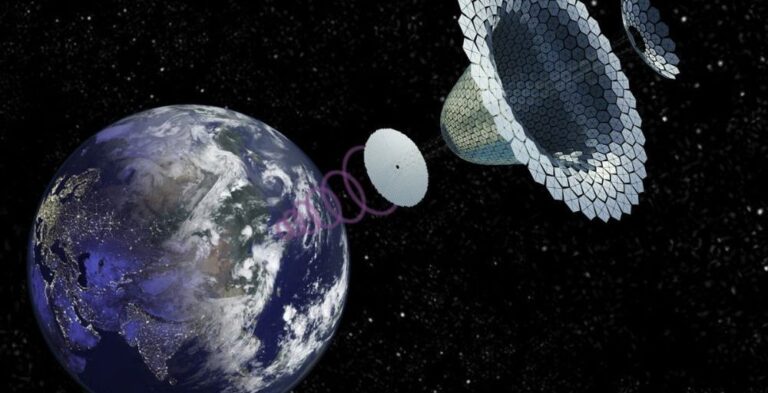
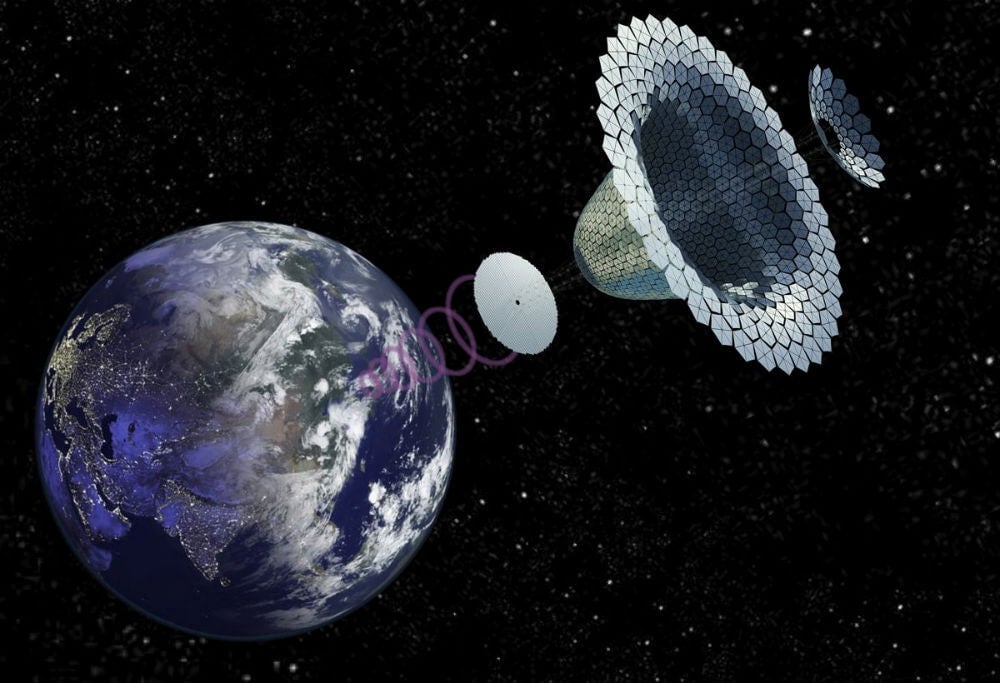
Space-based solar power is the concept of capturing solar energy in outer space and transferring it directly to Earth or other nearby planets.
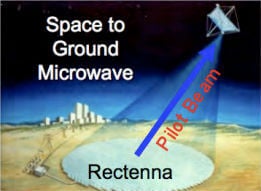
In simple terms, we would put some mechanism in outer space to capture the sun’s energy almost continuously and transmit that energy to Earth. This would happen day or night, rain or shine. Once we have received the energy on Earth at a rectenna (a special antenna for receiving energy), we can then easily distribute the power through our normal methods. Easy enough.
There are many ideas related to the SBSP mechanism configuration and architecture we could utilize. Location of the SBSP system, satellite architecture, energy collection, and energy transmission are a few basic areas to look at when understanding the different SBSP systems. Given the number of proposed concepts, we will only look at a few of the more notable options.
Location, Location, Location
Where exactly will we put this SBSP system? Geosynchronous orbit (GEO), mid Earth orbit (MEO), and low Earth orbit (LEO) are a few of the proposed choices. The most promising is utilizing GEO due to the simplistic geometry and alignment of the antenna to rectenna, scalability, and nearly constant power transmission. The main problem with GEO is the large amount of radiation exposure. General space hazards like micrometeors or solar flares also pose a threat.
Satellite Architecture
From creating lunar factories with mass drivers or mining asteroids to fabricate these self-assembling SBSP satellites, creating autonomous space-based factories is still rather challenging. Designs built in space utilizing local and free materials (e.g. lunar materials) to build these SBSP systems allow for different concepts compared to those that can be much more complex to construct on Earth.
One interesting setup we are currently ahem, building on Earth, is a modular roll out solar array being developed by Caltech and Northrop Grumman. The researchers discuss their functional prototype in the video below. https://www.youtube.com/watch?time_continue=2&v=KtNwYweL6hY&feature=emb_logo Another interesting concept is from private company Solaren. They plan to experiment in the future with building a 250 MW SBSP solar array plant in GEO. They even struck a deal with PG&E, California’s biggest energy utility company, in 2009 to provide space solar power (PDF). Solaren also maintains multiple patents and will definitely be an interesting player in this field to watch for new developments.
Even NASA’s SPS-ALPHA via Arbitrarily Large Phased Array concept (developed in 2012) has been getting some recent attention from John C. Mankins, one of the top SBSP experts in the world.
The two basic concepts related to energy collection are utilizing photovoltaics (solar panels) or solar thermal. One concept of solar thermal essentially captures solar energy by using mirrors to concentrate light and heat up a liquid. This in turn spins a turbine to generate electricity (e.g. by generating steam). This concept allows for a potential weight advantage over solar panels, as it could reduce overall mass per watt. The majority of concepts, however, look to utilize ultra lightweight and highly efficient photovoltaics in their prototypes.
Energy Transmission
Microwave power transmission is the typical choice in SBSP designs due to general efficiency, but utilizing laser power beaming is another highly regarded option due to lower weight and cost. However, there is the first initial thought of potential misuse wherein one could turn either choice into a space weapon (e.g. a death ray). Safety protocols can easily deter this unlikely threat given the technology being utilized. Designs incorporate microwave transmission power levels to be within OSHA’s required workplace exposure limits. There would be no worry of microwaving cities and all the living beings within it. A simple handshake between antenna and rectenna would disable the transmission if it came off course.
Now that we have a better understanding of what SBSP is, let’s delve into its biggest limitation.
SBSP Cost
There is always a catch. Some general safety issues were noted above, but the main impediment is related to the cost in sending all the materials required for the SBSP.
Current cost estimates to send roughly 1 kg of payload into space vary from $9,000 – $43,000 depending on the rocket and spacecraft utilized.
If we look at sending up solar panels alone, the low end of the spectrum for launch costs of an ultra-lightweight 4 MW SBSP system is 4,000 metric tons (per Wikipedia). However, Energy.gov estimates a SBSP to be more likely in the 80,000 metric ton range.
Low cost: 4,000 metric tons (4M kg) x $9,000 launch cost per kg = $36,000,000,000
High cost: 80,000 metric tons (80M kg) x $43,000 launch cost per kg = 3.44×10¹² or $3,440,000,000,000
While these numbers are not totally accurate to state-of-the-art systems and are simply an estimate, we are still looking at a very rough low cost of $36 billion up to a slightly more expensive cost of $3.4 trillion. Utilizing a lunar or asteroid factory suddenly seems within budget.
NASA’s SERT study results show that space solar power is “economically viable” if recurring launch costs range from $100 – $200 per kg of payload. While prices continue to fall thanks in part to SpaceX’s reusable rockets, there is still a long way to go. Nonetheless, this trend will follow Ray Kurzweil’s Law of Accelerating Returns and the prices of these launches will continue to come down, from billions to millions to thousands and, finally, into the hundred-dollar range.
Needless to say, it is not the tech that is the problem, it is the cost.
The Future of Solar Energy
SBSP’s ability to provide clean, reliable power for the planet 24/7 at a cheaper cost than any other energy source is real. It will take decades of investment, building, testing, and successful implementation before the system can begin to recoup its initial costs.
Isaac Arthur explores this concept in this incredibly informative video, and looks beyond the next decade of where this exponential technology can take us.
Nonetheless, one key component to moving SBSP forward as the de facto energy source is the right political climate, including leaders to drive this innovation. Bruce Dorminey from Forbes sums up this general sentiment to any future world leaders by stating:
If President Trump were to champion space-based solar energy as a means of delivering unlimited, renewable electricity from Earth orbit, it’s arguable that his administration could leave the US and the world at large with a revolutionary new source of energy.
Where Do We Go from Here?
Politics aside, if we get SBSP (or nuclear fusion) successfully running in the next decade, some of these sci-fi concepts could become reality:
Orbital rings – utilizes space elevators to create a ring around the earth as a space station for cheap movement of cargo and space exploration
Dyson spheres – a gigantic shell-like megastructure that encloses an entire star, capturing all its energy output
Matrioshka brains – a layered Dyson sphere setup built to turn stars into massive computers by utilizing all the stars’ energy output
Ringworlds – artificially-created colossal planets that utilize an entire star
You get the point…
While there are still many unknown factors related to SBSP and its implementation in the coming years, one thing is certain: political implications in the energy sphere will be critical for SBSP to expand beyond the concept phase and into a new type of reliable renewable energy. Ushering this new phase of energy into the world would change society in profound ways.
We are a participant in the Amazon Services LLC Associates Program, an affiliate advertising program designed to provide a means for us to earn fees by linking to Amazon.com and affiliated sites.
Pauline Hanson motion all lives matter failed in the Senate, Pauline says the gutless government voted against
Senator PAULINE HANSON (Queensland): I ask that general business notice of motion No. 612 standing in my name today relating to all lives matter be taken as a formal motion.
The PRESIDENT: Is there any objection to this motion being taken as formal? There is. Formality is denied, Senator Hanson.
Senator HANSON: Pursuant to contingent notice, I move:
That so much of the standing orders be suspended as would prevent the motion being moved immediately and determined without amendment or debate.
The PRESIDENT: As senators know, we now put those motions without the traditional debate in this section of the day. The question is to suspend standing orders to deal with matter No. 612. Hide Division Data
Senator Rachel Stewart Aboriginal Deaths in Custody (Western Australia—Australian Greens Whip) : I move: That the Senate take note of the answer by the Minister representing the Minister for Indigenous Australians (Senator Ruston) to a question without notice asked by Senator Siewert today relating to deaths in custody of First Nations peoples.
I asked: is the government ashamed of the fact that 437 Aboriginal and Torres Strait Islander people have died in custody since the 1991 royal commission report? Australia has the highest rate of incarceration of First Nations peoples per capita in the world. Is the government ashamed of that? Apparently not. I asked whether that is recorded in a centralised process across Australia. No, it isn’t. There was no answer to that either, and that is symptomatic of the problem that exists in this country: a failure of governments to address the causes of First Nations peoples ending up incarcerated. They aren’t changing the record. They aren’t changing the drivers that result in people ending up in custody, and they’re not holding people responsible for those deaths in custody. There has not been one conviction in relation to any of those deaths in custody.
What we need to do is change the record. Change the Record, the organisation that has been tracking the issue of justice for our First Nations peoples, is also articulating what the government should be doing. Across Australia, the government should be repealing the punitive bail laws that are the reason people end up in prison. The government should be getting rid of mandatory sentencing. How much more evidence does this mob need that mandatory sentencing is leading to First Nations peoples being discriminated against and is contributing to them ending up in prison? The government should be ending things like the criminalisation of public drunkenness. They should be decriminalising that. The government should be making sure that children don’t end up in prison. For far too long, governments across Australia have been obfuscating the issue; we need to address the fact that this country is locking up children. We need to end racist policing and require police accountability on these issues.
We need to make sure we genuinely implement the recommendations of the royal commission. I can tell you that the report that was tabled a couple of years ago—in fact, it wasn’t tabled and it was not released publicly; there had to be an order for the production of documents requiring that it be tabled in the Senate—found that, supposedly, two-thirds of those recommendations had been implemented. But, if you actually read the report— and, in estimates, we finally dragged the information out of the bureaucrats—it was, in fact, a desktop survey and they couldn’t track the information. This is a travesty. The government should be ashamed of its record.
Senator HANSON (Queensland) : The matter of public importance I have raised today is based on our state governments, in particular the weak leadership of Queensland Premier Annastacia Palaszczuk, allowing activists to breach COVID-19 restrictions without punishment even as these same restrictions are devastating jobs, businesses and lives. It’s a grave insult to all law-abiding Australians.
Last weekend we saw tens of thousands of Australians pack city centres across the nation protesting for Black Lives Matter. This protest started in the United States with the unnecessary death of a black American at the hands of police officers. No-one could possibly condone the way in which George Floyd died, but what upsets me is the attitude of many people, black and white, that his death matters more because he is black, and yet when a white 40-year-old Australian-American woman by the name of Justine Damond was shot, there was no protest. No-one really cared, because she was white.
George Floyd had been made out to be a martyr. This man had been in and out of prison numerous times. He was a criminal and a dangerous thug. George Floyd had a criminal history of breaking into a pregnant woman’s home, looking for drugs and money and threatening her by holding a gun to her stomach. It sickened me to see people holding up signs saying ‘Black Lives Matter’ in memory of this American criminal. I’m sorry, but all lives matter. If I saw signs being paraded on the day that said that very thing, we wouldn’t be having this debate.
More whites in Australia and America die in custody than blacks. That’s a fact. But where is the outrage for white people? For the majority of people in custody, it’s because they’ve broken the law. In other words, they’ve committed crimes against innocent people. To hear brainless comments from people saying our Indigenous Australians should not be locked up, as was the case put forward in 1995, is absolutely ridiculous. Black and white Australians must face punishment if they commit an offence or break the law. We cannot allow bleeding hearts and those on the Left to destroy the fabric of our society and our freedom. The public sentiment calls for those who do the wrong thing to be held to account for their actions. I’m used to seeing gutless behaviour from political parties, but the word ‘gutless’ doesn’t even begin to describe what I have seen transpire over the last few days.
When the severity of the coronavirus pandemic became apparent, we asked Australians to make some sacrifices. We asked them to stay at home, to shut down their businesses. We asked people to put their livelihoods on the line for the wellbeing of every Australian. And they’ve done that, much to their own detriment. So, after what I saw over the weekend, I don’t blame the 445,000 mum-and-dad businesses in my home state for saying they feel betrayed. Although there were just two new cases of coronavirus across Australia, the Queensland Labor Premier, Annastacia Palaszczuk, has kept our state border in lockdown, like a scene out of Germany in the 1960s when they established Checkpoint Charlie. While ‘Checkpoint’ Palaszczuk claims to be saving Queenslanders from COVID-19, she authorises a mass gathering of 30,000 Black Lives Matter protesters in Brisbane, which flies in the face of all social distancing laws. Reportedly, not one person was fined or held to account even when someone was filmed jumping on a police car. What an insult to law-abiding Australians.
We saw this scene played out across Australia, and every politician who turned a blind eye should hang their head in shame. People are furious, and I don’t blame them. They want to know how this can happen when our pubs, clubs, gyms, restaurants and businesses are still crippled by the full force of COVID-19 restrictions. They can barely have 20 people in a room. Doesn’t Queensland’s economy matter? Doesn’t Australia’s economy matter? These activists should never have been allowed to march and call Australians racist, especially when we can’t even hold a proper funeral for our loved ones. I say shame on the politicians who were too gutless and too scared of losing votes to stand up to the mob.
THE SENATE PROOF MATTERS OF PUBLIC IMPORTANCE COVID-19 SPEECH Wednesday, 10 June 2020
Senator Mehreen Faruqi (New South Wales) (BILLS – Official Development Assistance Multilateral Replenishment Obligations (Special Appropriation) Bill 2019 – Second Reading:
Faruqi: I rise to speak to the Official Development Assistance Multilateral Replenishment Obligations (Special Appropriation) Bill 2019. The bill provides funds to existing and future official development assistance multilateral replenishment obligations. The Greens support this bill, but the government needs to do much more. We are living through a global pandemic with the entire world impacted. We are set to face, as a global community, social and economic consequences at a massive scale which will be felt ever more deeply in the global south.
Wealthy nations like ours have a responsibility to share capacity, information and resources so that other countries have a fighting chance of withstanding this crisis and recovering from it. Sadly, the recent repurposing of our already shrinking aid budget is a signal the coalition government is moving further away from the global community and retreating from its responsibilities. The government should increase rather than repurpose aid to our immediate neighbours so we can come through stronger. The government should also cancel the debt owed to us by Pacific countries. I’m glad to see the Australian government committing to using its leverage at the International Financial Institutions for financial support packages in the Pacific, but this needs to go further. We should be lobbying for debt forgiveness. We live in a grossly unequal world, and we have an obligation to contribute to the global and ongoing response that this pandemic requires—and beyond. Australia has a crucial leadership role to play, and this involves continuing to fund multilateral organisations and work to ensure a strong international effort.
It is a shame then that we have seen the right-wing of politics in our country following in the footsteps of US President Donald Trump and attacking organisations like the World Health Organization. Divisive leaders will not get us on the other side of this. Closed-minded politicians will not get us on the other side of this, but our collective global community work will. This is a time when Australia must recognise and foster our global community with the understanding that we are all truly in this together. It’s not just one country; it is all of us. This is a time to show leadership. This is a time to build a global community that can face threats such as this in the future. It is also a time to move in solidarity towards a recovery.
Australia’s aid and development funding is pitifully low. In fact, it is the lowest it has been in decades. Our aid budget has been cut by 25 per cent since 2013. This is abysmal. It is a real shame that we are not willing to play our part in addressing the vast social, economic, environmental and health inequalities that exist across the world. The impact of COVID-19 will mean millions upon millions more people will fall into poverty in the global south, undoing decades of work fighting against poverty. Our aid is at a dismal level of less than 0.2 per cent of our gross national income, which is well below the OECD average. We must bring our aid back up to at least meet the United Nations’ target of 0.7 per cent of our GNI.
We know public health systems are desperately underfunded and ill equipped in many countries. These countries—already low income countries—will be disproportionately affected by the crisis, with social and economic costs of lockdowns and shutdowns far greater than we could imagine. In addition to increasing our aid budget, we must also act immediately to provide emergency funding to countries in the global south to bolster their health, social and economic response.
The climate emergency looms large in the landscape of global inequality. Given Australia’s ‘dirty hands’ in producing climate-changing emissions, we have a special responsibility to do everything we can for climate justice. The longer we wait, the greater the loss of life and the greater the threat to the world as we know it. Those who have contributed least to the climate emergency we face are often the hardest hit—by rising sea levels, extreme weather events and environmental change. Australia must provide climate reparations to affected countries and communities that are commensurate with its historical and ongoing contribution to the problem. Our aid programs must include mitigation, adaptation, and resilience building, with a focus on addressing the particular needs and challenges facing women and girls. Australia must not forget its Pacific neighbours in this public health crisis or in the climate crisis. Health systems in the region are already at risk of stretching to breaking point, and a full-blown outbreak could cause serious economic disaster. Climate change is already causing serious havoc to our Pacific neighbours. Australia should release new, targeted funding to add capacity to health systems and towards whatever other needs our Pacific Island nations have. This is a time to be working with our global partners to achieve a truly global response and to be prepared for the future. This is a time to be committing more, not less, to our foreign aid program.
While we are on the topic of our Pacific neighbours, I do want to bring up the comments made by the Minister for International Development and the Pacific which were reported in The Guardian. The comments criticised the people who attended the Black Lives Matter protests in Australia and called the Black Lives Matter protests ‘self-indulgent’. This just shows how out of touch Minister Hawke is with the deep systemic and structural racism, the discrimination and the calls for equality that the protesters and black and brown people and other indigenous people are demanding—racism and discrimination from which they have suffered for centuries, including those who live in the Pacific. Minister Hawke and the Prime Minister and their government need to listen. They need to learn. They need to heed these calls and act immediately to dismantle systems of racial discrimination and violence against First Nations people and people of colour.
At this time of crisis we must start to think transformatively about our foreign aid program. As we move to recovery, we must not forget that our foreign aid program is central to it. We must re-imagine foreign aid: not simply as charity but as an issue of global justice; not as a way to further our own national ambitions but as a way to right historic wrongs; and not as a way to further our greedy trade interests but as a way to build communities in parts of the world that have been left destitute. Australia has an obligation, particularly as a wealthy country and given its colonial past, to contribute to a just and equitable world by working with communities in the global south to alleviate poverty and to promote human rights and access to essential services such as health care and education. This is an obligation that we must take seriously as we move into the recovery phase and beyond.
The only things ‘inevitable’ about the ‘transition’ to wind and solar are rocketing electricity prices and unstable power grids.
The only things ‘inevitable’ about the ‘transition’ to wind and solar are rocketing electricity prices and unstable power grids. Recognizing that industrial wind and solar electricity bring little to no value to electrical grids, Mexico is moving to avoid the higher electrical prices experienced by Germany, Denmark, Great Britain, South Australia, California, Wisconsin, Minnesota, and other governments that have heavily subsidized their supply of intermittent electricity. Time for California to follow the lead of our Southern neighbor and pull the plug on renewable subsidies.
To stop continuous increases in the cost of electricity, Mexico stepped up to the plate and pulled the plug on subsidy dependent intermittent power from wind and solar that has been driving up the cost of electricity for its financially challenged population. The Mexican government has taken a stand that has sent renewable energy rent seekers into a tailspin.
Does California have the leadership mettle to reverse decades of price increases for electricity?
Based on what Newsom did in San Francisco, maybe not. Governor Newsom was the San Francisco Mayor for eight years. In 2003, Newsom was elected the 42nd Mayor of San Francisco, becoming the city’s youngest mayor in a century. Newsom was re-elected in 2007. In the event our leadership does nothing to curtail continuous increases in the cost of electricity, this California Political Review article America’s Havana – Thousands Say Ciao to San Francisco may be a preview of the outlook for the entire state under current leadership.
Hopefully, Newsom could deliver such a message. I, as a Toastmaster graduate, focus on the number of “ahs” from public speakers. Governor Newsom starts almost every sentence with an “ah”, so much so that it’s so distracting that I have stopped listening to his COVID-19 updates and wait for a condensed summary from the news broadcasters. When you listen to his next pandemic update, focus on all those “ahs” and you’ll understand!
For decades, California’s bizarre laws and regulations and subsides for “green” renewables have driven up the cost of electricity for its 40 million residents. It’s time for California to reverse that upward trend that gotten prices for electricity in California are already fifty percent higher than the national average for residents, and double the national average for commercial, and are projected to go even higher.
With the shuttering of Pacific Gas & Electric’s Diablo Canyon’s Nuclear 2,160 megawatts in 2024 and Los Angeles’ Mayor Garcetti’s desire for the forthcoming closures of three natural gas-powered plants that have been generating continuously uninterruptible electricity. Our elected officials seem to be oblivious to the fact that the State has no plans for electricity generating capacity to replace what’s going to be lost. Further, that “green” electricity from wind and solar is only intermittent, as neither generates when the wind is not blowing, and when the sun’s not shining.
Since California is currently unable to generate sufficient electricity in-state to meet demand, the state is forced by its own policies to import more electricity than any other state, an outcome that is not in the financial interest of any California resident. Without any known state-fostered plans to rebuild with more in-state power generation, California continues to shut down its safely functioning nuclear and natural gas electricity generation plants!
With this path forward, in the event other states cannot generate enough electricity to export to California to replace what’s being lost by shutting down the last nuclear plant and three natural gas plants in California, it’s lights out for California’s future. Who knows how high they will go as the state continues its importing appetite for expensive electricity?
Never mentioned by the green leadership is the worldwide ecological destruction from the mining of precious minerals to support renewables that leave lands uninhabitable and worthless for plants and trees. Renewable taxpayer handouts have stripped landscapes worldwide. Left in the wake of intermittent electricity farms and subsidized biomass-fueled power plants is cynical at best, and mercenary in their ability to destroy nature’s ability to alleviate the coronavirus via cleaner air.
During this global pandemic, dependence on China for rare earth minerals, which solar panels and wind turbines are useless without, renewable electricity a costly as well as dirty proposition.
Renewables make no sense when the entire world is sick. Only using Warren Buffet’s logic does chaotic wind power bring financial wealth when Mr. Buffett said: “We get a tax credit if we build a lot of wind farms. That is the only reasons to build them. They don’t make sense without the tax credit.”
The subsidies for “green” electricity has driven up California’s cost of electricity to be among the most expensive in America, and with decades of bizarre laws and regulations that have contributed to California being a complex regulatory state, Joel Kotlin from NewGeogrpahy summarized the future in the state in his article: The Coronavirus means millennials are more screwed than ever.
As America recovers from the COVID-19 shelter-in-place mandates, California cannot rid itself from the continuing and state-prescribed high costs of energy that other states are not shackled by, and those elected California officials are doing nothing to effectively and forever resolve the causes of the high energy costs that severely limit the state’s economic base and its potential for improvement.
It’s time for California to align Mexico’s leadership bold move and pull the plug on intermittent renewables as the state needs is continuous uninterruptable electricity that’s reliable and affordable, more than ever.
Author
Ronald Stein. Ron Stein is an engineer who, drawing upon 25 years of project management and business development experience, launched PTS Advance in 1995. He is an author, engineer, and energy expert who writes frequently on issues of energy and economics.
Republished without modification and with an attribution of the author and a link to CFACT.org within the body of the article.
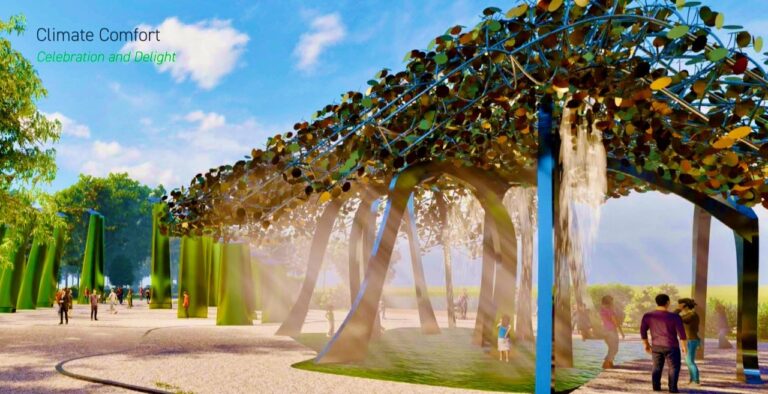
Townsville’s newest and biggest attraction is set to light up North Queensland skies even more, with the installation of two ‘solar trees’ at the North Queensland Stadium precinct.
Treasurer Cameron Dick today announced $6.5 million in state funding for beautification project, with Townsville City Council contributing $1.5 million.
“The new stadium is a game-changer and a job-creator for North Queensland, bringing world class sporting events and performances to local audiences and providing another reason for tourists to visit this beautiful part of the world.
The project will see two solar trees ranging from eight to 12 metres tall installed along Ross Creek between North Queensland Stadium and Townsville city centre, including a including a Rain Tree that will provide an interactive water experience.
Mr Dick said the project would create 120 direct and indirect jobs during construction and would deliver unique tourism infrastructure for the region.
Minister for State Development, Tourism and Innovation Kate Jones said the investment aligns with the Townsville North Queensland Destination Tourism Plan’s priorities.
“We know how important tourism is to North Queensland, especially as we emerge from the impacts of COVID-19.
“The Palaszczuk Government has a plan to Unite and Recover for Queensland Jobs and that means building new infrastructure, strengthening our existing industries and supporting growth industries.”
Member for Townsville Scott Stewart said the solar trees would provide many benefits.
“The North Queensland Stadium is the heart of Townsville, and this new attraction will enliven the area for tourists and locals alike.
“Growing jobs in the region means growing our tourist offerings, and this project ticks both boxes.”
Townsville Mayor Jenny Hill said tourism infrastructure projects like the Solar Tree would have a huge impact on the local economy and activate the CBD.
“Initial estimates have shown that this project could inject $8 million into our local economy and support more than 110 direct and indirect jobs- which is a huge boost to our construction industry on the back of the COVID-19 pandemic” Cr Hill said.
“This is a completely unique attraction that is perfect for our region thanks to using solar power to run. It will encourage those visiting the Stadium to make the walk to the CBD just to experience such a beautiful visual show.
“Central Park is a crucial link from the Stadium Precinct to the CBD and it’s projects like this that will provide a flow-on benefit our local restaurants, accommodation and retailers as people come to the city.”
The project is expected to take nine months to complete and will commence construction in July.
Attribution: Treasurer, Minister for Infrastructure and Planning The Honourable Cameron Dick
The biggest level crossing removal blitz in the state’s history is in full swing on the Frankston Line, as works continue to remove three dangerous and congested level crossings and build two new train stations.
Premier Daniel Andrews, Minister for Transport Infrastructure Jacinta Allan and Member for Mordialloc Tim Richardson today visited Mentone, where crews have been working around the clock to excavate more than two kilometres of new rail trenches.
The boom gates at Cheltenham and Mentone could be down for up to 49 minutes in the morning peak – causing delays and frustration for the 38,000 vehicles that travelled through these crossings each day.
Watch on Youtube https://www.youtube.com/watch?v=XdzYVbeaLOM
In the past two weeks, workers have removed more than 74 Olympic-sized swimming pools of soil for the new lowered rail line. The works are being delivered by a team of 1,700 workers, with 50 trucks an hour transporting the excavated soil and six of the biggest cranes in Australia lifting beams and moving material into the trenches.
With excavation now complete, workers will soon begin reinforcing the walls of the trench with 4,000 cubic metres of concrete before beginning to lay the tracks and signalling for the new Frankston line.
Locals in Mentone can already walk over the new rail trench at Balcombe Road to get a birds-eye view of the massive scale of work underway.
In Cheltenham, a major milestone was reached today with Park Road now open to traffic and free of boom gate delays for the first time. Charman Road will reopen later this week, making travel around the area easier and safer.
Work is also steaming ahead on the new Mentone Station, where platforms are being installed and beams are being lifted for the new heritage deck over the rail line, which will create new open space for the community.
When trains resume on 27 July, three level crossings will be gone for good at Park and Charman roads in Cheltenham, and Balcombe Road in Mentone, with the new Mentone and Cheltenham stations to open in August.
Works at Cheltenham and Mentone are part of a massive $3 billion investment on the Frankston line, which includes the removal of 18 level crossings, with eight already gone, and building 12 new stations.
Quote attributable to Premier of Victoria Daniel Andrews
“Coronavirus has had huge impacts on our community and our economy, but our building program hasn’t stopped supporting jobs and delivering the projects our state needs.”
Quote attributable to Minister for Transport Infrastructure Jacinta Allan
“It’s been a huge team effort so far, with the 1,700 workers getting on and removing these level crossings as part of our Frankston line blitz.”
Quote attributable to Member for Mordialloc Tim Richardson
“We promised to remove these dangerous and congested level crossings and we’re delivering – transforming our local area and making it safer.”